Debugging in software development cycle is the process of locating, diagnosing, and fixing software defects that cause incorrect behavior, performance issues, or system failures. It is an essential activity throughout software engineering because defects can occur during coding, integration, testing, or deployment. Effective debugging helps development teams improve software quality, reduce maintenance costs, and deliver reliable applications to users.
Key Takeaways
- Debugging in software development cycle involves identifying and correcting software defects.
- A structured debugging process improves efficiency and traceability.
- Root cause analysis helps eliminate underlying issues rather than symptoms.
- Different environments require specialized debugging tools and techniques.
- Effective debugging improves software quality, reliability, security, and performance.
- Regression testing is essential after implementing bug fixes.
- Documentation supports future maintenance and defect prevention.
What Is Debugging in Software Development?
Debugging in software development cycle refers to the structured practice of finding and correcting errors, commonly called bugs, within software systems.
Common bug categories include:
- Syntax errors
- Logical errors
- Runtime errors
- Integration defects
- Performance-related issues
Debugging in Software Development Cycle Example
A developer discovers that an e-commerce application calculates incorrect discounts during checkout. By analyzing the code, tracing variable values, and correcting the calculation logic, the defect is removed and verified through testing.
Many developers studying debugging in software development cycle GeeksforGeeks resources also explore debugging techniques, software testing practices, and error management processes.
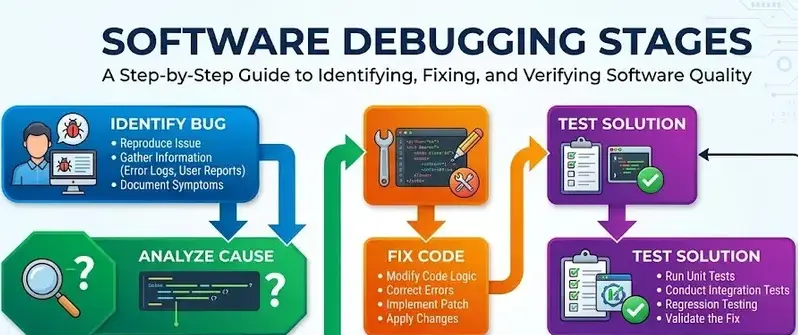
What Are the Stages in the Debugging Cycle in Software Engineering?
Debugging in software development cycle typically follows a structured sequence.
| Stage | Purpose |
| Defect Identification | Detect unexpected behavior |
| Problem Reproduction | Consistently recreate the issue |
| Root Cause Analysis | Determine why the defect occurs |
| Code Correction | Implement the required fix |
| Verification Testing | Confirm the issue is resolved |
| Regression Testing | Ensure no new defects were introduced |
| Documentation | Record findings and corrective actions |
Process of Debugging
- Observe the defect.
- Collect error logs and system information.
- Reproduce the issue.
- Isolate the faulty component.
- Apply a fix.
- Test the solution.
- Document the outcome.
This structured approach improves traceability and supports quality management practices used in modern software projects.
Why Is Debugging Important in the Software Development Cycle?
Debugging in software development cycle helps organizations maintain software quality and operational stability.
Key benefits include:
- Reduces software failures
- Improves user experience
- Enhances security and reliability
- Supports compliance requirements
- Lowers long-term maintenance costs
- Improves product performance
Industries such as healthcare, banking, aerospace, and manufacturing often require rigorous defect management because software failures may result in operational, financial, or safety risks.
Common Debugging Examples
- Fixing application crashes
- Resolving database connection failures
- Correcting inaccurate calculations
- Eliminating memory leaks
- Addressing API communication issues
How Do Developers Perform Root Cause Analysis During Debugging?
Debugging in software development cycle relies heavily on root cause analysis to identify the true source of a defect rather than only addressing symptoms.
Common analysis methods include:
- Log analysis
- Stack trace examination
- Breakpoint inspection
- Code review
- Data flow analysis
- Dependency tracing
Organizations frequently integrate these practices into software quality assurance frameworks to improve defect resolution efficiency.
What Are the Most Effective Debugging Techniques in Software Engineering?
Several established debugging techniques are widely used across software engineering projects.
| Technique | Description |
| Brute Force Debugging | Uses logs, outputs, and monitoring data |
| Backtracking | Traces execution backward from failure point |
| Cause Elimination | Systematically removes possible causes |
| Program Slicing | Examines only relevant code sections |
| Interactive Debugging | Uses debuggers and breakpoints |
These techniques help developers identify defects more quickly while minimizing unnecessary code modifications.
Embedded Software Debugging Tools and Techniques
Embedded systems often require specialized debugging approaches because they interact directly with hardware.
Common tools include:
- JTAG debuggers
- In-circuit emulators
- Logic analyzers
- Oscilloscopes
- STM32 debugging software
Engineers use these tools to analyze processor behavior, memory usage, and hardware-software interactions.
Mobile and Android Debugging Software
Mobile application debugging focuses on application stability, performance, and device compatibility.
Popular tools include:
- Android Studio Debugger
- Android Debug Bridge (ADB)
- Firebase Crashlytics
- Logcat
- Performance profiling tools
These solutions assist developers in identifying crashes, memory consumption issues, and device-specific defects.
Debugging Methods Used in System Software
System software debugging involves operating systems, device drivers, firmware, and low-level services.
Common methods include:
- Kernel debugging
- Memory dump analysis
- Driver verification
- Performance tracing
- System event monitoring
Because system software operates close to hardware, debugging often requires specialized diagnostic tools and extensive testing.
What Debugging Tools Are Commonly Used by Development Teams?
Debugging in software development cycle is supported by numerous tools designed for different environments.
| Category | Examples |
| IDE Debuggers | Visual Studio, Eclipse, IntelliJ IDEA |
| Web Debugging | Chrome DevTools, Firefox Developer Tools |
| Mobile Debugging | Android Studio, ADB |
| Embedded Debugging | JTAG, STM32 tools |
| Monitoring Tools | New Relic, Datadog |
| Error Tracking | Sentry, Crashlytics |
Selecting the appropriate tool depends on the software architecture, platform, and project requirements.
Conclusion
Debugging in software development cycle is a structured quality assurance activity that focuses on identifying, analyzing, and resolving software defects. By applying systematic stages, proven debugging techniques, and specialized tools, development teams can improve software reliability, maintainability, and performance. For broader defect-management continuity, organizations often connect debugging practices with the debugging life cycle in software testing to ensure comprehensive software quality throughout the development process.
FAQs
What is debugging in programming?
Debugging in programming is the process of finding, analyzing, and fixing errors that prevent software from functioning as intended.
What is the main purpose of debugging?
The primary purpose is to identify and correct defects to improve software reliability, accuracy, and performance.
What are the common types of software bugs?
Common bug types include syntax errors, logical errors, runtime errors, integration defects, and performance-related issues.
What tools are used for debugging?
Developers commonly use IDE debuggers, log analyzers, mobile debugging tools, embedded system debuggers, and application monitoring platforms.
Is debugging part of software testing?
Debugging and testing are related but distinct activities. Testing identifies defects, while debugging focuses on locating and fixing their causes.
Sources
- https://www.tricentis.com/learn/debugging
- https://www.meegle.com/en_us/topics/debugging/debugging-in-software-development
- https://www.geeksforgeeks.org/software-engineering/software-engineering-debugging/
- https://www.edureka.co/blog/what-is-debugging/
- https://jetruby.com/blog/debugging-in-software-development-process/
- https://www.guvi.in/blog/debugging-in-software-development/
- https://www.ranorex.com/blog/what-is-debugging-software-testing/
- https://programmers.io/blog/debugging-in-software-development/
- https://www.theknowledgeacademy.com/blog/what-is-debugging/