Phases of debugging in software testing refer to the systematic process of locating, diagnosing, fixing, and validating software defects discovered during testing. Debugging is a critical activity that follows defect detection and helps developers determine the root cause of failures. A structured debugging approach improves code quality, minimizes system downtime, and supports efficient software maintenance throughout the development lifecycle.
Key Takeaways
- Debugging begins after a defect is discovered during testing.
- Root cause analysis is the foundation of effective debugging.
- Six major phases guide the debugging process from detection to validation.
- Embedded systems often require specialized debugging tools.
- Regression testing confirms that fixes do not create new defects.
- Debugging and testing serve different but complementary purposes.
- Structured debugging improves software quality and reliability.
What Is Debugging in Software Testing?
The phases of debugging in software testing begin after a defect is identified during software testing. It is the process of tracing faults within a program, implementing corrective measures, and verifying that the software operates as intended afterward.
Key Characteristics of Debugging
- Focuses on finding root causes of defects
- Performed primarily by developers
- Uses debugging tools and diagnostic techniques
- Follows defect detection during testing
- Supports software quality assurance
Example of Debugging
A login application fails when users enter valid credentials. Testing identifies the defect, while debugging traces the issue to an incorrect database query. The developer corrects the query and verifies successful authentication.
Key Phases and Steps in the Software Debugging Process
The phases of debugging in software testing generally follow six structured stages.
| Phase | Purpose |
| 1. Error Identification | Detect the defect |
| 2. Error Reproduction | Recreate the issue consistently |
| 3. Root Cause Analysis | Determine why the defect occurs |
| 4. Defect Correction | Modify code to fix the problem |
| 5. Verification Testing | Confirm the fix works |
| 6. Regression Testing | Ensure no new defects were introduced |
1. Error Identification
Testers use functional, integration, system, and acceptance testing to detect behaviors that differ from expected software performance.
2. Error Reproduction
Developers recreate the issue under controlled conditions to gather reliable diagnostic information.
3. Root Cause Analysis
Common techniques include:
- Log analysis
- Code review
- Stack trace examination
- Breakpoint inspection
- Data flow analysis
4. Defect Correction
The faulty code, configuration, or logic is modified according to coding standards and project requirements.
5. Verification Testing
The corrected functionality is tested to confirm the original defect has been resolved.
6. Regression Testing
Additional testing ensures that related system components continue to operate correctly after the fix.
Why Debugging Is Important in Software Testing
The phases of debugging in software testing help organizations maintain software reliability and operational stability.
Benefits of Effective Debugging
- Improves software quality
- Reduces production failures
- Enhances user experience
- Supports regulatory compliance
- Lowers maintenance costs
Many professionals also explore related topics such as debugging vs testing, types of debugging, debugging tools, and software defect management to better understand quality assurance processes.
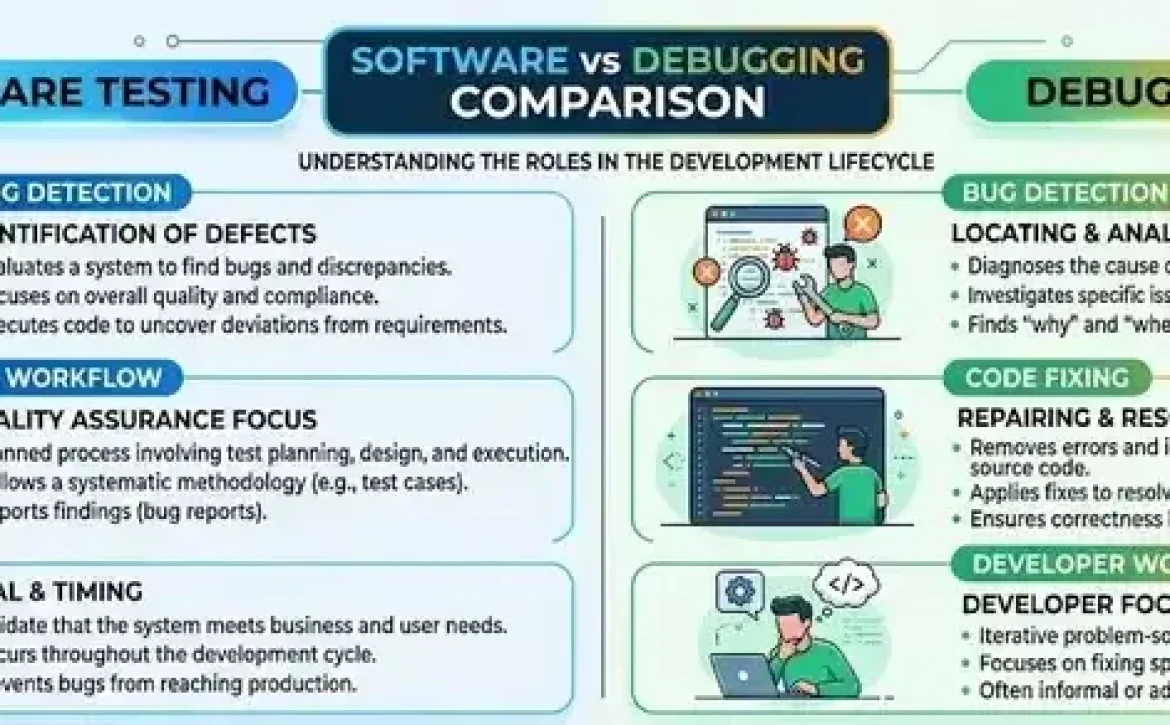
Debugging vs Testing
| Testing | Debugging |
| Finds defects | Fixes defects |
| Performed by testers and QA teams | Performed mainly by developers |
| Identifies failures | Determines root causes |
| Evaluates software quality | Corrects software issues |
Debugging Embedded Software: Tools and Best Practices
Embedded systems require specialized debugging techniques because they interact directly with hardware components.
Best Practices
- Use real-time monitoring tools
- Validate hardware-software integration
- Analyze memory utilization
- Monitor processor performance
- Perform interface testing
Common environments include automotive systems, medical devices, industrial controllers, and IoT applications.
Common Software Debugging Tools for Hardware and Microcontroller Systems
Several tools support debugging activities in embedded and hardware-based environments.
| Tool Type | Purpose |
| JTAG Debuggers | Hardware-level inspection |
| IDE Debuggers | Breakpoints and code tracing |
| Logic Analyzers | Signal analysis |
| Oscilloscopes | Electrical signal monitoring |
| Memory Profilers | Resource utilization analysis |
Examples include GDB, LLDB, Visual Studio Debugger, Keil Debugger, and STM32 debugging utilities.
Debugging Methods and Interactive Debugging Systems in Software Engineering
Different debugging approaches are applied depending on system complexity.
Common Types of Debugging
- Brute Force Debugging – Uses logs and memory dumps.
- Backtracking – Traces execution backward from the failure point.
- Cause Elimination – Removes possible causes systematically.
- Program Slicing – Focuses on relevant code sections.
- Interactive Debugging – Uses breakpoints and real-time code inspection.
Interactive debugging systems help developers observe program execution and identify defects more efficiently.

Conclusion
Understanding the phases of debugging in software testing provides a structured framework for identifying, analyzing, correcting, and validating software defects. Organizations that follow these stages consistently can improve software reliability, reduce maintenance effort, and support long-term system quality. For broader software quality practices, these phases naturally complement debugging steps in software engineering and overall defect management processes.
FAQ
What is the debugging phase?
The debugging phase is the process of locating, analyzing, correcting, and verifying software defects after they have been identified during testing.
What are the 7 phases of STLC?
Requirement Analysis, Test Planning, Test Case Development, Environment Setup, Test Execution, Defect Reporting, and Test Closure are the seven commonly accepted phases of the Software Testing Life Cycle.
What are the 5 phases of testing software?
The five commonly referenced testing phases are Planning, Design, Environment Setup, Execution, and Closure.
What are the 7 stages of testing?
Requirement Analysis, Test Planning, Test Design, Test Environment Preparation, Test Execution, Defect Management, and Test Closure form the seven commonly recognized stages of software testing.
What are the 6 steps of debugging?
The six steps are Error Identification, Error Reproduction, Root Cause Analysis, Defect Correction, Verification Testing, and Regression Testing.
Sources
- https://www.edureka.co/blog/what-is-debugging/
- https://www.geeksforgeeks.org/software-engineering/software-engineering-debugging/
- https://www.ranorex.com/blog/what-is-debugging-software-testing/
- https://www.ibm.com/think/topics/debugging
- https://aws.amazon.com/what-is/debugging/
- https://www.theknowledgeacademy.com/blog/what-is-debugging/
- https://www.scribd.com/document/478875697/Assignment-2
- https://testfort.com/blog/what-is-debugging-in-software-testing
- https://www.advancedetectiveagency.com/what-is-debugging-different-stages-of-debugging/