AI in education sector leverages intelligent technologies, machine learning tools, and data-based algorithms to optimize teaching practices, track student performance, and handle repetitive administrative activities. How is this technological evolution creating a smarter, more inclusive global education system?
Key Takeaways
- Indian education is witnessing rapid AI adoption under NEP 2020.
- Ethical governance and inclusivity remain top priorities.
- AI transforms education through automation, personalization, and predictive analytics.
- Adaptive learning and real-time analytics define the future of AI education ecosystems.
- Educators must balance technology integration with human-centered teaching approaches.
How is AI in education sector transforming traditional classrooms?
AI-driven tools are turning conventional classrooms into dynamic digital ecosystems by enabling:
- Educational platforms that dynamically adapt difficulty according to each learner’s performance..
- Speech recognition tools that assist differently-abled learners.
- AI tutors and chatbots offering round-the-clock academic assistance.
- Automated grading systems that reduce manual workload for teachers.
Institutions like the University of Illinois and GISMA Business School report improved learning retention and engagement through AI-assisted virtual classrooms.
What are the key benefits of AI in the education sector?
The advantages of AI in education include:
- Personalized Learning: Custom learning pathways based on cognitive behavior.
- Data-Driven Insights: Using real-time data to assess and monitor student performance..
- Accessibility: Enhanced inclusion for students with disabilities.
- Efficiency: Automation of routine administrative functions.
- Continuous Feedback: AI-driven assessments providing instant performance reports.
These benefits of AI in education create a balanced ecosystem for both educators and learners.
What types of AI are used in the education sector?
AI in education operates through multiple application types:
| Type of AI | Primary Function | Example Use Case |
| Machine Learning Models | Predict academic outcomes | Early warning systems for dropouts |
| Natural Language Processing | Language comprehension and feedback | Essay scoring, grammar correction |
| Computer Vision | Visual content recognition | Virtual science labs and AR lessons |
| Predictive Analytics | Pattern detection for decision-making | Curriculum optimization |
These types of AI in education sector collectively improve engagement and academic precision.
How is AI improving teacher efficiency and curriculum management?
AI applications assist educators by:
- Automating attendance, report generation, and grading.
- Suggesting customized learning materials based on student performance data.
- Deploying intelligent dashboards to visualize and track classroom trends..
- Strengthening the connection and communication among teachers, students, and their families.
For example, tools like LeewayHertz AI Learning Suite and Damco AI for Education help educators manage workflows efficiently, allowing more time for mentorship and innovation.
What is the impact of AI in Indian education?
In India, AI adoption in education is advancing rapidly through National Education Policy (NEP) 2020 initiatives.
- EdTech platforms such as BYJU’S and Vedantu use AI to personalize learning.
- Public institutions integrate AI-based analytics for teacher training and curriculum enhancement.
- AI-driven interventions are seen by EY India as a way to bridge skills gaps and enhance career prospects..
This demonstrates how AI in Indian education is catalyzing nationwide digital transformation.
What are common examples of AI in education today?
Notable AI in education examples include:
- Coursera’s recommendation engine for personalized course selection.
- Duolingo’s adaptive feedback model for language learning.
- Google Classroom’s AI integration for automatic grading and data analytics.
People also search for related terms such as AI tools in education, artificial intelligence in education essay, and importance of AI in education sector to understand this evolving domain.
What concerns and challenges surround the ethical use of AI in educational settings?
Key challenges include:
- Data Privacy: Protecting student information from misuse.
- Algorithmic Bias: Ensuring fairness in AI decision-making.
- Equity of Access: Bridging digital divides between rural and urban institutions.
- Teacher Training: Equipping educators to use AI responsibly.
Global organizations like UNESCO emphasize regulatory frameworks to ensure ethical and inclusive AI integration in schools.
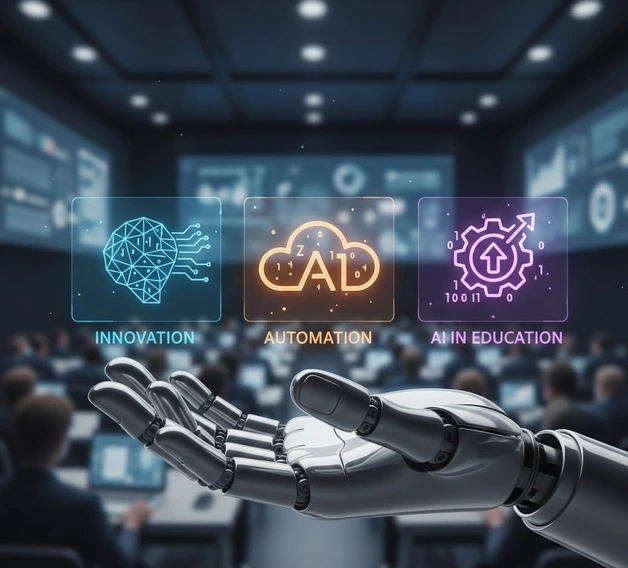
Conclusion
Through AI, the education system is evolving in the delivery, evaluation, and administration of learning.As institutions worldwide adopt these technologies, future-ready learning ecosystems are emerging. For deeper insight, explore our comprehensive guide on the application of AI in education to understand specific deployment strategies shaping 2026 and beyond.
FAQ
What are the advantages of AI in education?
AI enables personalized learning, automates assessments, supports accessibility, and enhances data-driven decision-making.
What is the role of AI in education in 2025?
AI in 2025 drives personalized learning, predictive analytics, and smart classrooms powered by adaptive systems.
What is the impact of AI in Indian education?
AI improves access to quality learning, teacher productivity, and employability across urban and rural India.
How does AI help students learn better?
By tailoring instruction to individual learning styles, providing instant feedback, and enhancing engagement through adaptive systems.
What challenges limit AI in education today?
Key challenges include data privacy concerns, unequal access, and limited teacher training on AI tools.
Sources
https://www.unesco.org/en/digital-education/artificial-intelligence
https://onlinedegrees.sandiego.edu/artificial-intelligence-education/
https://www.lpu.in/blog/the-impact-of-artificial-intelligence-on-education-in-india/
https://www.gisma.com/blog/how-is-ai-changing-the-education-sector
https://www.aiforeducation.io/
https://education.illinois.edu/about/news-events/news/article/2024/10/24/ai-in-schools–pros-and-cons
https://www.damcogroup.com/blogs/ai-in-education-sector
https://www.leewayhertz.com/ai-use-cases-in-education/
https://www.ey.com/en_in/insights/education/how-ai-is-activating-step-changes-in-indian-education