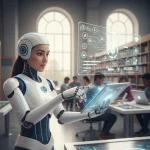
The use of AI in education involves applying artificial intelligence systems to enhance learning, teaching, and administrative processes. These technologies help personalize instruction, analyze data for better outcomes, and support teachers in managing classrooms effectively. How does AI truly reshape modern education systems worldwide?
Key Takeaways
- AI personalizes learning through data-driven insights.
- Teachers use AI for grading, curriculum design, and student monitoring.
- AI improves accessibility and global learning equity.
- Ethical use and data protection remain essential challenges.
- The continued growth of AI in education will foster more inclusive and adaptable learning environments.
In what ways does AI personalize education?
AI customizes content delivery according to individual learning preferences, speed, and competency.
Key strategies
- Adaptive learning systems: Solutions like DreamBox and Knewton alter difficulty based on real-time student progress.
- Intelligent tutoring systems: Virtual tutors provide one-on-one feedback and track progress.
- Learning analytics: AI evaluates performance data to recommend next steps for improvement.
Example: AI tools in education develop tailored learning plans so students can target their areas of difficulty.
What are the main applications of AI in classroom teaching?
AI enhances teaching through automation, analytics, and interactive learning systems.
Major applications include:
- Automated grading systems for quizzes and assignments.
- Lesson planning assistants that help teachers design curriculum aligned with student needs.
- Smart content generation that updates textbooks and learning materials dynamically.
- Speech-to-text and translation tools improving inclusivity for multilingual classrooms.
How does AI support teachers and educational institutions?
AI optimizes teaching efficiency and administrative accuracy.
- Administrative automation: Handles attendance, scheduling, and reporting.
- Predictive tools: Spot at-risk students ahead of time to implement corrective measures.
- Performance dashboards: Offer real-time insights into student engagement.
This technological automation empowers instructors to invest energy in creative pedagogy rather than manual operations.
How is AI improving accessibility and inclusivity in education?
AI technologies ensure equitable access for all learners.
• Voice-enabled reading software ensures accessibility for students with vision difficulties.
• Automatic translation and transcription services break language barriers for diverse learners.
• Affective computing systems identify emotional cues to gauge participation and focus during online lessons.
For instance, UNESCO advocates AI integration to enhance global digital inclusion and ensure no learner is left behind.
What are real-world examples of the use of AI in education?
Several global implementations illustrate AI’s impact:
| Institution/Platform | AI Application | Outcome |
| Coursera | Adaptive course recommendations | Increased completion rates |
| Carnegie Learning | Intelligent math tutoring | Improved problem-solving |
| Duolingo | AI-driven language learning | Personalized lesson pacing |
| Google Classroom | Automated feedback tools | Streamlined teacher workload |
What are the benefits and challenges of using AI in education?
Benefits:
- Enhances engagement through personalized content
- Increases efficiency in grading and management
- Expands accessibility for diverse learners
- Enables data-based decision-making
Challenges:
- Data privacy and security concerns
- Dependence on technology infrastructure
- Need for teacher training and ethical governance
People also explore related concepts such as “use of AI in education essay,” “AI in education examples,” and “advantages of AI in education” when seeking broader understanding.
What is the future outlook for AI in education?
AI will continue evolving as a core driver of educational transformation. Future systems will integrate emotional intelligence, predictive modeling, and global data networks for continuous learning improvement. Collaboration between policymakers, educators, and developers will determine ethical standards and scalability across institutions.

Conclusion
Across the globe, AI is redefining the methods of teaching, personalizing instruction, and assessing student outcomes. With continuous advancements in adaptive learning and intelligent systems, the future of education will rely on seamless collaboration between technology and educators to ensure equitable and data-driven learning environments. For deeper understanding, explore how these systems evolve in “how AI helps in education.”
FAQ
How is AI used in education?
AI applications in education focus on individualized learning paths, automated evaluations, and performance data analysis to refine teaching methods.
What is the main advantage of using AI in education?
The main advantage is personalized learning that adapts content and pace to individual student needs.
What are 20 benefits of AI?
Personalization, automation, accuracy, inclusivity, speed, engagement, accessibility, real-time analytics, scalability, innovation, adaptability, predictive insights, resource optimization, feedback improvement, decision support, reduced workload, increased retention, performance tracking, equitable learning, and cost efficiency.
What are some AI in education examples?
Examples include AI tutors, adaptive learning platforms, automated assessments, and language translation tools.
How does AI improve accessibility in education?
AI-driven accessibility tools—such as automated speech readers and real-time transcribers—support students with disabilities and non-native language speakers.
Sources
https://onlinedegrees.sandiego.edu/artificial-intelligence-education/
https://www.unesco.org/en/digital-education/artificial-intelligence
https://www.leewayhertz.com/ai-use-cases-in-education/
https://bernardmarr.com/how-is-ai-used-in-education-real-world-examples-of-today-and-a-peek-into-the-future/