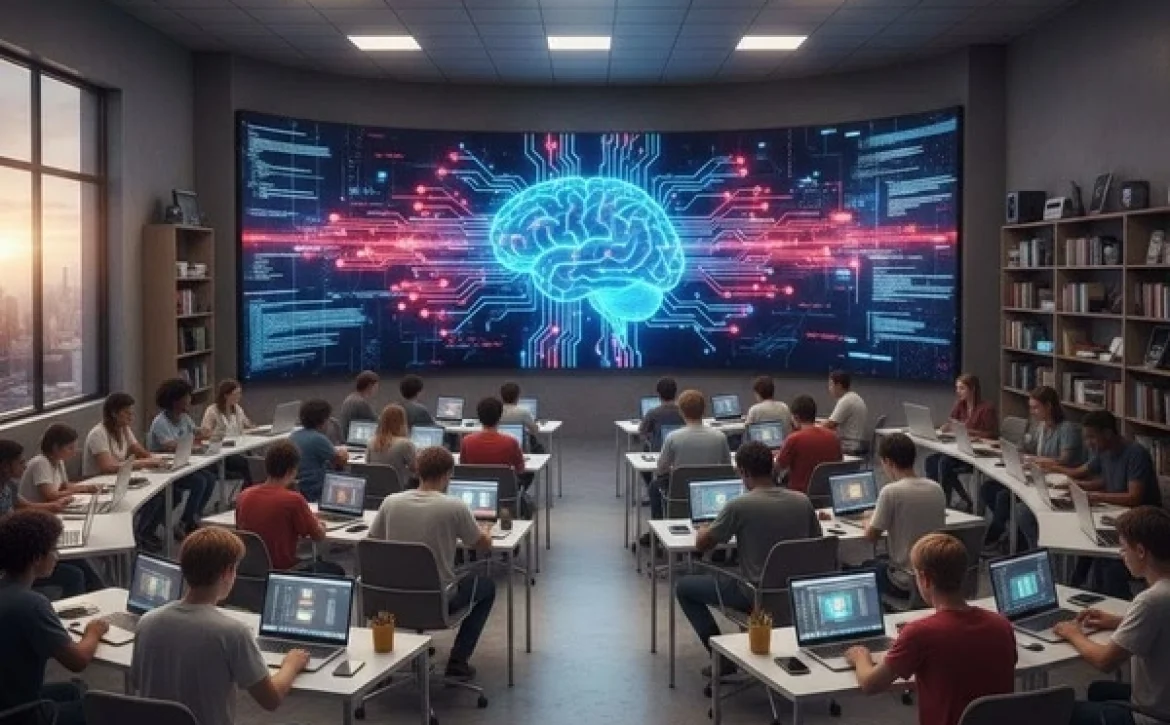
AI applications in education refer to the use of intelligent technologies to improve learning outcomes, teaching efficiency, and operational management. These systems provide personalized instruction, automate grading, and enhance decision-making in education. How can these tools practically reshape classroom and institutional performance?
Key Takeaways
- Through AI, education can provide personalized teaching and advanced assessment capabilities.
- Teachers benefit from efficiency tools and automated administrative support.
- Data-driven insights enhance student performance tracking and institutional decision-making.
- Collaborative and inclusive learning is supported by AI-driven platforms.
- Global adoption demonstrates measurable improvements in engagement, retention, and accessibility.
What are the key AI applications in education?
Educational settings leverage AI through diverse tools and platforms to support better learning and teaching results.
- Automated Grading Tools: Evaluate assignments and exams, reducing teacher workload.
- Learning Analytics: Identifies students at risk and supports personalized course planning.
- Administrative Automation: Streamline enrollment, scheduling, and reporting tasks.
- AI-Powered Learning Platforms: Deliver lessons that adapt dynamically to student progress.
- Smart Tutoring Applications: Offer instant, tailored feedback to improve understanding in key subjects.
Example: In India, education AI for teachers is increasingly integrated into digital classrooms to provide personalized recommendations for student improvemet.
How is learning personalized through AI?
In education, AI tools track performance and modify lessons to align with each student’s learning style and rate.
- Tracks learning progress and identifies gaps.
- Recommends exercises, quizzes, and resources based on performance.
- Provides real-time feedback to enhance student understanding.
Industry Practice: Tools like free AI tools for teachers in online platforms help instructors implement differentiated learning strategies efficiently.
Which AI applications support teacher efficiency?
AI applications in education reduce administrative and repetitive tasks for educators:
- Lesson Planning: AI-assisted content generation streamlines curriculum design.
- Grading Assistance: Automatically scores multiple-choice, short-answer, and some essay responses.
- Communication Automation: Manages notifications, reminders, and parent-teacher updates.
Example: Platforms highlighted in “7 AI Tools That Help Teachers Work More Efficiently” demonstrate time savings of 20–30% in daily task.
What role does AI play in student assessment?
AI applications in education enhance assessment by providing objective, accurate, and continuous evaluation:
- Generates personalized quizzes based on performance analytics.
- Offers adaptive testing to measure skill mastery dynamically.
- Uses predictive scoring to anticipate learning challenges.
Standards Reference: UNESCO promotes AI-driven assessment tools aligned with inclusive and equitable digital education strategies.
How is AI used for administrative management?
AI applications in education streamline institutional operations, enabling data-driven decisions:
- Enrollment management and application tracking.
- Scheduling and resource allocation optimization.
- Monitoring academic performance trends and reporting analytics.
Example: Universities in India employ AI systems to manage large student databases and optimize classroom resource allocation.
Which AI applications enhance collaborative learning?
AI applications in education foster interactive and collaborative environments:
- Intelligent discussion moderators support group problem-solving.
- Virtual classrooms integrate AI-driven participation tracking.
- Collaborative projects utilize AI for real-time feedback and progress monitoring.
Related Search Context: Collaborative learning tools are often discussed alongside education gamification platforms, student engagement software, and online learning management systems.
What are the advantages of AI in education globally?
AI applications in education provide multiple benefits for both teachers and students:
- Increased learning personalization.
- Efficient administrative management.
- Data-driven decision-making.
- Continuous assessment and performance tracking.
- Enhanced accessibility and inclusion.
Example: Artificial intelligence in education article studies show measurable improvements in engagement and knowledge retention.

Conclusion:
AI applications in education are reshaping teaching, learning, and institutional operations worldwide. By classifying tools into personalized learning, assessment, collaboration, and administration, educators can systematically enhance outcomes. For a broader understanding, explore how AI in higher education is driving innovation in universities and professional programs.
FAQ
What are the 5 applications of AI?
Personalized learning, intelligent tutoring, automated grading, predictive analytics, and administrative automation.
Which of these is an example of AI’s application in education?
Adaptive tutoring tools give students customized instruction and continuous performance feedback.
What is the application of it in education?
AI improves learning efficiency, personalizes instruction, automates grading, and enhances classroom management.
Can AI improve teacher productivity?
Yes, AI reduces repetitive tasks, supports lesson planning, and streamlines communication.
How does AI enhance student learning outcomes?
AI adapts content to student needs, provides feedback, and identifies learning gaps for improvement.
Sources
https://onlinedegrees.sandiego.edu/artificial-intelligence-education/
https://www.eduaide.ai/
https://ditchthattextbook.com/ai-tools/
https://www.analyticsvidhya.com/blog/2024/03/top-free-ai-apps-for-education/
https://www.unesco.org/en/digital-education/artificial-intelligence
https://emerj.com/examples-of-artificial-intelligence-in-education/
https://www.edutopia.org/article/7-ai-tools-that-help-teachers-work-more-efficiently/