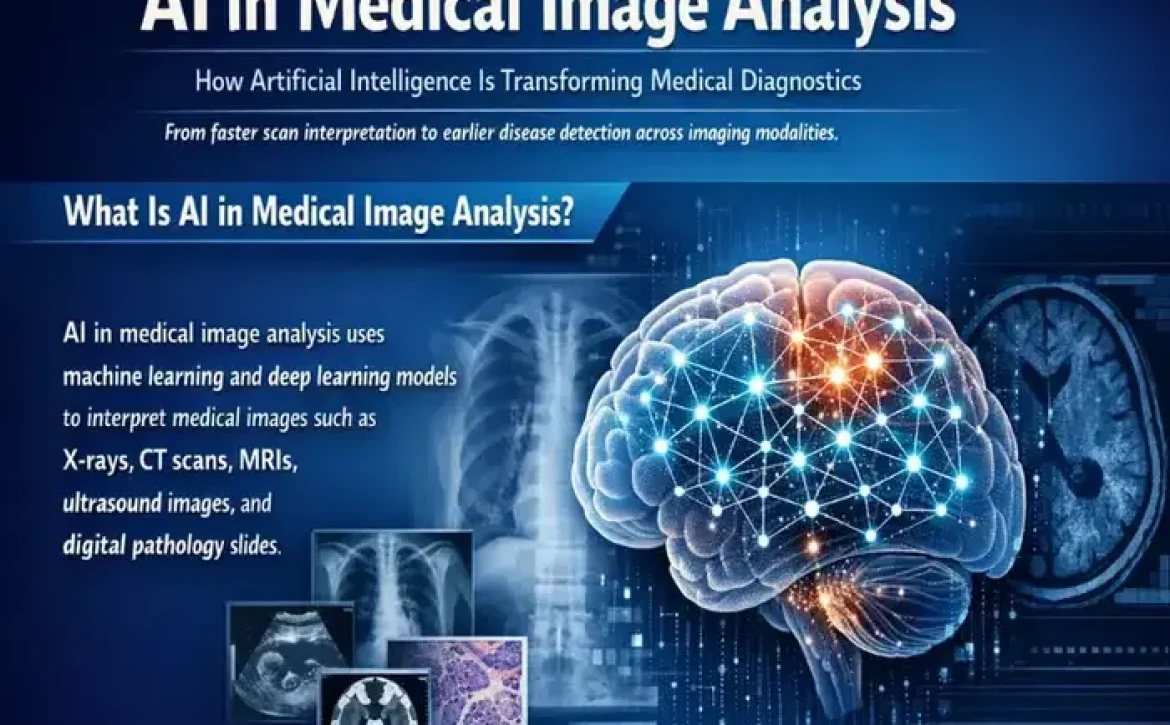
AI in medical image analysis applies machine learning and deep learning models to medical images such as X-rays, CT scans, MRIs, ultrasound images, and digital pathology slides to support diagnosis, triage, and treatment planning. Its importance stems from the rapid growth of imaging volumes, increasing diagnostic complexity, and the need for consistent, data-driven interpretation in clinical settings.
Key Takeaways
- ai in medical image analysis supports diagnosis, triage, and monitoring
- It is used across X-ray, CT, MRI, ultrasound, and pathology
- Regulatory oversight treats many systems as medical devices
- Accuracy depends on data quality, validation, and clinical scope
- These systems assist clinicians rather than replace them
What Is AI in Medical Image Analysis?
AI in medical image analysis combines computer vision, pattern recognition, and statistical learning to detect abnormalities, segment anatomical structures, quantify disease progression, and prioritize urgent findings. These systems are designed to assist clinicians by performing repeatable image-based tasks at scale, improving efficiency while maintaining clinical oversight.
For practical demonstrations, see examples of AI in medical image analysis .
How AI in Medical Image Analysis Is Used Across Healthcare Imaging
AI-driven image analysis is embedded across multiple medical imaging disciplines, adapting to modality-specific requirements and clinical objectives.
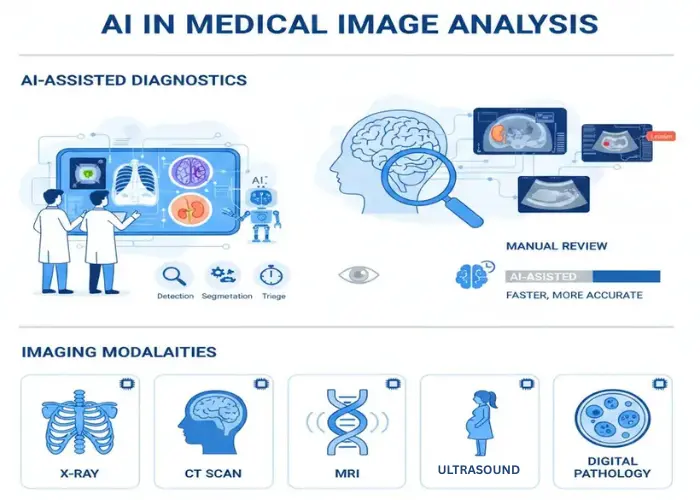
Common Imaging Modalities
- X-ray: fracture detection, chest screening
- CT: stroke triage, trauma assessment, cancer staging
- MRI: neurological and musculoskeletal analysis
- Ultrasound: cardiac measurements, fetal imaging
- Digital pathology: cell counting, tissue classification
Each modality requires rigorous validation before clinical deployment. Expanded modality-specific impacts are explored in AI-driven analysis in cellular imaging impact and AI in advanced imaging analysis for oral surgeons.
Clinical Applications of AI in Medical Image Analysis
AI supports clinicians by automating and augmenting image interpretation tasks, including:
- Detection of tumors, hemorrhages, fractures, and lesions
- Segmentation of organs or regions of interest
- Longitudinal comparison of imaging studies
- Prioritization of high-risk findings
These applications are increasingly standardized across radiology and diagnostics. A deeper diagnostic comparison is covered in comparing AI platforms for medical image analysis in diagnostics.
AI Image Analysis Tools and Platforms in Healthcare
AI image analysis tools range from standalone diagnostic systems to integrated hospital workflow platforms. These solutions vary in:
- Clinical scope
- Regulatory approval status
- Integration with PACS and EHR systems
An overview of vendors and solution categories is available in companies specializing in AI for healthcare medical imaging analysis.
Market Landscape of AI in Medical Imaging
The adoption of AI in medical image analysis is driven by workforce shortages, rising imaging demand, and advances in deep learning. Market growth reflects:
- Increased regulatory approvals
- Expansion into specialty imaging fields
- Investment in clinical-grade AI infrastructure
For a detailed economic and industry outlook, refer to artificial intelligence AI in medical imaging market analysis.
Benefits of AI in Medical Image Analysis
Healthcare systems adopt AI-driven image analysis to achieve:
- Faster diagnostic turnaround times
- Improved consistency across large imaging volumes
- Earlier detection of subtle abnormalities
- More efficient use of specialist expertise
Specific benefits in dentistry are discussed in benefits of AI in dental imaging analysis.
Accuracy and Clinical Reliability
AI in medical image analysis can achieve clinician-level accuracy for narrowly defined tasks when trained on high-quality, diverse datasets. Performance depends on:
- Image quality
- Clinical scope definition
- Continuous real-world validation
These systems are intended to assist, not replace, clinical judgment.
Regulatory Standards and Compliance
Many AI image analysis tools are regulated as medical devices. Common regulatory requirements include:
- Demonstrated clinical safety and performance
- Clearly defined intended use
- Post-market surveillance and monitoring
Regulatory oversight ensures responsible deployment across healthcare environments.
Limitations and Challenges of AI in Medical Image Analysis
Despite its promise, AI adoption faces constraints such as:
- Limited generalization across populations
- Dependence on labeled training data
- Integration challenges with hospital IT systems
These challenges are examined in detail in limitations of AI in medical image analysis.
Technical Foundations of Medical Image AI
At a technical level, AI image analysis systems rely on optimized algorithms, model architectures, and performance-efficient programming. Technical implementations—including low-level approaches—are discussed in writing image analysis AI in C++.
Future Outlook
As validation frameworks mature and integration improves, AI in medical image analysis will continue expanding into precision diagnostics, multimodal imaging, and clinical decision intelligence. Its role will increasingly intersect with broader AI in image analysis systems across healthcare.
What is the role of AI in medical image analysis?
It supports clinicians by detecting, measuring, and prioritizing findings in medical images to improve diagnostic efficiency.
Can AI interpret medical images?
Yes, it can interpret specific image features and patterns within defined clinical scopes.
Is there an AI that can analyze images?
Yes, multiple clinically approved systems analyze medical images across radiology and pathology.
How accurate is AI in medical imaging?
Accuracy varies by task and dataset but can reach clinician-level performance for validated use cases.
Sources
https://pmc.ncbi.nlm.nih.gov/articles/PMC10740686/
https://www.spectral-ai.com/blog/artificial-intelligence-in-medical-imaging/
https://www.sciencedirect.com/science/article/pii/S2666990024000132
https://health.google/imaging-and-diagnostics
https://www.onixnet.com/blog/how-ai-powered-medical-imaging-is-transforming-healthcare/
https://www.thelancet.com/journals/landig/article/PIIS2589-7500(20)30160-6/fulltext
https://onlinelibrary.wiley.com/doi/full/10.1002/ird3.70008