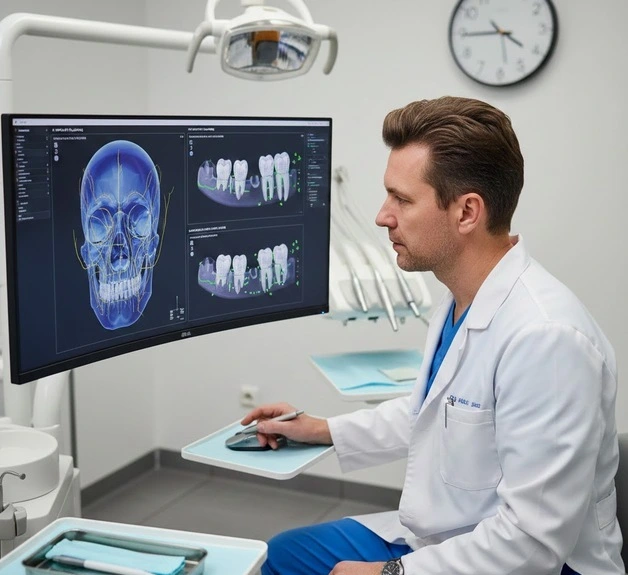
The benefits of AI in dental imaging analysis refer to the use of advanced software to evaluate dental radiographs and scans. These tools assist clinicians in detecting abnormalities, classifying dental conditions, and planning treatment with greater precision. How does this technology improve patient care and clinical workflows in practice?
Key Takeaways
- Increases the ability to detect decay, bone reduction, and dental abnormalities.
- Standardizes radiographic interpretation and reporting.
- Accelerates workflow and prioritizes urgent cases.
- Supports predictive and personalized treatment planning.
- Aligns with clinical and regulatory standards for safe use.
What are the key advantages of AI in dental imaging analysis?
The advantages of AI in dental imaging include accelerated assessments and precise results:
- Automatic detection of anomalies: Identifies cavities, bone loss, and lesions.
- Consistent interpretation: Reduces human variability in reading radiographs.
- Workflow optimization: Prioritizes high-risk cases for quicker intervention.
- Documentation: Automatically generates reports aligned with clinical standards.
How does AI improve diagnostic accuracy in dental radiology?
The application of AI in dental imaging strengthens diagnostic precision by:
- Cross-referencing patient data: Integrates prior scans and clinical records.
- Feature recognition: Detects micro-fractures, early caries, and periodontal changes.
- Quantitative assessment: Measures lesion sizes and bone density objectively.
People also search for AI dental X-ray analysis free tools for initial evaluation and study purposes.
What examples of AI in dentistry demonstrate real-world applications?
Examples of AI in dentistry highlight its practical impact:
- Caries detection: Software identifies early-stage tooth decay.
- Orthodontic planning: AI predicts tooth movement patterns for braces.
- Implant planning: Evaluates bone density and optimal placement angles.
- AI dental apps: Provide clinicians with interactive diagnostic support.
| Application | Benefit |
| Caries Detection | Early intervention reduces restoration needs |
| Orthodontics | Accurate tooth movement simulation |
| Implantology | Optimized implant positioning |
What role does AI play in enhancing efficiency for dental professionals?
The benefits of AI in dental imaging analysis streamline daily practice through:
- Automated radiograph review: Reduces time spent on manual reading.
- Triage support: Flags urgent cases for immediate attention.
- Standardized reporting: Generates structured outputs consistent with dental guidelines.
- Integration with AI dental software: Enables seamless updates and analysis.
Are there specific clinical standards guiding AI use in dental radiology?
The benefits of AI in dental imaging analysis align with established standards:
- International Radiology Guidelines: Ensures compliance with imaging protocols.
- ISO 13485 for medical devices: AI dental apps meet quality management standards.
- Regulatory approvals: Some AI systems are cleared for clinical decision support in multiple regions.
How does AI support patient outcomes and treatment planning?
AI dental imaging analysis benefits patient care by:
- Reducing diagnostic errors: Earlier detection improves prognosis.
- Personalized treatment plans: Supports evidence-based interventions.
- Predictive insights: Assesses risk for dental diseases over time.
Related tools include artificial intelligence in dental radiology, AI dental software, and AI dental apps.
Conclusion
The benefits of AI in dental imaging analysis extend from improved diagnostic accuracy to streamlined workflows and better patient outcomes. This technology reinforces standardized imaging practices and provides measurable clinical advantages. For a broader perspective on imaging-driven healthcare innovation, see ai-driven analysis in cellular imaging impact.
FAQ
What are the advantages of AI in imaging?
Accuracy is enhanced, analysis is faster, and data-driven assessments aid clinical decision-making through AI.
What are the advantages of AI in dentistry?
It improves diagnostic precision, supports treatment planning, and reduces human error.
How is AI used in dental radiology?
AI evaluates radiographs to detect cavities, bone loss, lesions, and supports predictive planning.
What are the benefits of AI analysis?
AI ensures consistent interpretation, identifies abnormalities early, and optimizes workflow efficiency.
Can AI dental apps aid daily practice?
Yes, they provide automated analysis, structured reporting, and clinical decision support.
Sources
https://ijmi.in/archive/volume/10/issue/3/article/6563
https://diagnocat.com/en/blog/ais-role-in-enhancing-dental-radiography-interpretation
https://www.teero.com/blog/advantages-of-ai-in-dentistry
https://blog.dental.com/what-is-an-ai-dental-scan-and-are-there-advantages
https://dimensionsofdentalhygiene.com/article/the-role-of-artificial-intelligence-in-dentistry/
https://www.umu.com/ask/q11122301573854321873
https://completesmilesbv.com.au/ai-dental-radiology-benefits-for-patient-care/
https://dentalcreations.in/ai-in-dentistry-advancing-precision-in-diagnosis-planning/