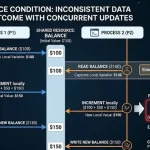
A software race condition is hard to debug because concurrent operations execute unpredictably and may produce inconsistent results under different runtime conditions. Race conditions occur when two or more execution paths access shared data simultaneously without controlled synchronization. In modern software engineering, these defects are considered high-risk because they can bypass testing environments yet appear in production systems under specific timing conditions.
Key Takeaways
- Race conditions occur when concurrent operations access shared resources unsafely.
- Timing variability makes race conditions difficult to reproduce.
- Traditional debugging tools can unintentionally alter execution timing.
- Mutual exclusion mechanisms reduce concurrent access conflicts.
- Structured logging improves concurrency failure analysis.
- Thread-safe design and synchronization are essential preventive measures.
Software Race Condition and Why Is It Hard to Debug
A software race condition is hard to debug because thread execution order changes continuously across processors, operating systems, and workloads. Small timing variations can completely alter application behavior.
Common causes of race conditions
| Cause | Technical Effect |
| Shared memory access | Data corruption |
| Missing locks | Concurrent write conflicts |
| Improper synchronization | Unpredictable state changes |
| Asynchronous execution | Non-deterministic outputs |
| Multi-core scheduling | Variable execution timing |
Why reproduction becomes difficult
- Bugs may disappear when logging is enabled.
- Compiler optimization can change execution timing.
- CPU scheduling differs between systems.
- Thread interleaving varies under workload pressure.
- Production traffic patterns differ from testing environments.
In C++ systems, race conditions frequently occur with unmanaged shared memory and improper mutex handling. Developers often search for “a software race condition is hard to debug because c++” due to the language’s low-level memory access and concurrency complexity.

Software Debugging Techniques
A software race condition is hard to debug because traditional debugging tools can alter timing behavior during execution.
Effective debugging methods
- Thread sanitizers
- Deterministic replay debugging
- Lock contention analysis
- Event tracing
- Static code analysis
- Memory synchronization auditing
Industry-standard tools
| Tool Type | Example Usage |
| Dynamic analyzers | Detect thread conflicts |
| Profilers | Identify timing bottlenecks |
| Trace loggers | Record execution order |
| Debug monitors | Observe runtime states |
In enterprise environments, developers frequently use Microsoft Visual Studio thread analysis tools to investigate deadlocks and race conditions. This explains why users often search for “a software race condition is hard to debug because visual studio.”
Software Testing vs Debugging
Software testing identifies failures, while debugging determines the root cause of failures. Race conditions complicate both activities because intermittent defects may not appear consistently during repeated test runs.
Testing and Debugging in Software Engineering
Testing validates software behavior against requirements, whereas debugging isolates synchronization faults, memory issues, and execution conflicts. Concurrent systems require stress testing and parallel execution analysis.
What Is Debugging Process in Software Testing
The debugging process includes:
- Reproducing the defect
- Isolating affected threads
- Analyzing shared resource access
- Applying synchronization controls
- Retesting under concurrent workloads
How Can Logging Help Us Test and Debug Software
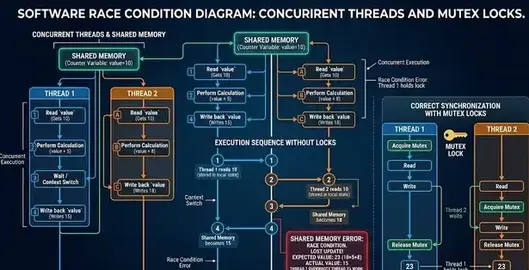
A software race condition is hard to debug because event sequences change rapidly across threads, making execution history difficult to observe without structured logging.
Benefits of logging in concurrency debugging
- Tracks thread execution order
- Detects timing anomalies
- Captures resource conflicts
- Improves failure reproducibility
- Supports post-crash analysis
Recommended logging practices
| Practice | Purpose |
| Timestamped events | Sequence reconstruction |
| Thread identifiers | Execution tracing |
| Centralized log storage | Cross-system analysis |
| Structured JSON logging | Automated parsing |
React developers also encounter related synchronization issues such as React state race condition errors caused by asynchronous state updates and delayed rendering cycles.
What Is Mutual Exclusion in Operating Systems?
A software race condition is hard to debug because multiple processes may simultaneously enter critical sections without mutual exclusion controls.
Mutual exclusion prevents concurrent access to shared resources by allowing only one thread or process to execute a critical section at a time.
Example of mutual exclusion
Thread A locks shared resource
Thread B waits for lock release
Thread A updates data safely
Thread B proceeds afterward
Common synchronization mechanisms
- Mutexes
- Semaphores
- Spinlocks
- Monitors
- Atomic operations
Operating systems such as Linux and Windows rely heavily on mutual exclusion techniques to maintain kernel stability.
How Do Engineers Fix Race Conditions?
A software race condition is hard to debug because fixes must preserve performance while eliminating unsafe concurrent access patterns.
Common remediation strategies
- Apply mutex synchronization
- Use atomic variables
- Reduce shared mutable state
- Implement thread-safe data structures
- Introduce deterministic scheduling tests
Best practices
- Prefer immutable data where possible
- Avoid excessive thread sharing
- Use concurrency-safe frameworks
- Conduct stress and load testing
- Review parallel code paths regularly
Related discussions often include software testing vs debugging, hardware and software debugging tools, and concurrent programming reliability practices.

Conclusion
Race conditions remain one of the most challenging categories of software defects because they depend heavily on unpredictable execution timing and concurrent resource access. Effective mitigation requires structured synchronization, deterministic debugging methods, and rigorous concurrency testing standards.
Organizations improving parallel system reliability should also understand how a software race condition is hard to debug within larger software quality assurance and system stability frameworks.
FAQ
Why are race conditions hard to debug?
Race conditions are difficult to debug because execution timing changes between runs, making defects inconsistent and difficult to reproduce reliably.
What are reasons software is difficult to debug?
Software becomes difficult to debug due to concurrency issues, hidden dependencies, asynchronous execution, memory corruption, and inconsistent runtime environments.
What is race condition in software testing?
A race condition in software testing occurs when multiple execution paths access shared resources simultaneously and produce unpredictable outcomes.
How to fix race condition?
Race conditions are fixed using synchronization techniques such as mutexes, semaphores, atomic operations, and thread-safe programming patterns.
Can logging solve race conditions?
Logging cannot directly solve race conditions, but it helps trace execution order and identify synchronization failures during debugging.
Sources
- https://www.quora.com/Why-are-race-conditions-in-software-development-so-tricky-to-reproduce-and-debug
- https://en.wikipedia.org/wiki/Race_condition
- https://brainly.com/question/31959455
- https://medium.com/javarevisited/debugging-race-conditions-in-production-73b05558fe9b
- https://undo.io/media/uploads/files/Debugging_Race_Conditions_Flyer-190717.pdf
- https://w3.cs.jmu.edu/kirkpams/OpenCSF/Books/csf/html/RaceConditions.html
- https://blog.devgenius.io/the-problem-and-solution-of-the-race-condition-in-computing-339c9a44df16
- https://www.imperva.com/learn/application-security/race-condition/