A software race condition is hard to debug because program behavior changes depending on the unpredictable timing of concurrent operations. These issues commonly appear in multithreaded applications, distributed systems, and real-time software where shared memory or resources are accessed simultaneously. Unlike syntax or logic errors, race conditions may disappear during testing and reappear only under specific execution loads, making diagnosis difficult for developers and system engineers.
Key Takeaways
- Race conditions occur when concurrent operations access shared resources unsafely.
- Timing-dependent behavior makes these defects difficult to reproduce.
- Synchronization methods such as mutexes and semaphores reduce concurrency risks.
- Specialized debugging tools help detect unsafe thread interactions.
- Prevention through secure concurrency design is more effective than reactive fixes.
What Makes a Software Race Condition Hard to Debug?
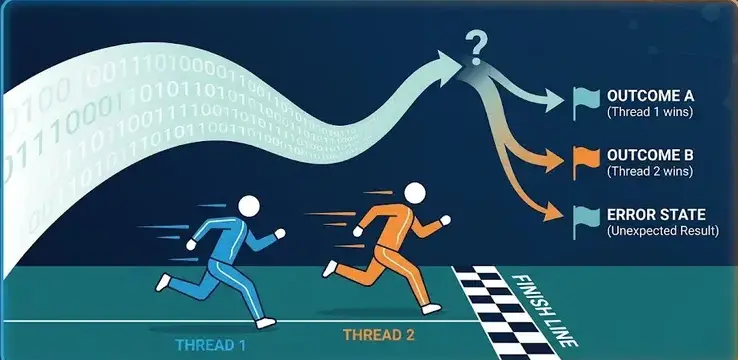
A software race condition is hard to debug because the defect depends on execution timing rather than a fixed code path. Small variations in CPU scheduling, thread priority, or memory access can change the outcome.
What Are the Main Causes of Race Conditions?
Common causes include:
- Unsynchronized shared variables
- Improper thread communication
- Non-atomic operations
- Missing locks or mutexes
- Cache coherence delays
How Can Timing Variations Affect Program Behavior?
Two banking threads updating the same account balance simultaneously may overwrite each other’s results if synchronization controls are absent.
| Condition | Result |
| Proper locking | Correct transaction order |
| Missing synchronization | Data corruption |
| Delayed thread execution | Inconsistent outputs |
Industries such as aerospace, automotive control systems, and telecommunications apply strict concurrency validation because race conditions can affect safety and reliability.
How Do Race Conditions Affect Concurrent Software Systems?
A software race condition is hard to debug in concurrent systems because thread execution order cannot be guaranteed.
What Problems Can Race Conditions Create?
Typical impacts include:
- Data corruption
- Deadlocks
- System crashes
- Security vulnerabilities
- Inconsistent application states
Why Are Race Conditions Important in Cybersecurity?
In cybersecurity, attackers sometimes exploit race conditions to manipulate file access or authentication timing. Standards such as the Common Weakness Enumeration classify this issue as CWE-362: Concurrent Execution using Shared Resource with Improper Synchronization.
Related discussions often include React state race condition handling, deadlock debugging, and mutual exclusion in operating systems.
What Tools Help Detect Race Conditions During Debugging?
A software race condition is hard to debug without specialized diagnostic tools that monitor thread behavior and memory access patterns.
Which Debugging Tools Are Commonly Used?
| Tool Type | Purpose |
| Thread analyzers | Detect unsafe concurrent access |
| Static analyzers | Identify synchronization risks |
| Runtime sanitizers | Monitor memory conflicts |
| Logging frameworks | Track execution timing |
| Profilers | Analyze CPU and thread usage |
Which Technologies Support Concurrent Debugging?
Common technologies include:
- ThreadSanitizer
- Valgrind Helgrind
- Java VisualVM
- GDB thread debugging
- Intel Inspector
Many enterprise teams also use deterministic replay debugging, which records thread execution so failures can be replayed consistently.
Why Are Race Conditions Difficult to Reproduce Consistently?
A software race condition is hard to debug because reproduction depends on exact timing conditions that rarely repeat identically.
What Factors Influence Reproducibility?
Factors influencing reproducibility include:
- Processor speed differences
- Operating system scheduling
- Background tasks
- Network latency
- Compiler optimization
How Do Production Environments Trigger Hidden Race Conditions?
A multithreaded inventory application may fail only under peak traffic conditions when simultaneous database updates occur within microseconds.
This unpredictability explains why some race conditions remain undetected until production deployment.
How Does Mutual Exclusion Prevent Race Conditions?
A software race condition is hard to debug when shared resources lack controlled access. Mutual exclusion ensures only one thread accesses critical sections at a time.
What Synchronization Methods Are Commonly Used?
Common synchronization methods include:
- Mutex locks
- Semaphores
- Spinlocks
- Monitors
- Atomic variables
What Is Mutual Exclusion in Operating Systems?
In printer spool management, the operating system restricts simultaneous write access so multiple users cannot corrupt the print queue.
Proper synchronization reduces nondeterministic behavior and improves software stability in distributed computing environments.
What Are the Best Practices for Preventing Race Conditions?
A software race condition is hard to debug, so prevention is generally more effective than post-deployment correction.
Which Development Practices Reduce Race Condition Risks?
Recommended practices include:
- Minimize shared mutable data
- Use thread-safe libraries
- Apply atomic operations
- Conduct stress and load testing
- Implement code reviews for concurrency logic
Which Standards Support Concurrent Software Reliability?
Many organizations align concurrency testing with:
- ISO/IEC 25010 software quality standards
- CERT secure coding guidelines
- MISRA standards for embedded systems
Preventive design significantly reduces operational failures in critical infrastructure software.
Conclusion
A software race condition is hard to debug because concurrency defects depend on unpredictable execution timing, resource access order, and system scheduling behavior. Effective mitigation combines synchronization controls, deterministic debugging methods, and structured concurrency testing practices.
Developers working with embedded or low-level architectures may also encounter similar diagnostic challenges in 68000 microprocessor software debug environments where timing-sensitive execution affects hardware interaction and memory control.
FAQs
Why is a race condition considered nondeterministic?
The outcome changes depending on thread scheduling and execution timing, which vary between runs.
What is the difference between a deadlock and a race condition?
A deadlock blocks program execution entirely, while a race condition produces unpredictable or incorrect results.
Can race conditions occur in single-core processors?
Yes. Even single-core systems can switch between threads rapidly enough to create unsafe execution sequences.
Which programming languages commonly face race conditions?
Languages supporting concurrency, including C++, Java, Go, Rust, and JavaScript, can experience race conditions.
How do developers test for race conditions?
Developers use stress testing, thread analyzers, runtime sanitizers, and deterministic replay debugging tools.
Sources
- https://www.quora.com/Why-are-race-conditions-in-software-development-so-tricky-to-reproduce-and-debug
- https://brainly.com/question/31959455
- https://medium.com/javarevisited/debugging-deadlocks-and-race-conditions-8d184525a1fd
- https://en.wikipedia.org/wiki/Race_condition
- https://undo.io/resources/debugging-race-conditions-cpp/
- https://dev.to/eyalk100/how-to-debug-race-conditions-between-threads-in-java-13lm
- https://www.imperva.com/learn/application-security/race-condition/
- https://ralph.blog.imixs.com/2016/01/24/how-to-debug-race-conditions/