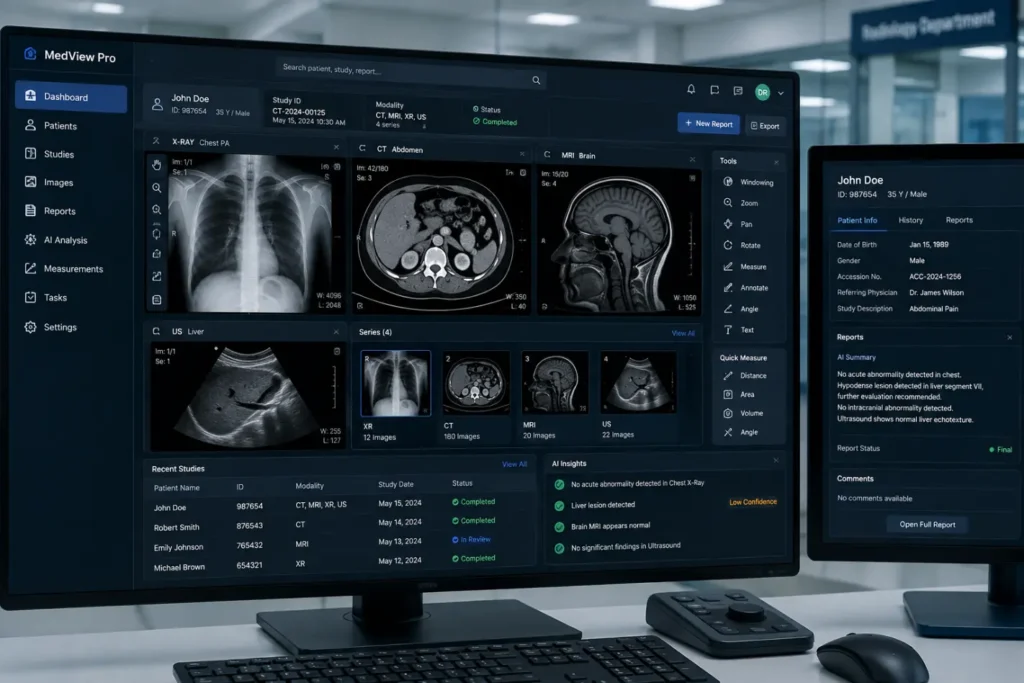
Medical software startups are having a moment. Investors are writing bigger checks, hospitals are asking for AI tools, and new rules are opening doors for products that did not exist a few years ago. But healthcare is not a normal software market. A bug can hurt a patient, and one missing contract clause can stall a deal for months. This guide covers what founders of medical software startups should sort out first: what you are really building, which rules apply, how to stay secure, how you will get paid, and how to win your first buyers. Every figure and date below was checked against its original source in November 2026.
Key Takeaways
- Medical software startups should decide early whether your product counts as a regulated medical device. That one answer shapes your budget and timeline.
- Funding is rising but concentrated, so a narrow niche beats a broad pitch.
- AI alone no longer sets a company apart. Investors now look for deep clinical know-how, hands-on implementation and trusted partnerships.
- There is no official HIPAA certificate. Buyers check signed agreements and real security controls.
- Plan EHR and payer integrations from day one, not after launch.
- Hospitals and insurers want proof of results, and many now tie part of the fee to measurable targets.
- Several rule deadlines land between now and 2028. Put them on a calendar (see the dates table below).
What Counts as Medical Software?
The label covers a wide range, and plenty of it never touches diagnosis. Most products fall into one of four groups:
- Administrative tools. Scheduling, billing and practice management software for clinics.
- Clinical workflow tools. Documentation, EHR add-ons and decision support for care teams.
- Patient-facing apps. Telehealth, mental health programs and remote patient monitoring.
- Diagnostic or treatment software. Products that diagnose, treat or monitor disease, often called Software as a Medical Device (SaMD).
The split matters for medical software startups because regulators judge a product by what it is meant to do, not by how it is built. FDA says it does not regulate AI as such; it regulates medical devices, including AI-enabled ones. A scheduling tool and a cancer-detection algorithm face very different rules, and that shapes medical software development choices from the start.
Why Medical Software Startups Are Drawing Capital
Rock Health counted $7.4 billion raised by US digital health startups across 244 deals in the first half of 2026. A year earlier it was $6.4 billion across 245 deals. The median deal rose to $14 million, up from $12 million in 2025 and a level not seen since 2022.
The catch is concentration. Nineteen companies raised 20 rounds of $100 million or more, and those rounds took 45% of all capital while making up just over 8% of deals. For comparison, mega-deals were 22% of funding in 2024 and 42% in 2025.
Two other signals matter for founders. Mental health was the top-funded clinical area for the seventh year in a row, with weight management second, helped by the GLP-1 market. And exits are picking up: Rock Health logged 115 digital health acquisitions in the first half of 2026, against 199 in all of 2025, with revenue cycle management seeing the most consolidation.
For healthtech startups, the practical reading is simple. A sharp niche and a credible clinical story count for more than a long feature list, and a buyer or acquirer may be closer than a public listing.
What Investors and Buyers Look for Now
Rock Health stopped tagging startups as “AI-enabled” earlier this year because AI has become too common to separate one company from another. Investors and buyers now ask which medical software startups offer something AI alone cannot provide. Its report points to four sources of lasting advantage:
- Founder edge. Founders with clinical or administrative backgrounds understand how care teams and buyers actually work, which helps them pick problems worth solving.
- Owning more of the workflow. Well-funded companies are expanding to cover more of a health system’s operating layer, so their products have more context to work with.
- Hands-on delivery. Buyers expect measurable returns after they sign. Some vendors now place forward-deployed engineers inside customer organizations to adapt products to real workflows.
- Partnerships. Links with trusted medical societies, standards bodies and health systems lower a buyer’s perceived risk, and each new tie makes the next sale easier.
There is also a warning for thin products. Rock Health notes that incumbents such as Epic are giving customers more ways to build their own agents.Medical software startups that are only a light layer on top of the EHR should test whether the EHR vendor could ship the same thing.
Where Founders Are Finding Real Openings
Medical software startups tend to gain traction where a deadline or a clear pain point already exists. Four areas stand out right now.
- Admin automation. Coverage of Rock Health’s data points to AI agents, chronic care and workforce tools landing large rounds in 2026.
- Prior authorization and payer data exchange. CMS-0057-F requires affected payers to run Provider Access, Payer-to-Payer and Prior Authorization APIs by January 1, 2027, and to update their Patient Access API. Process changes, such as faster decisions and specific denial reasons, began on January 1, 2026. The rule binds payers rather than providers, but it changes life for anyone who submits prior authorization requests.
- Remote monitoring. Medicare added new remote monitoring billing codes for 2026 (see the next section).
- Direct-to-consumer care. About 64% of mental health and weight management startups that raised in the first half of 2026 sell straight to consumers, against 29% across digital health overall.
How Medical Software Startups Get Paid
Most sell subscriptions or licenses to health systems, payers and employers. Three payment trends are worth planning around.
Performance-based contracts. The Peterson Health Technology Institute surveyed 321 digital health purchasers in July 2026. About 57% use performance-based contracts, including 68% of employers and 55% of health plans. Among organizations that use them, 85% put at least a quarter of contract value at risk, and 31% put more than half at risk. The most common hurdle, named by 41% of purchasers, is agreeing with vendors on how each metric is defined. Source and second report.
Reimbursement your customers can bill. Congress extended many Medicare telehealth flexibilities through December 31, 2027. For 2026, CMS also finalized new remote physiologic and therapeutic monitoring codes, covering as few as two to 15 days of data in a month and shorter management time. Many remote monitoring codes sit outside the telehealth-list restrictions, so they do not depend on that 2027 date. Remember that your clinician customer, not you, bills these codes, and remote physiologic monitoring requires an established patient relationship. Sources: KFF, Arnold & Porter and Medical Economics.
Direct-to-consumer. The consumer route moves faster, since you skip procurement. You also carry the marketing cost and the privacy duties yourself. Many healthcare software startups end up mixing both routes over time.
Rules to Understand Before You Write Code
United States: FDA
For medical software startups in the US, FDA looks at intended use. On January 6, 2026, it issued revised final guidance on clinical decision support (CDS) software and general wellness products, easing oversight of some tools. CDS software can sit outside the device definition only if it meets all four statutory criteria. In short, it must not process medical images or signals, it must work with medical information, it must give recommendations to a clinician, and it must let that clinician review the basis for each recommendation independently. FDA also said it will use enforcement discretion for some CDS that offers a single recommendation when only one option is clinically appropriate. Patient-facing tools still fall under other digital health policies. Check the criteria with a regulatory specialist before you assume an exemption.
If your product is a device, it usually goes through 510(k), De Novo or PMA review. FDA’s public list shows it has authorized over 1,600 AI-enabled medical devices as of September 2026, so AI products have a well-worn path. One analysis of the list found about 96% cleared through 510(k), and about three in four are radiology products, so non-imaging products will have fewer precedents to point to. FDA itself notes the list is not comprehensive. A predetermined change control plan can also let you describe planned algorithm updates in advance instead of resubmitting every time.
Connected devices carry cybersecurity duties too. Section 524B, in force since March 29, 2023, asks sponsors of cyber devices to include a postmarket vulnerability plan, processes that keep the device secure (including updates and patches), and a software bill of materials. FDA can refuse a submission that falls short. FDA’s quality regulation, which brings in ISO 13485, took effect on February 2, 2026. FDA reissued its premarket cybersecurity guidance the next day to match.
Europe
Healthtech startups selling in Europe face the Medical Device Regulation as well. Under its Rule 11, software that informs diagnostic or treatment decisions starts at class IIa and rises to IIb or III if a wrong output could cause serious harm or death. Class I is a small leftover category. From class IIa upward, a notified body must be involved, so budget time and money for it. The EU’s guidance on software classification (MDCG 2019-11, revised in June 2025) walks through the decision steps.
The EU AI Act comes on top. Under the Digital Omnibus on AI (Regulation (EU) 2026/1744, in force since July 27, 2026), high-risk duties for AI built into products such as medical devices now start on August 2, 2028. That is not extra time for your device work: MDR obligations apply today. Transparency duties, such as telling people when they are dealing with an AI system, were not postponed. Sources: EUAIAct.com and Pure Global.
India and other markets
Founders building in India face a similar logic. Software with a medical function is already regulated as a medical device under the Medical Devices Rules, 2017, with four risk classes. In October 2025, the CDSCO released draft guidance that separates standalone software (SaMD) from software embedded in hardware (SiMD) and explains how existing rules apply across the software lifecycle. Patient data falls under the Digital Personal Data Protection Act, 2023, and its 2025 Rules, which phase in over about 18 months. Sources: Nishith Desai Associates and Ecorpit. Selling in any other country means checking its own device and privacy regime first.
State rules for healthcare AI
US states have started writing their own rules, and most land on your customers, which means they will appear in your contracts. California’s AB 3030 (January 2025) requires a disclaimer on AI-generated clinical messages to patients unless a licensed provider reviews them. California’s AB 489 (January 2026) bars AI systems from implying they hold a healthcare license, and SB 1120 stops health plans from deciding medical necessity with AI alone. In Texas, SB 1188 (September 2025) requires practitioners to review AI-generated records, and the Texas Responsible AI Governance Act (January 2026) adds disclosure duties. Illinois restricts AI therapy. The patchwork changes quickly, so recheck before launch. Sources: Akerman and Mondaq.
Engineering Standards That Make You Audit-Ready
If your software is a device, regulators and notified bodies expect recognized standards, not just good intentions. Four come up most often:
- ISO 13485 covers your quality management system, and FDA’s updated quality regulation now incorporates it.
- IEC 62304 sets software lifecycle processes. FDA recognizes the current edition (1.1), and the EU lists the 2006 standard with its 2015 amendment as harmonized. Its safety classes (A, B and C) decide how much rigor each activity needs. It does not cover validation and final release.
- ISO 14971 covers risk management and ties into IEC 62304.
- IEC 62366-1 covers usability engineering.
Even if your product is not a device today, borrowing this discipline (traceable requirements, documented risk analysis, controlled releases) makes security reviews and later regulatory steps much easier.
Privacy, Security and the Proof Buyers Ask For
Medical software startups that handle patient data for a provider or health plan are usually business associates under HIPAA. That means signed business associate agreements, cloud host included, and a documented risk analysis.
Founders often ask where to get a HIPAA certificate. There is no official one, because HHS does not endorse or recognize private organizations’ certifications, and they do not shield you from enforcement. Buyers lean on signed agreements, security questionnaires and third-party reports such as SOC 2 or HITRUST. Keep in mind that HITRUST or SOC 2 shows security maturity but does not by itself prove HIPAA compliance.
HHS proposed a tougher Security Rule in January 2025, with mandatory encryption and multifactor authentication. It is still only a proposal. The latest federal agenda moved it to the long-term list, with July 2027 as the target for final action, though such dates are estimates. Building those controls now is cheaper than retrofitting later, so treat compliance integration as a design task from the first sprint. A sensible baseline includes encryption in transit and at rest, multifactor sign-in, role-based access, audit logs and a tested incident response plan.
Plan for the worst day as well. Under HIPAA, affected individuals must be told without unreasonable delay and no later than 60 days after discovery, and 60 days is an outer limit rather than a target. A business associate must notify the covered entity within the same 60-day window, so check what your customer contracts require. The stakes are real: IBM’s 2026 study put the average healthcare breach at $6.64 million, the highest of 17 industries, with 220 days on average to identify a breach and 72 more to contain it.
Build for Integration From Day One
A medical product that cannot talk to the electronic health record rarely survives a hospital review. Most connections run through FHIR APIs or older HL7 messages. Healthcare software startups often leave this work for the end, which is when it hurts most.
Two developments make early planning easier. First, payers must stand up FHIR-based APIs under CMS-0057-F by January 1, 2027, which should make payer data easier to reach. Second, Epic’s partner marketplace is now called Showroom, and it replaced the retired App Orchard. Epic offers a free developer sandbox, but each health system still has to switch on your connection, and a listing is not an endorsement from Epic. Read the current program details before you promise a go-live date.
Map each data flow, decide what the other system may see, and test failure paths, not just the happy path. Good medical software development treats those connections as part of the product, not as a favor to do after launch.
Winning Hospitals, Payers and Patients
Medical software startups selling to a health system usually face a security review, a legal review and often a pilot before any contract appears. Buyers want evidence, and the contract numbers above show why. Agree on success metrics before a pilot starts, define each metric in writing (the top complaint from buyers), and write down what happens if you hit them. Open-ended pilots tend to drift.
Because buyers see so many vendors, borrowed trust helps. Integrations, society partnerships and early reference customers all shorten the path to the next deal. If you sell to consumers instead, you skip procurement but take on the marketing cost and privacy duties yourself.
Team, Advisers and Funding
For medical software startups, a clinician on the founding team or advisory board changes how buyers and investors read you. Rock Health reports that early-stage investors weigh domain expertise more heavily now that AI has made building easier. Healthtech startups that show real outcomes, even from a small pilot, give a funder something solid to underwrite.
If you are hiring for medical software development for the first time, look for someone who has lived through a hospital security review. They will save you months. If you outsource the build, ask a prospective partner for four things: a quality system aligned with ISO 13485, experience with IEC 62304 if your software may be a device, references from customers who passed a hospital security review, and clear terms on who owns the code.

A Stage-by-Stage Roadmap
Use this sequence to keep regulation, security and sales moving together instead of one after another.
| Stage | What to settle | What you should have in hand |
| 1. Define | One clinical problem, one buyer, one intended use | A one-page intended-use statement |
| 2. Classify | Device or not, in each market you will sell in | A written regulatory rationale reviewed by a specialist |
| 3. Design | Data flows, security controls, integration approach | A data map, a risk analysis and an integration plan |
| 4. Build | A small first version made with a clinical adviser | Traceable requirements and a controlled release process |
| 5. Pilot | Success metrics, data access, who pays afterward | A signed pilot plan with defined metrics |
| 6. Sell and scale | Security review, BAA, procurement, reimbursement path | Signed agreements, references and outcome data |
Key Dates Founders Should Track
| Date | What happens |
| Jan 1, 2026 | CMS-0057-F process changes begin; California AB 489 and the Texas Responsible AI Governance Act take effect |
| Feb 2–3, 2026 | FDA’s quality regulation (ISO 13485) takes effect; FDA reissues its premarket cybersecurity guidance |
| Aug 2, 2026 | EU AI Act transparency duties apply |
| Jan 1, 2027 | Payer APIs required under CMS-0057-F (Provider Access, Payer-to-Payer, Prior Authorization) |
| July 2027 (target) | HHS’s planned date for final action on the HIPAA Security Rule overhaul; dates can slip |
| Dec 31, 2027 | Current end date for many Medicare telehealth flexibilities |
| Aug 2, 2028 | EU AI Act high-risk duties start for AI built into medical devices |
Mistakes That Sink Early Medical Software Startups
- Building first and asking regulatory questions later.
- Making health claims the product cannot back up.
- Assuming a decision-support exemption without documenting why each criterion is met.
- Treating a SOC 2 report as a replacement for signed agreements.
- Leaving integration for “version two.”
- Running pilots with no success metrics, or with metrics defined differently by each side.
- Competing with the EHR vendor on a feature it could add itself.
- Shipping patient-facing AI without checking state disclosure rules.
- Designing for the pilot instead of the security and legal review that follows it.
Frequently Asked Questions
What are medical software startups?
They are young companies building software for clinical care, health administration or patient support. Some products are regulated medical devices, such as diagnostic algorithms. Many are not, such as scheduling and billing tools.
Do medical software startups need FDA approval?
Not always. It depends on the product’s intended use. Software that diagnoses, treats or monitors disease is often regulated as a device, and most are cleared through the 510(k) route. Some decision support and wellness tools fall outside the device definition. Confirm yours with a regulatory specialist.
Do healthcare software startups need HIPAA certification?
No official HIPAA certification exists. If you handle protected health information for a provider or plan, you must follow HIPAA and sign business associate agreements. Buyers may also ask for a SOC 2 or HITRUST report.
How do medical software startups make money?
Most sell subscriptions or licenses to health systems, payers and employers. Many contracts now tie part of the fee to results. Some products help clinicians bill for services such as remote monitoring, and others sell directly to patients through subscriptions or paid programs.
How do you start a medical software startup?
Start with one clear clinical problem and one buyer. Check whether the product counts as a device, map your data flows, and set up HIPAA basics before you handle real patient data. Then build a small version with a clinical adviser and test it in a pilot with written success metrics.
How much does it cost to build medical software?
No reliable independent figure exists, and vendor quotes vary widely. Cost depends mainly on four things: whether the product is a device, how many EHR and payer integrations you need, the security audits buyers require, and how much clinical evidence you must produce. Ask for a scoped estimate that lists each of those rather than trusting a headline number.
Does using AI change the rules?
Not the basic logic. FDA regulates devices, not AI as such, so intended use still decides. AI adds extra layers: FDA’s change-control plans for model updates, the EU AI Act’s later deadlines, and state disclosure laws for patient-facing AI.
Do I need SOC 2 or HITRUST?
Neither is a legal requirement. They are proof points that many buyers request during security review. Start with a signed business associate agreement and a documented risk analysis, then add a third-party report when sales demand it.
Bottom Line
Medical software startups win when they treat regulation, security and integration as part of the product, not as paperwork. Pick a narrow problem, learn which rules apply, and bring evidence to every buyer conversation.
Start this week with three documents: a one-page statement of what your software is meant to do, a map of the data it touches, and a calendar of the rule dates that affect you. Most of the hard decisions follow from those three.