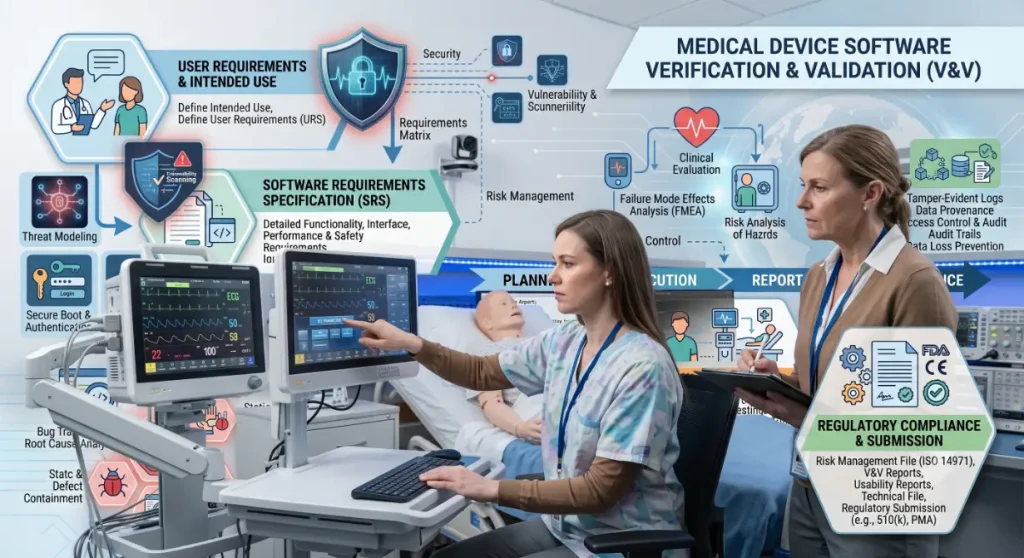
Medical device software is now used for everything from monitoring patients and controlling equipment to analyzing medical images and supporting clinical decisions. Since software errors can affect patient safety, manufacturers need to show that their software works correctly, performs as intended, and meets applicable regulatory requirements.
Key Takeaways
- Verification checks whether software meets specified requirements.
- Validation confirms software is suitable for its intended use.
- Risk management and traceability are central to effective V&V.
- Proper testing and documentation support regulatory compliance.
This is where medical device software verification, validation, and compliance become important.
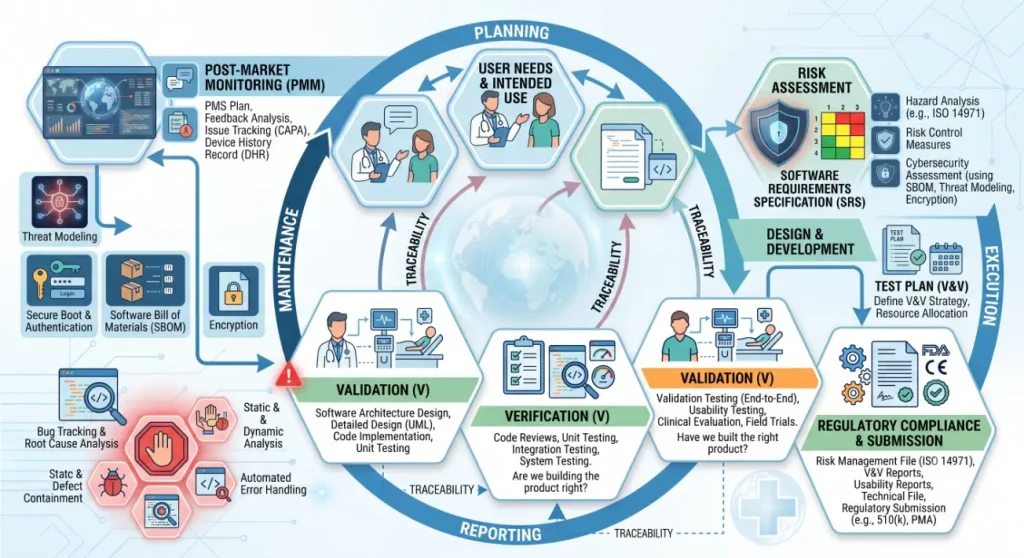
Verification and validation are closely related, but they are not the same. Verification checks whether the software has been built correctly according to the specified requirements and specifications.
What is meant by medical device software verification and validation?
Software verification and validation (V&V) is a documented process used to demonstrate that medical device software meets defined requirements and is appropriate for its intended purpose.
The process can include:
Requirements reviews
Software design reviews
Peer code review
Unit-level and integration testing
End-to-end system testing
Risk-based testing
Usability testing
Performance testing
Cybersecurity testing
Validation in the intended-use environment
Regression testing
The exact activities depend on the type of software, its intended use, associated risks, and applicable regulations.
Verification vs. Validation
The simplest way to understand the difference is to look at the question each one answers.
| Verification | Validation |
| Did we build the software correctly? Checks against specified requirements | Checks suitability for intended use |
| Includes unit, integration, and system testing | Includes overall product and user evaluation |
| Focuses on development outputs | Focuses on the completed system and its use |
For example, if software is designed to calculate a patient’s measurement, verification can confirm that the calculation follows the approved specification. Validation would consider whether the complete software performs appropriately for its intended users and clinical purpose.
Also Read:
Why Is V&V Important?
Medical device software can fail in ways that are not always obvious. A calculation error, incorrect data display, software crash, or communication problem could potentially affect clinical decisions or patient care.
A well-planned V&V process helps manufacturers:
- Identify software defects before release
- Address safety-related risks
- Demonstrate that requirements have been tested
- Maintain traceability between requirements and test results
- Support regulatory submissions
- Control software changes
- Improve confidence in software performance
V&V should be considered throughout development rather than being left until the final stage of the project.
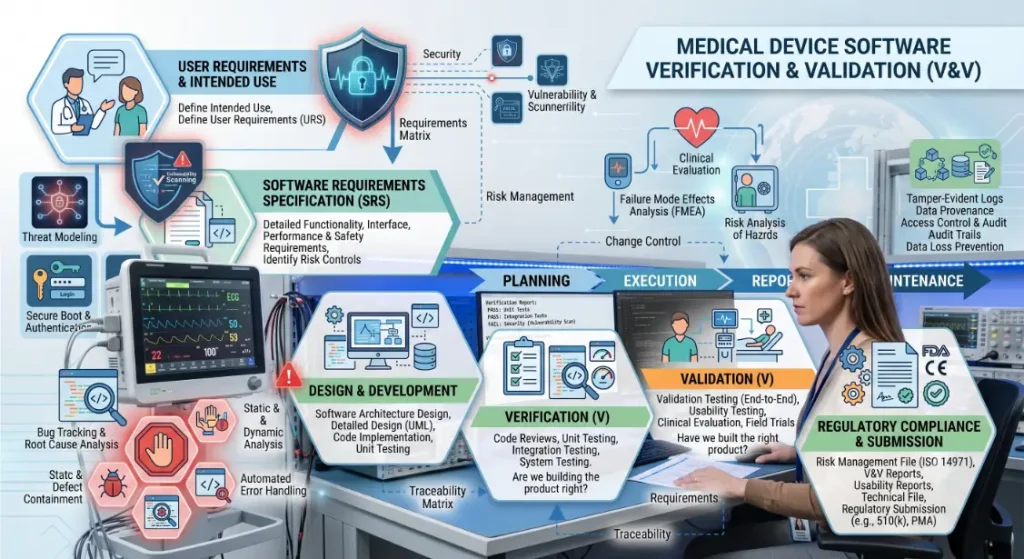
Key Steps in Medical Device Software V&V
1. Define Software Requirements
Requirements should clearly describe what the software needs to do. They may cover functionality, accuracy, performance, security, usability, data handling, and interfaces.
Good requirements should also be measurable and testable.
2. Identify and Manage Risks
Software-related risks should be identified as part of the medical device risk-management process.
Potential risks may include:
- Incorrect calculations
- Loss of patient data
- Incorrect display of results
- Unauthorized access
- Communication failures
- Software crashes
- Incorrect device operation
Testing should give particular attention to functions where failure could create significant risks.
Also Read:HIPAA-Compliant Medical Software
3. Conduct Software Testing
Testing can take place at several levels:
- Unit testing: Tests individual software components.
- Integration testing: Checks how different components work together.
- System testing: Evaluates the complete software against its requirements.
- Regression testing: Checks whether software changes have affected existing functions.
4. Maintain Traceability
Traceability connects requirements, risks, controls, test cases, and results.
A typical relationship may look like:
User Need → Software Requirement → Risk Control → Test Case → Test Result
Medical Device Software Compliance
Regulatory expectations vary depending on the country, device, classification, and intended use. Manufacturers must first determine which standards and requirements apply to their specific medical devices.
Commonly considered standards and frameworks include:
- IEC 62304: Medical device software – Software life cycle processes
- ISO 14971: Risk management for medical devices
- IEC 62366-1: Usability engineering for medical devices
- Applicable rules and regulations from the FDA and regulatory bodies of other countries
Additionally, accurate and comprehensive documentation is crucial for ensuring compliance.
Records may include the software development plan, requirements, risk documentation, test protocols, test results, traceability matrix, defect records, change-control records, and validation reports.
Common Challenges
Medical device software teams often face challenges such as:
- Changing requirements during development
- Complex hardware and software interfaces
- Incomplete documentation for legacy software
- Maintaining traceability as the product grows
- Managing cybersecurity vulnerabilities
- Retesting software after significant changes
A risk-based approach can help teams decide where testing and documentation require the most attention.
Also Read: Cloud Medical Software
Frequently Asked Questions
1. What is medical device software verification?
Verification checks whether software has been developed according to its specified requirements. It may include reviews, inspections, and different levels of software testing.
2. What is medical device software validation?
Validation determines whether the completed software is suitable for its intended use. It considers the complete system, intended users, environment, and intended purpose.
3. Is verification the same as validation?
No. Validation asks whether the finished software is appropriate for its intended use.
4. Why is IEC 62304 important?
IEC 62304 provides a framework for managing medical device software lifecycle processes, including development, maintenance, risk-related activities, configuration management, and problem resolution.
5. Does software need testing after an update?
Often, yes. Regression testing and an assessment of the change’s impact may be necessary before the updated software is released.
6. Is documentation important for software compliance?
Yes. V&V activities should produce objective, reviewable evidence showing what was tested, how it was tested, what the results were, and how identified issues were addressed.