Healthcare organizations handle a huge amount of information every day. Patient records, medical images, laboratory results, prescriptions, billing details, and appointment data all contribute to the larger picture of patient care. The challenge is not simply collecting this information. It is making sense of it and using it responsibly. So that Exploring enterprise-level analytics in medical software solutions plays a vital role.
Key Takeaways
- Enterprise analytics connects data from multiple healthcare systems.
- It can support clinical, operational, financial, and population health decisions.
- Data integration, quality, security, and governance are essential for reliable analytics.
- Enterprise analytics provides a broader view than department-level reporting.
Exploring enterprise-level analytics in medical software solutions shows how healthcare organizations can bring data from different systems together, identify useful patterns, and use those findings to support clinical and operational decisions.
What Is Enterprise-Level Analytics in Medical Software?
Enterprise-level analytics refers to the use of analytics tools across different departments, systems, and locations within a healthcare organization. Instead of reviewing information from one application at a time, organizations can analyze data from multiple sources within a common environment.
These sources may include:
- Electronic health records (EHRs)
- Laboratory information systems
- Medical imaging and PACS platforms
- Pharmacy management systems
- Billing and claims software
- Patient monitoring devices
- Hospital management applications
- Appointment and scheduling systems
For example, a hospital could compare emergency department visits with bed availability, diagnostic turnaround times, and staffing information. Looking at these factors together can help management understand where delays are occurring and whether additional resources may be required.
This is an important part of exploring enterprise-level analytics in medical software solutions, particularly for organizations managing large volumes of clinical and operational data.
Also Read: Medical Equipment Software
How Healthcare Organizations Use Enterprise Analytics
Supporting Clinical Decisions
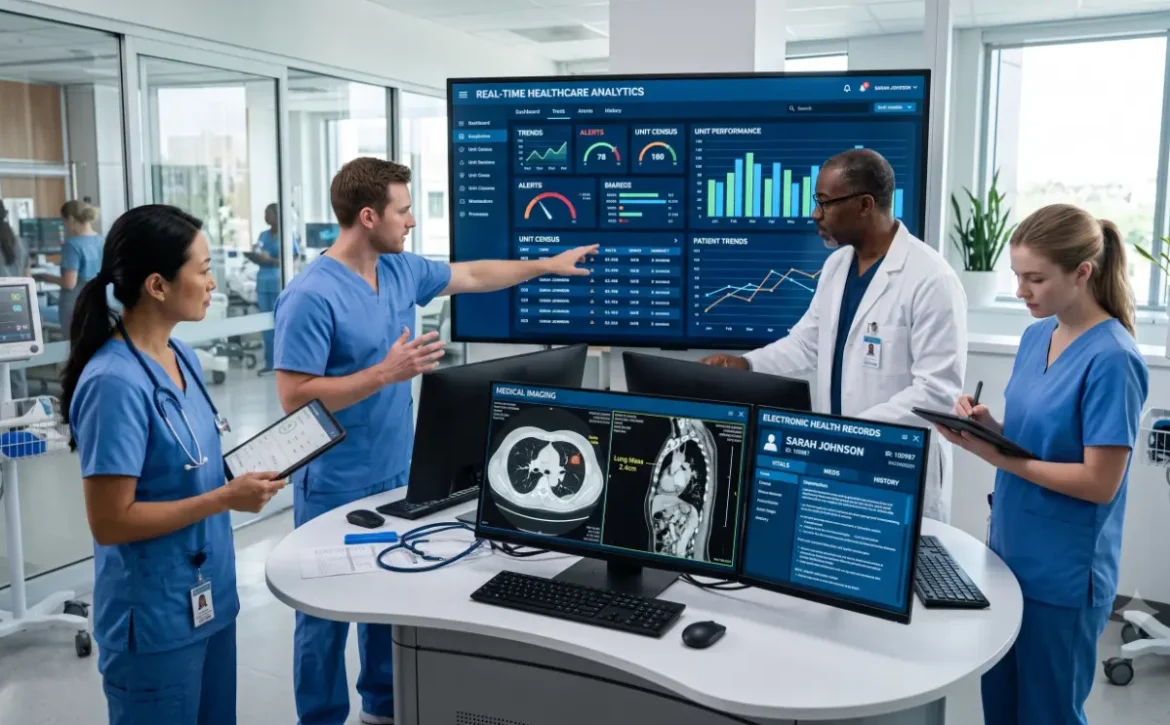
Medical software can analyze patient information and present relevant findings to healthcare professionals. Depending on the application, analytics may help identify changes in laboratory results, patient history, imaging findings, or treatment patterns.
AI-powered clinical decision-support tools can also assist with recognizing patterns in medical data. These systems are intended to support healthcare professionals rather than replace their clinical judgment.
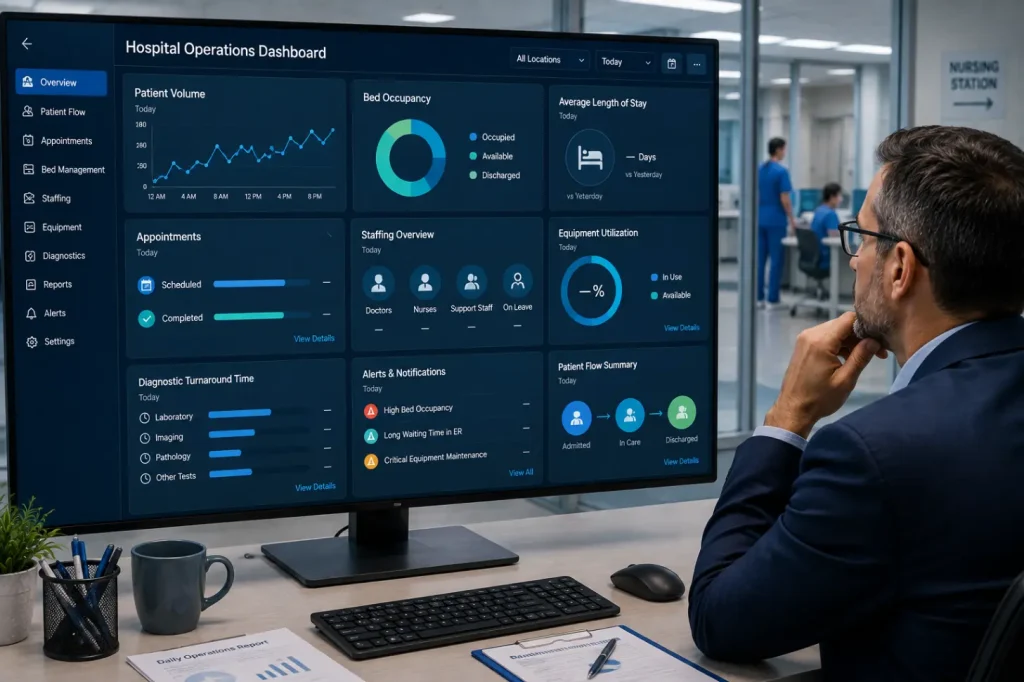
Monitoring Hospital Operations
Running a hospital involves managing many different activities at the same time. Analytics can help administrators monitor for Exploring enterprise-level analytics in medical software solutions.
- Patient volumes
- Appointment utilization
- Bed occupancy
- Operating room usage
- Diagnostic turnaround times
- Equipment utilization
- Department-level workload
Having this information available can help administrators identify capacity problems and understand where delays may be occurring. Exploring enterprise-level analytics in medical software solutions also involves understanding how information from separate departments can contribute to a broader view of hospital operations.
Managing Population Health
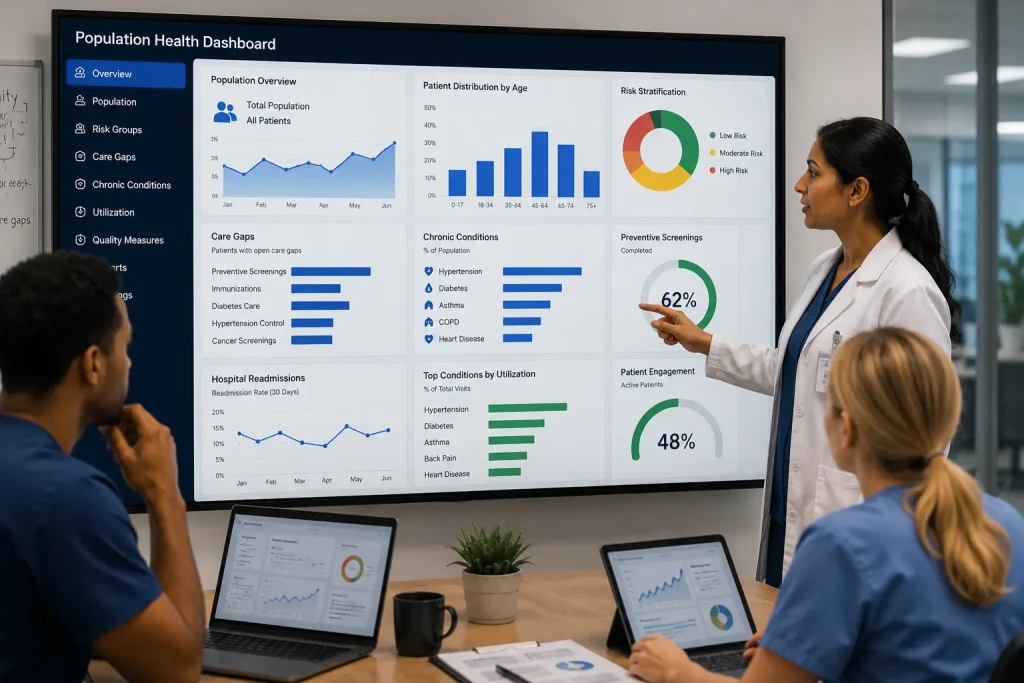
Exploring enterprise-level analytics in medical software solutions is useful when healthcare providers need to study groups of patients rather than individual cases.
For example, a healthcare network may analyze data to identify patients who are overdue for preventive screenings or groups with higher rates of hospital readmission. These findings can help healthcare teams plan appropriate follow-up and preventive care programs.
This broader approach is another important consideration when exploring enterprise-level analytics in medical software solutions, especially for healthcare networks serving large patient populations.
Understanding Costs and Resource Use
Healthcare organizations also need to manage financial and operational resources carefully. Analytics can provide information about procedure volumes, service utilization, resource consumption, and departmental performance.
| Healthcare Area | Data Analyzed | Potential Use |
| Clinical care | Patient records, lab results, imaging | Support clinical assessment |
| Hospital operations | Beds, appointments, patient volumes | Monitor capacity and workflow |
| Radiology | Imaging studies, reporting times | Track diagnostic performance |
| Laboratory | Test volumes and turnaround times | Identify service delays |
| Population health | Patient groups and health trends | Support preventive care planning |
| Finance | Procedures, billing, resource use | Review financial performance |
| Equipment | Usage and maintenance data | Plan equipment management |
Important Components of Medical Analytics
A reliable enterprise analytics system usually depends on several parts working together. Exploring enterprise-level analytics in medical software solutions requires looking beyond dashboards and considering how information is collected, stored, processed, and protected.
Data Integration
Data integration connects information from different medical applications. It helps organizations bring together information that would otherwise remain separated across departments or systems.
Data Warehouses and Data Platforms
Data warehouses and other data platforms provide an environment for storing and analyzing information from multiple sources. Historical data can also be retained for reporting and trend analysis.
Dashboards and Reporting
Dashboards present complex information in a format that users can understand. A hospital executive may need information about overall performance, while a radiology manager may focus on imaging volumes and reporting times.
Advanced Analytics
Advanced analytics can use statistical methods and predictive models to identify trends and potential risks. Where appropriate, AI-powered clinical decision-support can provide additional assistance with data interpretation.
Security and Governance
Healthcare analytics systems may process sensitive patient information. Appropriate access controls, encryption, auditing, data governance, and security practices are therefore essential. These considerations are central to exploring enterprise-level analytics in medical software solutions responsibly.
Challenges to Consider
Implementing enterprise analytics is not always simple. Healthcare organizations may have older software, different data formats, disconnected systems, and varying workflows between departments.
Common challenges include:
- Fragmented healthcare data
- Legacy software and infrastructure
- Inconsistent data formats
- Duplicate or incomplete records
- Integration difficulties
- Patient data privacy concerns
- Security and access-control requirements
- Limited staff familiarity with analytical tools
Data quality is particularly important. If information is incomplete, duplicated, outdated, or inconsistent, the resulting analysis may be unreliable.
Privacy and security also require careful planning. Only authorized users should have access to information relevant to their roles. Organizations must also consider applicable healthcare regulations and internal data policies.
These issues should be addressed early when exploring enterprise-level analytics in medical software solutions, rather than after an analytics platform has already been deployed.
Enterprise Analytics vs Department-Level Analytics
There is an important difference between analyzing information within one department and analyzing data across an entire healthcare organization.
| Feature | Department-Level Analytics | Enterprise-Level Analytics |
| Data scope | Usually one department | Multiple departments and systems |
| Main users | Department teams | Clinicians, managers, executives |
| Data sources | Limited | Multiple healthcare applications |
| Focus | Specific workflow | Organization-wide performance |
| Reporting | Department reports | Cross-functional dashboards |
| Decision support | Local decisions | Broader clinical and operational decisions |
Enterprise analytics does not necessarily replace department-level reporting. Both can serve different purposes and work together.
The Future of Enterprise Analytics
As medical software continues to develop, analytics will become more closely connected with clinical and operational workflows. Healthcare organizations are likely to use data from EHRs, imaging systems, laboratory platforms, connected devices, and patient-generated sources.
The goal should not be to create more reports simply for the sake of having more data. Useful analytics should help users find relevant information, understand what it means, and make informed decisions.
Also Read: Medical Software Development
Exploring enterprise-level analytics in medical software solutions also means considering how future systems can handle larger datasets while maintaining data quality, security, interoperability, and usability.
Healthcare providers will likely continue looking for analytics platforms that fit into existing workflows instead of requiring staff to work across disconnected systems. The focus should remain on making information useful and accessible to the people who need it.
Conclusion
Enterprise-level analytics gives healthcare organizations a practical way to understand information collected across multiple systems. It can support clinical decision-making, hospital operations, population health management, and resource planning.
Exploring enterprise-level analytics in medical software solutions makes it clear that successful implementation depends on more than analytical software alone. Reliable data, good integration, security, clear reporting, and responsible use all matter.
When these elements are properly considered, enterprise analytics can help healthcare organizations make better use of the information they already have without adding unnecessary complexity to everyday workflows.
Frequently Asked Questions
1. What is enterprise-level analytics in healthcare?
It is the process of collecting and analyzing data from multiple healthcare systems and departments to support clinical, operational, and management decisions.
2. What systems can be connected to medical analytics software?
Depending on the organization, analytics platforms may connect with EHRs, PACS, laboratory systems, pharmacy software, billing platforms, patient monitoring systems, and hospital management applications.
3. Can analytics improve clinical decision-making?
Analytics can provide healthcare professionals with useful patterns and information. AI-powered clinical decision-support may provide additional assistance, but final clinical decisions remain with qualified healthcare professionals.
4. What are the main challenges of healthcare analytics?
Common challenges include fragmented data, legacy systems, inconsistent information, privacy concerns, security requirements, and difficulties integrating different healthcare applications.
5. Why is data quality important in medical analytics?
Analytics depends on the information being analyzed. Incomplete, outdated, duplicated, or inaccurate data can produce misleading results and reduce the usefulness of the system.
6. Why is enterprise analytics useful for healthcare organizations?
It provides a broader view of information across departments and systems. This can help organizations understand clinical activity, operational performance, resource use, and patient trends more effectively.