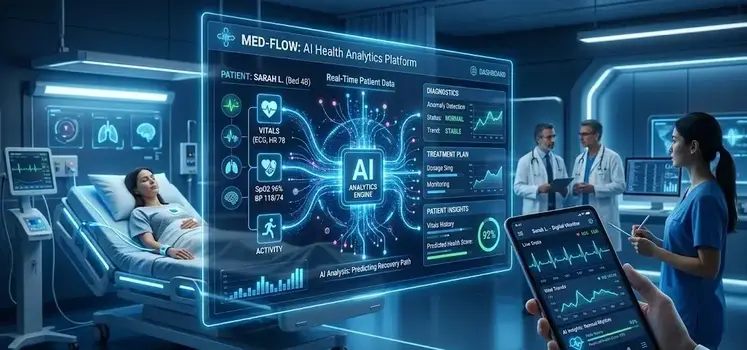
AI in healthcare app development is the use of data-driven models and automation within healthcare applications to support clinical decisions, patient monitoring, and operational efficiency. It supports healthcare providers in managing large datasets, refining diagnostic outcomes, and personalizing patient care. How does this technology reshape modern healthcare delivery?
Key Takeaways
- AI in healthcare app development improves clinical accuracy and efficiency
- Common applications include diagnostics, monitoring, and virtual assistants
- Development requires structured processes and regulatory compliance
- Challenges include data privacy, bias, and system integration
- Adoption is expanding across multiple healthcare and technology domains
How does AI contribute to healthcare app development?
AI in healthcare app development plays a functional role in improving decision-making and automation within medical systems.
Key roles include:
- Clinical decision support: Assists doctors with diagnosis recommendations
- Predictive analytics: Identifies risks such as disease progression
- Workflow automation: Reduces administrative workload
- Patient engagement: Enables chatbots and virtual assistants
Example:
AI-driven radiology applications interpret medical images to detect anomalies quicker than conventional methods.
What are the primary use cases of AI in healthcare apps?
AI in healthcare app development supports multiple real-world applications across medical domains.
| Application Area | Description |
| Medical imaging | Detects tumors, fractures, anomalies |
| Virtual health assistants | Provides symptom checking and guidance |
| Remote patient monitoring | Tracks vitals using wearable devices |
| Drug discovery | Accelerates research and molecule prediction |
| Personalized medicine | Tailors treatments using patient data |
A healthcare application ecosystem is often discussed alongside telemedicine platforms, wearable health apps, and electronic health record systems.
Why is AI in healthcare app development important?
AI in healthcare app development is important due to its measurable impact on healthcare quality and efficiency.
Core benefits:
- Improved accuracy: Reduces diagnostic errors
- Cost efficiency: Automates repetitive processes
- Scalability: Supports large patient populations
- Faster insights: Processes vast clinical datasets quickly
Industry reference:
The World Health Organization and similar global institutions encourage the safe and responsible adoption of intelligent healthcare technologies.
How is AI applied in real-world healthcare app development scenarios?
AI in healthcare app development includes several practical implementations used globally.
Examples:
- Diagnostic apps: Skin disease detection tools using image recognition
- Mental health apps: Chat-based therapy assistants
- Fitness and wellness apps: Personalized health recommendations
- Chronic disease management apps: Diabetes and heart monitoring tools
These examples demonstrate how AI improves both preventive and clinical care delivery.
How is AI in healthcare app development built and implemented?
AI in healthcare app development follows structured development steps aligned with healthcare standards.
Typical process:
- Data collection: Gather clinical and patient data
- Model training: Train algorithms using datasets
- Integration: Embed models into mobile or web apps
- Testing: Validate accuracy and reliability
- Compliance check: Ensure adherence to standards like HIPAA or GDPR
- Deployment: Launch with continuous monitoring
Best practices:
- Use secure cloud or hybrid deployment
- Ensure data privacy and encryption
- Validate models with clinical experts
What challenges exist in AI in healthcare app development?
AI in healthcare app development deals with a range of technical and regulatory complexities.
Key challenges:
- Data privacy risks: Sensitive patient data handling
- Regulatory compliance: Meeting healthcare laws and standards
- Bias in data: Inaccurate outcomes due to unbalanced datasets
- Integration complexity: Compatibility with legacy systems
Addressing these challenges requires strong governance frameworks and validation processes.
Conclusion
AI in healthcare app development is transforming clinical workflows through structured applications such as diagnostics, monitoring, and predictive analytics. Its classification into applications, processes, and compliance frameworks provides clarity for implementation. As industries evolve, similar structured adoption can also be observed in domains like ai in food delivery app development, reflecting broader cross-sector innovation.
FAQs
What is AI in healthcare app development?
It is the integration of intelligent data-processing systems into healthcare apps to improve diagnosis, monitoring, and decision-making.
What are key benefits of AI in healthcare apps?
They improve accuracy, automate workflows, and enable personalized treatment approaches.
What technologies are used in AI healthcare apps?
These technologies commonly involve machine learning, natural language processing, and computer vision.
Is AI in healthcare app development regulated?
Yes, it is required to meet regulatory requirements such as HIPAA, GDPR, and medical device guidelines.
Can students build AI healthcare projects?
Yes, common projects include disease prediction models, symptom checkers, and health monitoring apps.
Sources
https://pmc.ncbi.nlm.nih.gov/articles/PMC8285156/
https://www.aleaitsolutions.com/ai-in-healthcare-app-development
https://www.coursera.org/in/articles/ai-in-health-care
https://trigma.com/industries/ai-healthcare-app-development/
https://www.delveinsight.com/blog/top-artificial-intelligence-based-healthcare-mobile-apps
https://appinventiv.com/guide/healthcare-app-development-guide/
https://solveit.dev/blog/healthcare-app-development-guide
https://www.aress.com/blog/read/steps-to-create-an-ai-healthcare-android-app-in-2025
https://www.who.int/teams/digital-health-and-innovation/harnessing-artificial-intelligence-for-health