AI in food delivery app development utilizes sophisticated computational methods to refine order processing, logistics management, and customer engagement. It supports real-time insights, predictive modeling, and automated workflows. How do these advancements drive better performance and user satisfaction in a competitive landscape?
Key Takeaways
- ai in food delivery app development enhances efficiency and personalization
- Core applications include logistics optimization and demand forecasting
- Technologies include ML, NLP, and cloud computing
- Challenges include cost, data privacy, and system complexity
- Widely adopted across modern digital food platforms
How does AI in food delivery app development work, and what does it involve?
ai in food delivery app development operates by analyzing large datasets from user behavior, orders, and logistics systems to improve decision-making.
Core components include:
- Predictive models using machine learning for demand estimation
- NLP-driven chatbots and voice ordering interfaces
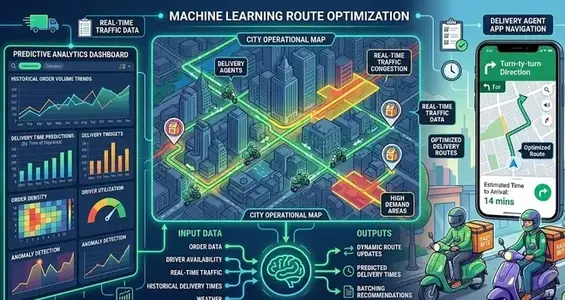
- Intelligent routing systems for efficient deliveries
Example workflow:
- User places an order
- System predicts preparation and delivery time
- Delivery route is optimized in real time
These systems align with data processing standards and API-driven architectures for scalability.
How does ai in food delivery app development improve customer experience?
AI in food delivery app development elevates customer experience with personalized features and efficient operations.
Key improvements:
- Personalized food recommendations based on order history
- Smart search and voice-enabled ordering
- Real-time order tracking with predictive delivery time
Example:
Apps suggest meals during peak hours based on previous preferences, increasing engagement and repeat orders.
What practical use cases define AI in food delivery app development?
ai in food delivery app development is applied across multiple operational and customer-facing functions.
Primary use cases:
| Use Case | Functionality |
| Demand forecasting | Predicts order volume by time/location |
| Delivery optimization | Reduces delivery time and fuel costs |
| Chatbots | Handles customer queries automatically |
| Fraud detection | Identifies suspicious transactions |
These applications are commonly integrated into cloud-based and hybrid deployment models.
How does ai in food delivery app development optimize logistics and operations?
ai in food delivery app development improves backend efficiency through automation and predictive systems.
Operational benefits:
- Dynamic route planning using traffic and weather data
- Automated order assignment to delivery agents
- Inventory prediction for restaurants
Industry practice:
Platforms use real-time GPS data and predictive analytics to minimize delays and maximize delivery efficiency.
Which tools and technologies support AI in food delivery app development?
ai in food delivery app development relies on multiple technologies working together.
Core technologies include:
- Machine learning for predictions
- Computer vision for food image recognition
- Cloud computing for scalability
- Big data analytics for insights
These technologies comply with data security and interoperability standards such as RESTful APIs and cloud compliance frameworks.
What are the challenges in implementing ai in food delivery app development?
ai in food delivery app development presents several technical and operational challenges.
Common challenges:
- High initial development and integration costs
- Data privacy and regulatory compliance issues
- Model accuracy and bias in predictions
- Infrastructure requirements for real-time processing
Addressing these requires structured data governance and continuous system optimization.
Related Context
ai in food delivery app development is often discussed alongside AI food delivery app systems, AI in food technology, and artificial intelligence in food industry research applications.
Conclusion
AI in food delivery app development is enhancing modern food platforms with smart, automated, and user-focused technologies. Its classification into customer experience, logistics optimization, and operational intelligence provides a clear implementation framework. As digital commerce evolves, its integration aligns closely with broader innovations such as ai in ecommerce app development.
FAQs
What is ai in food delivery app development?
It is the use of intelligent systems to optimize ordering, delivery, and customer engagement in food delivery platforms.
How does AI improve food delivery apps?
It enhances personalization, delivery speed, and operational efficiency through predictive analytics and automation.
What are examples of AI in food delivery apps?
Examples include recommendation engines, delivery route optimization, and chatbot-based customer support.
Is AI expensive to implement in food delivery apps?
Initial costs can be high, but long-term automation and efficiency reduce operational expenses.
What technologies are used in AI food delivery apps?
It relies on machine learning, natural language processing, computer vision, and cloud computing technologies.
Sources
https://appinventiv.com/blog/ai-in-food-industry/
https://www.algosoft.co/blogs/ai-powered-food-delivery-app-development-company/
https://toxsl.ae/blog/27/how-ai-is-helping-food-delivery-app-development
https://www.orangemantra.com/blog/how-is-ai-empowering-food-delivery-apps-like-doordash/
https://appcrunk.com/blogs/food-delivery-apps-with-intelligent-ai-features
https://www.protocloudtechnologies.com/ai-in-food-delivery-app-development/
https://kodytechnolab.com/blog/ai-in-food-delivery-apps/
https://blocktechbrew.com/how-to-build-a-food-delivery-app-for-restaurant-with-ai-powered-features/
https://75way.com/food-delivery-app-development-company