AI tools for reducing latency in app development are technologies and frameworks designed to optimize response times in intelligent applications. They work by improving computation speed, reducing data transfer delays, and optimizing system architecture. How can developers ensure consistent low latency across distributed systems and real-time applications?
Key Takeaways
- AI tools for reducing latency in app development optimize speed across multiple system layers
- Model compression and edge deployment are critical techniques
- Infrastructure design directly impacts response time
- Monitoring tools ensure consistent performance
- Industry standards support secure and efficient implementation
What Are the Most Effective AI Tools for Reducing Latency in App Development?
AI tools for reducing latency in app development include platforms and frameworks that optimize inference, caching, and infrastructure.
Common tools and platforms:
- Model optimization: TensorRT, ONNX Runtime
- Monitoring systems: Prometheus, Grafana
- Edge computing platforms: Cloudflare Workers, AWS Lambda@Edge
- Distributed databases: Aerospike, Redis
Key capabilities:
- Real-time inference acceleration
- Memory-efficient execution
- Load balancing across nodes
How Do AI Tools for Reducing Latency in App Development Work?
AI tools for reducing latency in app development operate by optimizing different layers of the application stack.
Core mechanisms:
- Model compression – Reduces model size using quantization and pruning
- Edge deployment – Moves computation closer to users
- Caching strategies – Stores frequent responses for instant retrieval
- Parallel processing – Executes tasks simultaneously
| Layer | Optimization Technique | Impact on Latency |
| Model Layer | Quantization, pruning | Faster inference |
| Network Layer | CDN, edge nodes | Reduced travel time |
| Data Layer | In-memory caching | Instant access |

Which Industry Practices Help Reduce Latency in AI Applications?
AI tools for reducing latency in app development are most effective when aligned with industry practices.
Best practices:
- Use event-driven architectures for real-time responsiveness
- Implement asynchronous processing pipelines
- Adopt microservices architecture for modular scaling
- Monitor latency using Service Level Objectives (SLOs)
Regulatory alignment:
- ISO/IEC 27001 for secure data handling
- GDPR for data locality compliance
- SOC 2 for system reliability
How Can Developers Optimize AI Agents and Frameworks for Speed?
AI tools for reducing latency in app development improve agent performance through targeted optimizations.
Steps to improve speed:
- Reduce prompt size and complexity
- Cache intermediate responses
- Use streaming outputs instead of batch responses
- Optimize frameworks such as LangChain with memory control
A common related consideration includes improving agent execution speed, optimizing LangChain workflows, and reducing response delays in distributed systems.
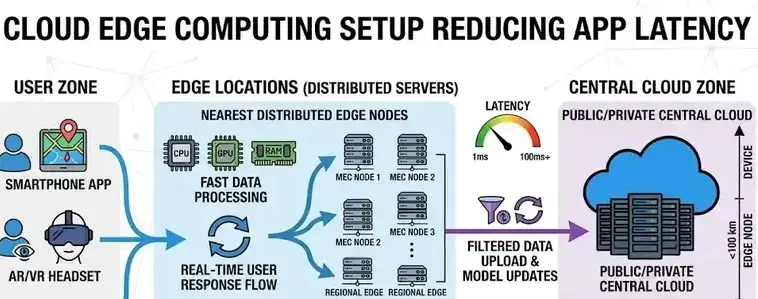
What Role Does Infrastructure Play in Latency Reduction?
AI tools for reducing latency in app development depend heavily on infrastructure design.
Infrastructure strategies:
- Deploy multi-region servers to reduce geographic delay
- Use GPU acceleration for heavy computation
- Implement load balancing to distribute traffic
- Adopt serverless architectures for dynamic scaling
Example:
A fintech app using edge computing can reduce transaction response time from 300ms to under 100ms.
How Is Latency Measured and Monitored in AI Systems?
AI tools for reducing latency in app development include monitoring systems to track performance in real time.
Key metrics:
- Response time (ms)
- Throughput (requests per second)
- Time to first byte (TTFB)
Monitoring tools:
- Real-time dashboards
- Distributed tracing systems
- Log-based anomaly detection

Conclusion
AI tools for reducing latency in app development provide structured methods to optimize performance across models, infrastructure, and data layers. Their effectiveness depends on combining technical tools with standardized practices and scalable architecture. Future implementations should align with frameworks such as responsible ai practices in app development to ensure both performance and system reliability.
FAQ
What are AI tools for reducing latency in app development?
They are platforms and techniques used to minimize response time in intelligent applications through optimization and efficient resource use.
Why is latency important in app development?
Low latency ensures faster response times, improving user experience and system performance in real-time applications.
How can latency be reduced in AI systems?
By using model optimization, caching, edge computing, and efficient infrastructure design.
What is the role of edge computing in latency reduction?
It processes data closer to users, reducing network delays and improving response speed.
Which industries benefit most from low-latency AI applications?
Finance, healthcare, gaming, and real-time analytics platforms benefit significantly from reduced latency.
Sources
https://www.walturn.com/insights/reducing-latency-in-generative-ai-applications
https://coralogix.com/ai-blog/reducing-latency-in-ai-model-monitoring-strategies-and-tools/
https://medium.com/@yuxiaojian/building-responsive-ai-a-practical-guide-to-optimizing-agent-latency-7364e12937af
https://www.linkedin.com/pulse/optimizing-performance-flutter-ai-apps-reducing-latency-cdq1f
https://latitude.so/blog/5-ways-to-reduce-latency-in-event-driven-ai-systems
https://www.novumlogic.com/eli5/how-do-we-reduce-latency-in-our-ai-stack
https://techexactly.com/blogs/latency-in-ai-applications
https://www.cqlsys.com/Latency-real-time-apps-gaming-fintech
https://aerospike.com/blog/real-time-ai-latency-cost-reduction/