Medical AI as doctors’ assistant is the use of computational systems to support clinical decision-making, patient management, and healthcare workflows. These systems analyze medical data, assist in diagnosis, and streamline administrative processes. How can healthcare providers balance efficiency with accuracy while managing increasing patient volumes?
Key Takeaways
- Medical AI as doctors’ assistant enhances clinical decision-making
- Improves diagnostic accuracy through data analysis
- Reduces administrative workload in healthcare systems
- Enables early detection of diseases, especially in imaging
- Requires strict regulatory compliance and human oversight
What is medical AI as doctors’ assistant in clinical practice?
Medical AI as doctors’ assistant functions as a support layer that enhances physician performance rather than replacing it.
Key functions include:
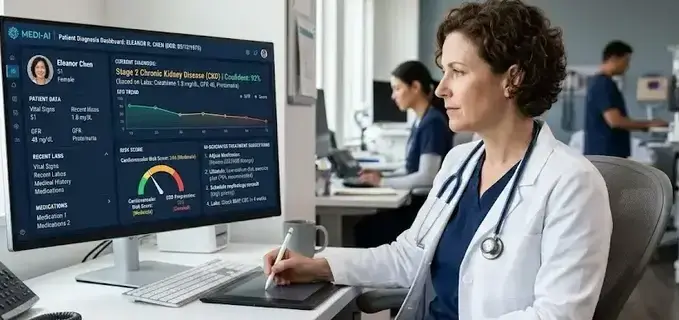
- Clinical decision support using patient data
- Automated documentation (e.g., visit summaries)
- Diagnostic image interpretation
- Workflow optimization in hospitals
Example:
In outpatient clinics, digital assistants transcribe patient visits and generate structured electronic health records (EHRs), reducing manual workload.
How does medical AI as doctors’ assistant improve diagnosis accuracy?
Medical AI as doctors’ assistant improves diagnostic precision by identifying patterns across large datasets.
Applications:
- Radiology: Detecting tumors in imaging scans
- Pathology: Classifying tissue samples
- Cardiology: Predicting cardiac risks
Comparison Table:
| Task | Traditional Method | Assisted Method |
| Image Analysis | Manual review | Pattern detection |
| Data Interpretation | Limited datasets | Large-scale analysis |
| Error Rate | Variable | Reduced variability |
Industry Practice:
Hospitals integrate diagnostic support tools alongside clinician review to ensure accuracy and compliance with medical standards.

What role does medical AI as doctors’ assistant play in patient workflow?
Medical AI as doctors’ assistant streamlines patient visits by reducing administrative burden.
Workflow improvements:
- Automated appointment scheduling
- Real-time transcription during consultations
- Instant clinical documentation
- Follow-up reminders and alerts
Outcome:
- Reduced physician burnout
- Increased patient throughput
- Improved record accuracy
How is medical AI as doctors’ assistant used in early disease detection?
Medical AI as doctors’ assistant is widely applied in early detection, especially in imaging-based conditions.
Examples:
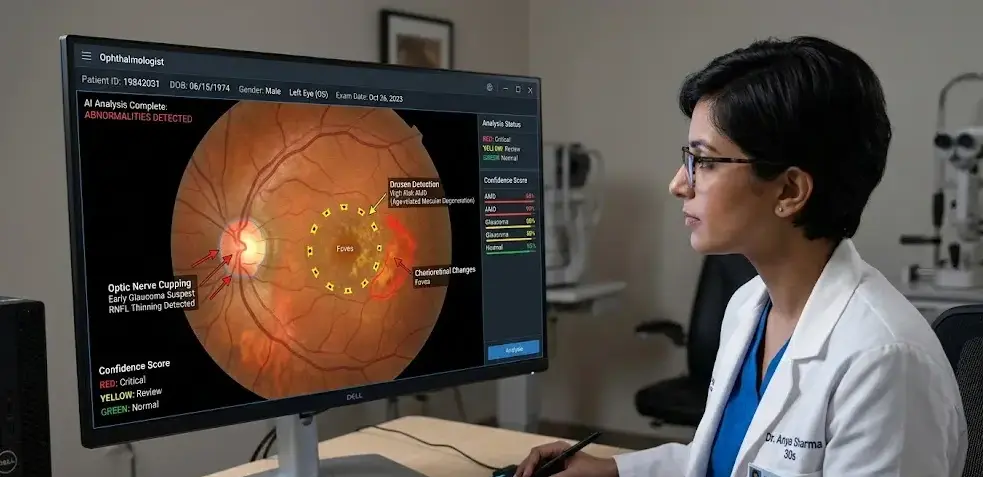
- Retinal disease screening (diabetic retinopathy)
- Cancer detection in early stages
- Neurological disorder prediction
AI-Based Retinal Image Analysis (3rd level keyword):
- Detects microaneurysms and hemorrhages
- Classifies severity levels
- Supports ophthalmologists in screening programs
How does medical AI as doctors’ assistant support optometry and ophthalmology?
Medical AI as doctors’ assistant enhances precision in vision-related specialties.
AI in Optometry
- Automated vision testing
- Prescription recommendations
- Eye health monitoring
AI in Ophthalmology
- Detection of glaucoma and cataracts
- Retinal imaging interpretation
- Surgical planning assistance
Clinical Benefit:
Faster screening allows early intervention, particularly in high-volume healthcare settings.
What are regulatory and safety considerations for medical AI as doctors’ assistant?
Medical AI as doctors’ assistant must comply with healthcare regulations and validation standards.
Key considerations:
- Clinical validation before deployment
- Data privacy compliance (e.g., patient confidentiality laws)
- Human oversight in decision-making
- Risk classification based on clinical impact
Standards:
- FDA (U.S.) software as medical device (SaMD)
- CE marking (Europe)
- National digital health guidelines
Related context:
Medical AI as doctors’ assistant is often discussed alongside AI medical chatbot, medical chat AI free tools, and medical AI for medical students.
Conclusion
Medical AI as doctors’ assistant is evolving into a standardized clinical support layer that improves accuracy, efficiency, and early diagnosis. Its classification across diagnostic, workflow, and predictive systems ensures structured adoption in healthcare. As digital healthcare expands, integration with areas like ai in mobile app development will further extend accessibility and real-time clinical support.
FAQ
What is medical AI as doctors’ assistant?
It is software that supports doctors in diagnosis, documentation, and patient management using data-driven insights.
Can medical AI replace doctors?
No, it functions as a support tool while final decisions remain with qualified medical professionals.
Is medical AI as doctors’ assistant accurate?
Accuracy depends on data quality and validation, but it generally reduces variability in diagnostics.
Where is medical AI most commonly used?
It is widely used in radiology, ophthalmology, pathology, and primary care workflows.
Is medical AI regulated?
Yes, it must comply with medical device regulations and healthcare data protection standards.
Sources
https://play.google.com/store/apps/details?id=com.ai.medical.doctor&hl=en_IN
https://medical.chat-data.com/
https://www.meegle.com/en_us/topics/ai-assistant/ai-assistant-for-doctors
https://www.doctronic.ai/
https://apps.apple.com/cd/app/med-ai-doctor-assistant/id6747831331
https://pmc.ncbi.nlm.nih.gov/articles/PMC8285156/
https://doctorassist.ai/
https://insight.kellogg.northwestern.edu/article/what-happens-when-we-give-doctors-an-ai-assistant
https://www.medicalassistants.ai/