RCEE+Networks LLC
  • Home
  • About
  • Services
    • IMACAM™ Tech Support
  • Products
    • RetinaWiseAI™
  • Contact
1-844-2-THEOWL
info@rceenetworks.com
logotype
  • Home
  • About
  • Services
    • IMACAM™ Tech Support
  • Products
    • RetinaWiseAI™
  • Contact
logotype
  • Home
  • About
  • Services
    • IMACAM™ Tech Support
  • Products
    • RetinaWiseAI™
  • Contact
Uncategorized
Home Uncategorized Page 2

Category: Uncategorized

Uncategorized
Umesh Kumar KhiriApril 13, 2026 0 Comments
Share article:TwitterFacebookLinkedin
5 Views
0 Likes

ai app development company in usa: 7 Proven Criteria for Choosing the Right Partner

An ai app development company in usa is a service provider focused on building applications powered by intelligent algorithms, language processing, and data-driven frameworks. These companies play a critical role in industries such as healthcare, finance, and retail by enabling automation and predictive capabilities. What factors determine the right provider for your business requirements?

Key Takeaways

  • ai app development company in usa delivers intelligent, data-driven applications
  • Services include model development, integration, and analytics
  • Compliance with regulatory standards is essential
  • Costs vary based on complexity and scale
  • Choosing the right partner requires evaluating expertise and scalability

What are the typical offerings of an ai app development company in usa?

An ai app development company in usa delivers end-to-end services covering strategy, development, and deployment.

Core services include:

  • Custom AI model development
  • Mobile and web app integration
  • Data engineering and analytics
  • Natural language processing (NLP) solutions
  • Computer vision applications
  • AI consulting and system architecture

Example:
A healthcare application may use predictive analytics to assess patient risks, while an e-commerce app may integrate recommendation engines.

How do ai app development companies in usa ensure compliance and quality?

An ai app development company in usa adheres to industry standards and regulatory frameworks.

Key compliance areas:

  • Healthcare: HIPAA regulations
  • Finance: PCI DSS and SEC guidelines
  • Data privacy: GDPR and CCPA

Quality assurance practices:

  • Automated testing pipelines
  • Model validation and bias checks
  • Continuous monitoring and updates

These measures ensure reliability, transparency, and security in production environments.

What fields benefit significantly from an ai app development company in usa?

An ai app development company in usa supports multiple sectors with tailored solutions.

IndustryAI Application Example
HealthcareDiagnostic prediction systems
FinanceFraud detection algorithms
RetailPersonalized recommendation engines
LogisticsRoute optimization
EducationAdaptive learning platforms

These implementations improve operational efficiency and decision-making accuracy.

How much does it cost to hire an ai app development company in usa?

The cost of an ai app development company in usa depends on project scope, complexity, and expertise.

Typical pricing factors:

  • Development hours and team size
  • Data availability and processing needs
  • Integration with existing systems
  • Maintenance and updates

Estimated ranges:

  • Small projects: $20,000–$50,000
  • Mid-scale solutions: $50,000–$150,000
  • Enterprise systems: $150,000+

What are the key criteria for selecting the best ai app development company in usa?

The process of choosing an ai app development company in usa includes reviewing its technical strengths and operational processes.

Selection checklist:

  1. Proven portfolio with real-world applications
  2. Expertise in relevant AI technologies
  3. Compliance with industry regulations
  4. Transparent development process
  5. Post-deployment support and scalability

A company offering both mobile and AI expertise can bridge gaps between intelligent systems and user experience.

How does a custom ai development company differ from standard app developers?

An ai app development company in usa focuses on data-driven intelligence rather than static functionality.

Key differences:

  • AI-driven apps learn and adapt over time
  • Require large datasets and model training
  • Include predictive and automation features

A standard mobile app development company in USA typically builds fixed-function apps, while AI-focused firms deliver evolving systems.

An ai app development company in usa is often discussed alongside custom AI development company services, AI development companies, and iOS app development company capabilities.

Conclusion

An ai app development company in usa combines advanced engineering, regulatory compliance, and industry-specific expertise to deliver intelligent applications. A suitable partner should demonstrate strong technical skills, scalable solutions, and alignment with required standards. As businesses increasingly integrate ai in mobile app development, structured evaluation of providers becomes essential for long-term success.

FAQs

What does an ai app development company in usa do?

It designs and develops applications using machine learning, data analytics, and automation technologies.

How long does AI app development take?

Development timeframes usually extend from a few months to over a year, depending on the level of complexity and data involved.

Are AI apps secure and compliant?

Yes, reputable companies follow regulations such as GDPR, HIPAA, and CCPA to ensure compliance.

Can startups hire an ai app development company in usa?

 Yes, several firms create adaptable solutions suited to startup budgets and long-term growth needs.

What technologies are commonly used in AI app development?

Widely used technologies include Python, TensorFlow, PyTorch, and cloud environments like AWS and Azure.

Sources

https://www.manektech.com/ai-app-development
https://usmsystems.com/top-25-mobile-app-development-companies-in-usa/
https://75way.com/ai-development-company-in-usa
https://www.intuz.com/blog/best-ai-app-development-companies-in-usa
https://www.techaheadcorp.com/services/ai-development/
https://itechindia.co/us/mobile-application-development-services/
https://www.orangemantra.com/blog/ai-development-companies-in-the-usa/
https://www.linkedin.com/pulse/leading-ai-development-companies-usa-innovation-m3gnc
https://www.reddit.com/r/top10companies/comments/1qhtvme/10_top_ai_app_development_companies_in_usa/
https://www.forbes.com/lists/ai50/

READ MORE
Uncategorized
Umesh Kumar KhiriApril 13, 2026 0 Comments
Share article:TwitterFacebookLinkedin
4 Views
0 Likes

ai in mobile app development: 7 Powerful Facts Shaping the Future

ai in mobile app development is the use of machine learning models, natural language processing, and predictive analytics within mobile applications to enable intelligent behavior. It allows apps to learn from user data, automate processes, and deliver adaptive experiences. How do modern apps achieve real-time personalization and automation at scale? This is largely driven by AI-powered capabilities embedded directly into mobile platforms.

Key Takeaways

  • ai in mobile app development enables intelligent, adaptive applications
  • Core technologies include machine learning, NLP, and computer vision
  • Use cases span healthcare, finance, retail, and more
  • Challenges include compliance, accuracy, and system integration
  • Future trends focus on on-device AI and autonomous app capabilities

What Is the Role of ai in mobile app development Today?

ai in mobile app development plays a central role in enhancing app intelligence and usability across platforms.

Key roles include:

  • Personalization engines: Deliver tailored content based on user behavior
  • Voice and chat interfaces: Enable natural interaction through assistants
  • Predictive analytics: Forecast user needs and optimize workflows
  • Automation: Reduce manual tasks in operations and support

Example: Streaming apps recommend content using user viewing patterns, while fintech apps detect fraud in real time.

How Does ai in mobile app development Improve User Experience?

ai in mobile app development improves user experience by making applications adaptive and context-aware.

Core improvements:

  • Real-time recommendations
  • Smart search with natural language understanding
  • Image and speech recognition features
  • Context-aware notifications

Industry practice:

  • E-commerce apps use AI for dynamic pricing and product suggestions
  • Healthcare apps apply AI for symptom analysis and patient monitoring

What Are the Key Technologies Behind ai in mobile app development?

ai in mobile app development relies on multiple technologies working together.

TechnologyFunction in Mobile Apps
Machine LearningPattern recognition and predictions
Natural Language ProcessingChatbots and voice assistants
Computer VisionImage recognition and AR features
Edge AIRunning processes locally increases speed and safeguards sensitive data.

Standards reference:

  • On-device AI frameworks follow platform-specific SDK guidelines such as Android AI Core and iOS Core ML.

What practical use cases exist for ai in mobile app development?

ai in mobile app development is broadly utilized in different sectors.

Major use cases:

  1. Healthcare: Diagnosis assistance and wearable integration.
  2. Finance: Detects suspicious transactions and strengthens credit scoring systems.
  3. Retail: Enhances user experience with personalized offers and predicts inventory needs
  4. Travel: Smart itinerary planning and dynamic pricing
  5. Gaming: Adaptive difficulty and NPC intelligence

A generative AI Android app, AI agents in Android, and AI Core SDK are often discussed alongside features like conversational interfaces and automated content generation.

What Challenges Affect ai in mobile app development Implementation?

ai in mobile app development presents technical and regulatory challenges.

Key challenges:

  • Data privacy compliance: Must meet regulations such as GDPR
  • Model accuracy: Requires continuous training and validation
  • Integration complexity: Combining AI with existing app architecture
  • Resource constraints: Balancing performance with battery and storage usage

Best practice:
Implement edge computing to perform on-device processing and limit cloud latency issues.

How Is ai in mobile app development Evolving in 2026?

ai in mobile app development is evolving toward more autonomous and scalable systems.

Emerging trends:

  • On-device generative AI for faster processing
  • AI-driven app development tools
  • Multimodal interfaces combining voice, text, and visuals
  • Increased adoption of AI agents for task automation

Industry shift:
Mobile platforms now embed AI capabilities at the OS level, enabling developers to build smarter apps with fewer external dependencies.

Conclusion

ai in mobile app development continues to redefine how applications are designed, deployed, and experienced. As platforms standardize AI integration and improve on-device capabilities, developers can build more responsive and intelligent systems. For broader context, the concept aligns closely with ai in app development, which extends these principles across all software environments.

FAQs

What is ai in mobile app development?

It is the integration of AI technologies into mobile apps to enable automation, personalization, and intelligent decision-making.

Why is AI important for mobile apps?

AI improves user experience, enhances efficiency, and enables real-time insights within applications.

What industries use ai in mobile app development?

AI-powered mobile apps are widely adopted in sectors such as healthcare, finance, retail, travel, and gaming.

What are examples of AI features in mobile apps?

Standard app features often include chatbots, recommendation algorithms, voice interaction tools, and image recognition functions.

What challenges exist in AI mobile app development?

Significant obstacles include data protection concerns, model precision, complex integration processes, and resource allocation.

Sources

https://www.neuronimbus.com/blog/incorporating-ai-into-mobile-apps-trends-challenges-and-best-practices
https://developer.android.com/ai
https://webandcrafts.com/blog/ai-in-mobile-app-development
https://www.silvertouch.ca/blog/ai-in-mobile-app-development/
https://smtlabs.io/blog/ai-in-mobile-app-development
https://karol-wrotniak.medium.com/10-ways-ai-can-speed-up-your-mobile-app-development-68e59b2cb44b
https://manysphere.com/blog/ai-mobile-app-development-benefits-use-cases
https://rork.com/
https://www.iqlance.com/guide-to-ai-in-mobile-app-development/
https://www.coursera.org/specializations/generative-ai-for-mobile-app-developers

READ MORE
Uncategorized
Umesh Kumar KhiriMarch 10, 2026 0 Comments
Share article:TwitterFacebookLinkedin
24 Views
2 Likes

debugging services ran out of memory android: 7 Powerful Causes and Fixes Developers Must Know

Debugging services ran out of memory android refers to a condition where Android debugging tools, applications, or the development environment exceed the available RAM or heap space during execution or analysis. This typically occurs during intensive debugging sessions, large dataset processing, or inefficient memory management. When memory limits are exceeded, Android throws errors such as OutOfMemoryError, which can terminate the application or disrupt debugging workflows.

Key Takeaways

  • The error occurs when Android debugging or applications exceed allocated memory.
  • Android limits memory through device-specific heap size restrictions.
  • Memory leaks and large object allocations are the most common causes.
  • Android Studio Memory Profiler helps identify allocation problems and leaks.
  • Implementing onTrimMemory() improves memory management under system pressure.
  • Efficient resource handling reduces the risk of OutOfMemoryError.

What Does “debugging services ran out of memory android” Mean?

The debugging services ran out of memory android error indicates that the debugging process or application has exceeded the available memory allocated by the Android system.

Android manages memory through the Dalvik/ART runtime, which restricts how much heap space an application can use.

Common situations include:

  • Large bitmap or image allocations
  • Multiple background services consuming RAM
  • Memory leaks from activities or fragments
  • Continuous object creation without garbage collection

Example scenario:

ScenarioResult
Loading large images repeatedlyHeap memory exhaustion
Debugging with memory profiling enabledIncreased RAM usage
Improper resource releasePersistent memory growth

When these occur, Android may terminate the process or display memory-related errors.

Why Does debugging services ran out of memory android Occur?

The debugging services ran out of memory android issue typically occurs due to inefficient memory handling during development or runtime.

Major causes include:

1. Memory Leaks

Objects remain in memory even after they are no longer needed.

Examples:

  • Activities referenced by static variables
  • Unreleased broadcast receivers
  • Persistent thread references

2. Large Object Allocation

Allocating large images, videos, or datasets can exceed the heap limit.

3. Excessive Background Services

Multiple services running simultaneously consume RAM.

4. Inefficient Data Structures

Using heavy collections or caching unnecessary objects increases heap pressure.

What Is the Android App Memory Limit?

The debugging services ran out of memory android issue is often tied to Android’s application memory limits.

Android assigns a maximum heap size depending on device configuration.

Device CategoryTypical Heap Size
Low-end devices16–64 MB
Mid-range devices128–256 MB
High-end devices256–512 MB or higher

Developers can check heap size programmatically:

ActivityManager activityManager =
(ActivityManager) getSystemService(ACTIVITY_SERVICE);
int memoryClass = activityManager.getMemoryClass();

Important concepts:

  • Android heap size limit restricts memory usage per app.
  • Applications exceeding this limit trigger OutOfMemoryError.

How Can Developers Enable Memory Usage Profiling in Android?

The debugging services ran out of memory android problem can often be diagnosed using Android’s built-in memory profiling tools.

Steps to enable memory profiling:

  1. Open Android Studio
  2. Select Profiler
  3. Run the application on a device or emulator
  4. Select Memory Profiler
  5. Monitor heap usage and allocation tracking

The Android Studio Memory Profiler allows developers to:

  • Track object allocation
  • Detect memory leaks
  • Monitor garbage collection events
  • Analyze heap dumps

Many developers also ask whether memory usage profiling should be enabled in Android; it is recommended during development but typically disabled in production to reduce overhead.

How to Check RAM Usage in Android 14?

The debugging services ran out of memory android issue can be investigated by checking system RAM usage in Android 14.

Method 1: Using Developer Options

  1. Enable Developer Options
  2. Navigate to Memory
  3. View average RAM usage over time

Method 2: Using ADB Commands

adb shell dumpsys meminfo <package_name>

This command provides detailed memory statistics, including:

  • Native heap usage
  • Dalvik heap allocation
  • Graphics memory consumption

These metrics help determine whether memory pressure originates from the application or the system.

How Does Android onTrimMemory Help Prevent Memory Errors?

The debugging services ran out of memory android condition can be mitigated by implementing the Android onTrimMemory() callback.

onTrimMemory() notifies applications when the system is running low on memory.

Example implementation:

@Override
public void onTrimMemory(int level) {
    if(level >= ComponentCallbacks2.TRIM_MEMORY_BACKGROUND) {
        cache.clear();
    }
}

Best practices include:

  • Clearing image caches
  • Releasing unused resources
  • Stopping background services
  • Reducing memory-intensive operations

Proper implementation allows applications to free memory before the system terminates them.

How Can Developers Reduce RAM Usage in Android 14?

Reducing RAM consumption directly prevents the debugging services ran out of memory android issue.

Recommended optimization techniques:

1. Optimize Bitmap Usage

  • Use BitmapFactory.Options.inSampleSize
  • Load scaled images instead of full resolution

2. Use Efficient Data Structures

Prefer lightweight collections such as SparseArray.

3. Avoid Memory Leaks

Tools for detection include:

  • LeakCanary
  • Android Studio Profiler

4. Manage Background Tasks

Limit long-running services and threads.

5. Release Resources Early

Close database connections, cursors, and file streams.

Developers frequently examine related areas such as Android heap size limit, Android Studio Memory Profiler, how to check RAM usage in Android 14, and enabling memory usage profiling when diagnosing memory failures

Conclusion

The debugging services ran out of memory android error occurs when an Android application or debugging environment exceeds allocated memory due to leaks, inefficient allocation, or large resource usage. Understanding heap limits, profiling tools, and lifecycle memory callbacks helps developers identify and correct these problems. For broader context on memory-related development issues, developers often review guidance related to debugging services ran out of memory across different runtime environments.

FAQ

What causes debugging services ran out of memory android?

It occurs when an Android app or debugging environment exceeds the device’s available RAM or heap allocation.

What is the Android heap size limit?

The heap limit depends on device hardware and typically ranges from 16 MB to over 512 MB.

How can developers check RAM usage in Android 14?

RAM usage can be checked using Developer Options, Android Studio Memory Profiler, or ADB commands like dumpsys meminfo.

Should memory usage profiling be enabled in Android?

Yes during development, as it helps detect memory leaks and allocation spikes; it is usually disabled in production builds.

What is the purpose of Android onTrimMemory()?

onTrimMemory() alerts applications when the system is low on memory so they can release resources and prevent crashes.

Sources

https://stackoverflow.com/questions/36584626/android-running-out-of-memory
https://developer.android.com/ndk/guides/memory-debug
https://developer.android.com/topic/performance/memory
https://riggaroo.dev/fixing-memory-leaks-in-android-outofmemoryerror/
https://blog.heaphero.io/debugging-outofmemoryerror-in-a-microservices-architecture-unique-challenges-and-container-specific-solutions/
https://discussions.unity.com/t/android-build-via-command-line-runs-into-system-out-of-memory/550631
https://source.android.com/docs/core/tests/debug/native-memory
https://github.com/microsoft/DockerTools/issues/357
https://developers.google.com/maps/documentation/places/android-sdk/memory-best-practices

READ MORE
Uncategorized
Umesh Kumar KhiriMarch 9, 2026 0 Comments
Share article:TwitterFacebookLinkedin
23 Views
4 Likes

debugging services ran out of memory: 7 Critical Causes and Reliable Fixes

Debugging services ran out of memory refers to a failure condition where a debugger or development environment cannot allocate additional memory required to continue a debugging session. When this occurs, debugging is terminated to prevent system instability. The issue commonly appears in environments such as application debugging platforms, integrated development environments, and containerized testing systems where memory allocation limits are exceeded.

Key Takeaways

  • Debugging services ran out of memory occurs when debugging tools exhaust available RAM.
  • Large symbol files, memory leaks, and heavy inspection features are common causes.
  • 32-bit debugging environments face stricter memory limits.
  • Memory profiling and runtime diagnostics help identify root causes.
  • Increasing memory limits and optimizing application design prevents recurring failures.

What does “debugging services ran out of memory” mean?

When debugging services ran out of memory appears, the debugging engine has exhausted the available memory required to analyze program execution.

This typically occurs when:

  • The debugger attempts to load large symbol files
  • Large data structures are inspected during runtime
  • Debugging sessions include memory-heavy applications
  • The development environment approaches system memory limits

Typical error manifestations

EnvironmentExample Message
Visual development toolsDebugging services ran out of memory
Web application runtimeASP.NET out of memory exception
System runtimeInsufficient memory to continue execution
Container environmentsOOM (Out of Memory) termination

In most cases, the debugger halts execution to prevent crashes or corruption.

Why do debugging services run out of memory?

Debugging services ran out of memory situations usually arise due to excessive memory allocation during runtime inspection.

Common technical causes include:

  1. Large memory dumps
    • Debuggers loading extensive process memory snapshots.
  2. Memory leaks in applications
    • Objects remain allocated but are never released.
  3. Symbol file overload
    • Large debugging symbol files consume RAM during analysis.
  4. 32-bit process limitations
    • 32-bit applications can typically access only ~2–4 GB of memory.
  5. Heavy debugging features
    • Live variable inspection
    • Watch windows
    • Large object evaluation
  6. Insufficient system memory
    • Running multiple resource-intensive tools simultaneously.

Which environments commonly experience this error?

The debugging services ran out of memory condition is reported across multiple development environments and runtime systems.

Typical platforms affected

  • Integrated development environments
  • Application servers
  • Containerized deployments
  • Continuous integration systems

Common error contexts

  • Visual Studio out of memory exception
  • IIS system out of memory exception
  • Source control explorer out of memory
  • Insufficient memory to continue execution in C++
  • Memory out of bound exception

Developers also encounter similar issues when debugging web applications or microservices under heavy data loads.

A closely related technical discussion often includes topics like ASP.NET out-of-memory exceptions, container OOM errors, and runtime heap memory limits.

How can developers diagnose memory exhaustion during debugging?

When debugging services ran out of memory, diagnosing the root cause requires systematic inspection of memory usage and debugging configuration.

Practical diagnostic steps

  1. Monitor process memory
    • Use system monitoring tools to track RAM consumption.
  2. Inspect memory allocation
    • Analyze heap usage and object retention.
  3. Check debugger settings
    • Disable unnecessary memory inspection features.
  4. Analyze memory dumps
    • Identify large objects or abnormal allocation patterns.
  5. Review symbol loading
    • Reduce or selectively load debugging symbols.

Common diagnostic tools

ToolPurpose
Memory profilersDetect leaks and large allocations
Runtime diagnostic toolsMonitor application memory
System monitorsTrack system resource usage

What are the most effective solutions for this error?

Resolving debugging services ran out of memory typically requires adjustments in application design, debugging configuration, or system resources.

Reliable fixes

1. Increase available memory

  • Upgrade RAM
  • Increase container memory limits

2. Use 64-bit debugging environments

  • Enables significantly larger memory address space.

3. Optimize application memory usage

  • Reduce object allocation
  • Release unused resources.

4. Limit debugger inspection

  • Disable unnecessary watch variables
  • Avoid evaluating large collections.

5. Split large debugging sessions

  • Debug smaller modules instead of full systems.

6. Optimize build configuration

  • Reduce debugging symbol size when possible.

These steps significantly reduce memory pressure during debugging.

How can developers prevent debugging memory failures?

Preventing debugging services ran out of memory issues requires proactive memory management and efficient debugging practices.

Recommended prevention strategies

  • Design applications with controlled memory allocation.
  • Use profiling tools during development.
  • Regularly analyze heap usage.
  • Avoid loading extremely large datasets during debugging.
  • Configure development environments to limit unnecessary memory inspection.

Adopting these practices reduces debugging instability in large-scale applications.

Conclusion

The debugging services ran out of memory error occurs when debugging tools exceed available memory resources during runtime analysis. Identifying causes such as memory leaks, large debugging symbols, and process limitations allows developers to apply effective corrective measures. In related scenarios like .net debugging services ran out of memory, adjusting runtime configuration and optimizing memory usage provides a stable debugging environment.

FAQ

How to debug out of memory error?

Use memory profiling tools, inspect heap allocations, and analyze memory dumps to identify large objects or leaks causing the failure.

How do I fix out of memory error?

Increase available memory, optimize application memory usage, and disable unnecessary debugging features that consume excessive RAM.

How to fix an insufficient memory error?

Reduce program memory consumption, close other resource-heavy applications, or upgrade system memory capacity.

What happens when a system runs out of memory?

The operating system or runtime environment terminates processes or debugging sessions to prevent system instability.

Why does debugging terminate when memory is exhausted?

Debuggers require memory to inspect variables, symbols, and program state; when memory allocation fails, debugging must stop.

Sources

https://learn.microsoft.com/en-us/visualstudio/debugger/error-debugger-services-no-memory?view=visualstudio
https://stackoverflow.com/questions/14186256/net-out-of-memory-exception-used-1-3gb-but-have-16gb-installed
https://github.com/microsoft/DockerTools/issues/357
https://developercommunity.visualstudio.com/t/visual-studio-runs-out-of-memory-when-debugging-th/1596281
https://www.gauthmath.com/solution/1807636333290502/The-NET-Debugging-Services-ran-out-of-memory-and-caused-debugging-to-be-terminat
https://blog.elmah.io/debugging-system-outofmemoryexception-using-net-tools/
https://medium.com/@moksh.9/debugging-and-preventing-out-of-memory-oom-issues-on-google-compute-engine-1be055554ba3
https://repost.aws/knowledge-center/ecs-resolve-outofmemory-errors
https://www.reddit.com/r/delphi/comments/teynhb/debugger_using_a_lot_of_memory_and_causing/

READ MORE
Uncategorized
Umesh Kumar KhiriMarch 9, 2026 0 Comments
Share article:TwitterFacebookLinkedin
23 Views
4 Likes

.NET Debugging Services Ran Out of Memory: 6 Critical Causes and Reliable Fixes

.NET debugging services ran out of memory refers to a debugging failure where the .NET runtime or debugging tools cannot allocate enough memory to continue debugging operations. The error frequently occurs in development environments such as Visual Studio when large applications, heavy datasets, or memory leaks consume available resources. When this happens, debugging sessions terminate unexpectedly, preventing developers from diagnosing runtime issues effectively.

Key Takeaways

  • The .NET debugging services ran out of memory error occurs when debugging tools cannot allocate sufficient memory.
  • Large applications, memory leaks, and 32-bit process limits are the most common causes.
  • Diagnostic tools such as memory profilers and runtime monitors help identify the issue.
  • Switching to 64-bit debugging and optimizing memory usage often resolves the problem.
  • Preventive memory management practices reduce debugging failures in .NET environments.

What Does “.NET Debugging Services Ran Out of Memory” Mean?

The .NET debugging services ran out of memory message indicates that the debugging engine exceeded available memory while attempting to inspect application state or execute debugging operations.

Typical scenarios include:

  • Debugging very large .NET applications
  • Running memory-intensive processes
  • Loading large symbol files or debugging data
  • Analyzing extensive object graphs

When the debugger cannot allocate additional memory, it terminates the session to prevent system instability.

ComponentRole in DebuggingMemory Impact
Debugger EngineExecutes debugging commandsHigh
Symbol LoaderLoads debugging symbolsModerate
Runtime MemoryStores application objectsHigh

Why Does .NET Debugging Services Run Out of Memory?

The .NET debugging services ran out of memory error generally occurs due to resource exhaustion within the development environment.

Common causes include:

1. Large Application Memory Footprint

  • Applications consuming multiple gigabytes of RAM during runtime.

2. Debugging Large Object Graphs

  • Complex data structures increase memory overhead during inspection.

3. Memory Leaks

  • Objects that remain allocated without being released.

4. 32-bit Debugging Limitations

  • 32-bit processes typically have a memory limit of around 2–4 GB.

5. Excessive Breakpoints or Watch Expressions

  • Debugger continuously tracks many variables.

Many developers encounter related issues such as ASP.NET out of memory exception, IIS system out of memory exception, or Microsoft .NET Framework out of memory errors when server applications consume excessive memory.

How Can Developers Diagnose the Memory Problem?

Diagnosing the .NET debugging services ran out of memory issue requires analyzing application memory usage and debugging behavior.

Recommended diagnostic steps

  1. Use Visual Studio Diagnostic Tools
    • Monitor memory usage during debugging.
  2. Analyze Memory Dumps
    • Capture dumps when the failure occurs.
  3. Use .NET Memory Profilers
    • Tools like dotMemory or PerfView identify leaks.
  4. Check Garbage Collection Activity
    • Evaluate GC behavior and object retention.

Example diagnostic workflow:

StepToolPurpose
Monitor runtime memoryVisual Studio Diagnostic ToolsIdentify spikes
Analyze object retentionMemory profilerDetect leaks
Examine crash stateMemory dumpInvestigate failure

What Are Effective Fixes for the Error?

When .NET debugging services ran out of memory occurs, several corrective actions can restore debugging stability.

Practical solutions

  • Switch debugging environment to 64-bit
  • Reduce application memory usage
  • Disable unnecessary debugger features
  • Increase system RAM if possible
  • Optimize code to prevent memory leaks

Example memory optimization techniques

  • Dispose unmanaged resources correctly
  • Avoid storing large collections unnecessarily
  • Implement efficient caching strategies
  • Use streaming instead of loading entire datasets

These measures help prevent memory exhaustion during debugging sessions.

How Does the Issue Affect Visual Studio and Windows Environments?

The .NET debugging services ran out of memory Visual Studio error often appears on development machines running Windows.

Typical environment-related factors:

  • Limited RAM on Windows 10 development systems
  • Large debugging symbol files
  • Multiple debugging sessions running simultaneously
  • Containerized environments consuming memory

Developers working with frameworks such as React with ASP.NET backends or containerized .NET services may experience increased memory usage due to combined runtime environments.

Some related technical topics often discussed together include:

  • ASP.NET out of memory exception
  • IIS system out of memory exception
  • Insufficient memory to continue execution in C++
  • .NET Framework out of memory errors

What Best Practices Prevent Debugging Memory Failures?

Preventing .NET debugging services ran out of memory problems requires systematic development practices.

Key best practices

  • Use 64-bit debugging environments
  • Monitor memory consumption regularly
  • Avoid extremely large in-memory datasets
  • Use profiling tools during development
  • Optimize garbage collection behavior

Memory management practices

PracticeBenefit
Efficient object disposalPrevents leaks
Streamed data processingReduces memory load
Profiling during developmentDetects issues early

Following these practices reduces the likelihood of debugger failures and improves application stability.

Conclusion

The .NET debugging services ran out of memory error occurs when debugging environments cannot allocate sufficient memory for analysis or execution. Identifying root causes such as memory leaks, large datasets, or 32-bit limitations allows developers to apply targeted solutions. For deeper diagnostic workflows and advanced troubleshooting, integrating Data analysis for software debugging provides structured insights into runtime behavior and memory consumption.

FAQ

How to debug out of memory error?

Use memory profiling tools, analyze memory dumps, and monitor runtime memory usage to identify leaks or excessive allocations.

How do you handle memory leaks in .NET applications?

Use profiling tools to detect retained objects, ensure proper disposal of resources, and implement efficient garbage collection practices.

Is 16GB RAM enough for Visual Studio?

Yes, 16GB RAM is typically sufficient for most development tasks, though large enterprise solutions or containerized environments may require more.

How to avoid out of memory exceptions in C#?

Optimize data structures, dispose unmanaged resources, avoid large in-memory collections, and monitor memory usage during runtime.

How to fix ASP.NET out of memory exceptions in IIS?

Optimize application memory usage, increase server memory limits, recycle application pools, and identify memory leaks through profiling.

Sources

https://learn.microsoft.com/en-us/visualstudio/debugger/error-debugger-services-no-memory?view=visualstudio

https://stackoverflow.com/questions/14186256/net-out-of-memory-exception-used-1-3gb-but-have-16gb-installed

https://github.com/microsoft/DockerTools/issues/357

https://developercommunity.visualstudio.com/t/Net-debugging-services-ran-Out-of-Memor/10613661?sort=newest&topics=visual

https://blog.elmah.io/debugging-system-outofmemoryexception-using-net-tools

https://www.gauthmath.com/solution/1807636333290502/The-NET-Debugging-Services-ran-out-of-memory-and-caused-debugging-to-be-terminat

https://medium.com/@fran6_ca/how-to-solve-outofmemoryexception-net-609796cfdc72

https://youtrack.jetbrains.com/projects/RIDER/issues/RIDER-136136/Out-of-memory-error-when-debugging-large-.NET-Framework-app

READ MORE
Uncategorized
Umesh Kumar KhiriMarch 9, 2026 0 Comments
Share article:TwitterFacebookLinkedin
24 Views
3 Likes

Data Analysis for Software Debugging: 7 Powerful Methods Developers Use to Identify Errors

Data analysis for software debugging is the systematic examination of program data, execution logs, and system behavior to identify and resolve defects in software applications. It combines debugging techniques with analytical methods to detect anomalies, trace program flow, and determine error sources. Effective debugging depends on analyzing runtime information, memory states, and execution patterns to isolate issues accurately.

Key Takeaways

  • Data analysis for software debugging uses runtime data and logs to locate software defects.
  • Log analysis, stack trace examination, and memory inspection are core debugging methods.
  • Structured debugging processes improve reliability and reduce error resolution time.
  • Debugging tools help analyze execution data and isolate faults effectively.
  • Data-driven debugging practices are essential in modern software engineering and testing environments.

Why Is Data Analysis Important for Software Debugging?

Data analysis for software debugging helps developers identify hidden software defects by examining program outputs, system logs, and execution traces. Without structured data evaluation, identifying the root cause of errors becomes inefficient.

Key benefits include:

  • Root cause identification: Reveals underlying faults rather than symptoms
  • Improved debugging efficiency: Reduces time spent locating defects
  • System reliability: Prevents recurring failures in production systems
  • Better testing insights: Helps refine software testing strategies

Example industry applications:

IndustryExample Debugging Scenario
Financial softwareIdentifying transaction processing errors
Web platformsDebugging API failures and server crashes
Embedded systemsAnalyzing device memory faults

What Types of Data Are Analyzed During Software Debugging?

Data analysis for software debugging relies on several types of runtime and development data collected during program execution.

Common data sources include:

  • Application logs: Records of system events and errors
  • Stack traces: Function call sequences during program crashes
  • Memory dumps: Snapshots of program memory for analysis
  • Performance metrics: CPU usage, response time, and resource consumption
  • User input records: Inputs that triggered unexpected behavior

For example, a data analysis for software debugging example may involve reviewing a server log to identify a null pointer exception triggered during a database query.

What Are the Key Methods Used in Data Analysis for Software Debugging?

Developers apply multiple analytical techniques when performing data analysis for software debugging.

1. Log File Analysis

Examining system logs to detect abnormal patterns or errors.

2. Stack Trace Examination

Analyzing function calls to locate the exact point where the program failed.

3. Memory Inspection

Investigating memory allocation issues such as leaks or invalid references.

4. Statistical Error Analysis

Studying recurring failure patterns across multiple system runs.

5. Trace-Based Debugging

Tracking execution flow across modules to identify faulty interactions.

These methods are standard practices in debugging in software engineering and help isolate errors efficiently.

How Does the Debugging Process Use Data Analysis?

The debugging process integrates data analysis at multiple stages to locate and correct software defects.

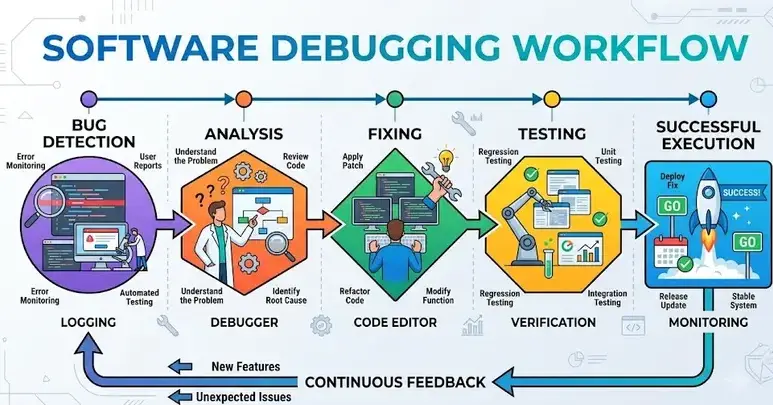
Typical debugging workflow:

  1. Error detection – Identify abnormal behavior during execution
  2. Data collection – Gather logs, stack traces, and execution data
  3. Data analysis – Examine runtime information to locate anomalies
  4. Fault isolation – Identify the specific module or function causing the issue
  5. Error correction – Modify the code to resolve the defect
  6. Testing verification – Confirm that the fix resolves the problem
  7. Documentation – Record debugging findings for future reference

This structured approach is commonly applied in debugging in software testing and large-scale software development.

Which Tools Support Data Analysis for Software Debugging?

Several tools assist developers when performing data analysis for software debugging.

Tool TypeExamplesFunction
Integrated DebuggersVisual Studio Debugger, GDBStep-by-step code execution
Log Analysis ToolsELK Stack, SplunkLog monitoring and pattern detection
Performance ProfilersValgrind, JProfilerResource usage analysis
Python Debugging ToolsPDB, PyCharm DebuggerDebugging Python applications

For example, what is debugging in Python often involves analyzing variable states, execution flow, and exception logs using built-in debugging tools

What Are the Main Types of Debugging Used in Software Engineering?

Different types of debugging use data analysis in distinct ways.

Debugging TypeDescription
Print DebuggingUsing printed outputs to monitor variable values
Remote DebuggingAnalyzing issues in applications running on remote systems
Post-Mortem DebuggingExamining crash reports and memory dumps
Interactive DebuggingUsing breakpoints and step execution
Automated DebuggingTools automatically detect anomalies

These techniques are often discussed alongside debugging tools, debugging process models, and debugging in software engineering frameworks.

Conclusion

Data analysis for software debugging enables developers to systematically identify software defects by examining runtime data, logs, and execution patterns. Applying structured debugging techniques improves fault detection accuracy and reduces development time. When combined with disciplined workflows and established methods—such as those discussed in Best practices for debugging third party dll—data-driven debugging significantly strengthens software reliability and maintainability.

FAQ

What are the 7 debugging steps?

The seven debugging steps are error detection, data collection, analysis, fault isolation, correction, testing verification, and documentation.

What is software debugging?

Software debugging is the process of identifying, analyzing, and correcting defects or errors in computer programs to ensure correct operation.

What are the 7 steps of software testing?

The seven steps include requirement analysis, test planning, test case development, test environment setup, test execution, defect tracking, and test closure.

What is debugging 4 steps?

The four basic debugging steps are identifying the error, locating the fault in the code, correcting the problem, and verifying the fix.

What is debugging in programming?

Debugging in programming is the systematic process of detecting and fixing logical, runtime, or syntax errors in software code.

Sources

https://www.geeksforgeeks.org/software-engineering/software-engineering-debugging

https://www.sonarsource.com/resources/library/debugging

https://www.coursera.org/in/articles/what-is-data-analysis-with-examples

https://www.ranorex.com/blog/what-is-debugging-software-testing

https://link.springer.com/article/10.1007/s11704-019-9176-z

https://www.naukri.com/code360/library/debugging-in-software-engineering

https://www.tricentis.com/learn/debugging

https://www.ibm.com/think/topics/debugging

READ MORE
Uncategorized
Umesh Kumar KhiriMarch 7, 2026 0 Comments
Share article:TwitterFacebookLinkedin
21 Views
4 Likes

Best Practices for Debugging Third Party DLL: 7 Essential Techniques for Reliable Software Troubleshooting

Best practices for debugging third party dll are structured techniques used to analyze errors or unexpected behavior within compiled dynamic link libraries provided by external vendors. Because these libraries typically lack editable source code, developers must rely on debugging tools, symbol files, and runtime inspection methods. Understanding reliable debugging strategies helps developers diagnose integration failures, performance bottlenecks, and compatibility issues across complex software environments.

Key Takeaways

  • Third-party DLL debugging focuses on analyzing compiled libraries without modifying their source code.
  • Visual Studio debugging tools enable runtime inspection and breakpoint analysis.
  • Symbol files significantly improve stack trace accuracy and code visibility.
  • Decompilers such as ILSpy help inspect internal library structures.
  • Proper environment configuration prevents many DLL-related failures.

Why Are Best Practices for Debugging Third Party DLL Important?

Best practices for debugging third party dll are critical because third-party libraries often operate as black-box components. When failures occur, the main application may appear responsible even though the issue originates in the DLL.

Common scenarios include:

  • Runtime exceptions triggered inside the DLL
  • Incorrect API usage between application and library
  • Version incompatibility with dependent frameworks
  • Memory management conflicts

Industry environments such as enterprise .NET systems, embedded software, and financial platforms rely heavily on external libraries. Structured debugging helps isolate the root cause without modifying the vendor code.

What Tools Help Implement Best Practices for Debugging Third Party DLL?

Best practices for debugging third party dll typically rely on professional development tools capable of inspecting compiled assemblies.

ToolPrimary FunctionTypical Use Case
Visual Studio DebuggerRuntime inspection and breakpointsInvestigating DLL calls
ILSpy.NET assembly decompilationReviewing internal logic
WinDbgAdvanced memory and crash analysisDiagnosing runtime faults
Dependency WalkerDependency trackingIdentifying missing DLLs

Developers often analyze call stacks, inspect parameters, and monitor memory usage to identify incorrect interactions with the library.

A related concept often discussed alongside this topic includes DLL decompilers, Visual Studio debugging tools, and methods for opening DLL files in Visual Studio Code.

How Can Visual Studio Be Used to Debug a Third Party DLL?

Best practices for debugging third party dll commonly involve attaching a debugger to the running application in Visual Studio.

Typical workflow:

  1. Enable debugging symbols
    • Load .pdb symbol files if available.
  2. Attach debugger
    • Use Debug → Attach to Process.
  3. Enable external code debugging
    • Activate Just My Code settings to step into external assemblies.
  4. Set breakpoints
    • Break at the method where the DLL is called.
  5. Inspect call stack
    • Identify whether the failure originates inside the DLL.

If symbols are available from the vendor, developers can step directly through the external code.

What Techniques Help Analyze Third Party DLL Behavior?

Best practices for debugging third party dll include structured analysis techniques that reveal how the library behaves at runtime.

Common diagnostic methods

1. Logging integration

  • Capture input parameters sent to the DLL
  • Log return values and exceptions

2. Assembly inspection

  • Use ILSpy or other decompilers to examine compiled code structure.

3. API validation

  • Verify function signatures and data types.

4. Memory monitoring

  • Detect leaks or buffer misuse.

Example diagnostic checklist

  • Confirm correct DLL version
  • Validate platform compatibility (x86 vs x64)
  • Verify configuration settings
  • Inspect dependency chain

These techniques help developers isolate integration errors without modifying third-party code.

How Do Symbol Files Improve DLL Debugging Accuracy?

Best practices for debugging third party dll strongly recommend using symbol files (.PDB) whenever possible.

Symbol files provide:

  • Function names and method mapping
  • Variable information
  • Source file references
  • Accurate stack traces

Without symbols, debugging becomes limited to assembly-level inspection, making root cause analysis significantly more difficult.

Many vendors distribute debugging symbols alongside production libraries to support enterprise troubleshooting.

What Common Mistakes Should Be Avoided When Debugging DLLs?

Best practices for debugging third party dll include avoiding several common diagnostic mistakes.

Frequent errors

  • Ignoring dependency conflicts between DLL versions
  • Debugging without symbol files
  • Assuming application code is always responsible
  • Mixing incompatible runtime frameworks
  • Running mismatched CPU architectures

Correct environment configuration is often the most important step in resolving DLL-related failures.

Conclusion

Best practices for debugging third party dll focus on systematic analysis, specialized tools, and structured runtime inspection to identify problems in external libraries. Techniques such as symbol loading, assembly inspection, and debugger attachment enable developers to diagnose issues without modifying vendor code. In complex enterprise environments, professional .net debugging services often support advanced diagnostics, performance analysis, and integration troubleshooting.

FAQ

Is it possible to debug a DLL?

Yes. A DLL can be debugged by attaching a debugger to the host application and stepping into the library code if symbols or decompiled assemblies are available.

What is the best approach to debugging code?

The best approach involves reproducing the issue, using breakpoints and logs, analyzing call stacks, and isolating the exact function where the failure occurs.

How to debug third party DLL in Visual Studio?

Load debugging symbols if available, attach Visual Studio to the running process, disable “Just My Code,” and inspect the call stack when the DLL method executes.

What tools or techniques do you use for debugging issues?

Common tools include Visual Studio Debugger, ILSpy, WinDbg, logging frameworks, and dependency analysis utilities.

Sources

https://stackoverflow.com/questions/349918/debugging-a-third-party-dll-in-visual-studio
https://blog.yaakov.online/debugging-third-party-code-in-visual-studio/
https://learn.microsoft.com/en-us/windows/win32/dlls/dynamic-link-library-best-practices
https://jackspektor.medium.com/not-just-my-code-how-to-debug-third-party-libraries-without-decompiling-them-8e47e706dbe7
https://blog.novacare.no/so-you-want-to-debug-third-party-dlls/
https://community.intel.com/t5/Intel-Fortran-Compiler/How-to-attach-debugger-to-third-party-EXE-to-test-a-DLL/m-p/815420
https://asawicki.info/news_1777_debugging_third-party_apps_in_visual_studio
https://optics.ansys.com/hc/en-us/articles/42661744928147-How-to-debug-a-DLL-or-EXE
https://michaelscodingspot.com/debug-3rd-party-code-dotnet/

READ MORE
Uncategorized
Umesh Kumar KhiriMarch 7, 2026 0 Comments
Share article:TwitterFacebookLinkedin
18 Views
4 Likes

.NET Debugging Services: 7 Powerful Methods to Diagnose and Fix Application Errors

.NET debugging services are systematic diagnostic procedures used to detect and correct runtime errors, logic faults, and performance issues in software applications built using the .NET framework. These services rely on debugging tools, breakpoints, stack tracing, and memory inspection to identify code-level failures. Why are these services critical? Because production systems depend on stable code execution and rapid issue resolution to prevent downtime and maintain application integrity.

Key Takeaways

  • .NET debugging services diagnose and fix runtime errors in .NET applications and Windows Services.
  • Debugging tools such as Visual Studio and WinDbg enable detailed runtime analysis.
  • Developers often debug services by attaching to running processes or running them in console mode.
  • Structured debugging workflows reduce application downtime and improve system stability.
  • Professional debugging integrates logging, monitoring, and diagnostic analysis.

What Are .NET Debugging Services and How Do They Work?

.NET debugging services involve analyzing application execution to locate faults in compiled code or runtime processes. Developers typically perform debugging using tools such as Visual Studio, runtime diagnostic utilities, and log analyzers.

Common debugging mechanisms include:

  • Breakpoint execution analysis
  • Call stack inspection
  • Variable and memory monitoring
  • Exception tracking
  • Runtime profiling

Typical workflow:

  1. Reproduce the error in a controlled environment
  2. Attach a debugger to the application process
  3. Use breakpoints to pause execution
  4. Inspect variables and stack traces
  5. Identify root cause
  6. Apply code corrections
  7. Re-test the application

These steps ensure that code behaves according to expected functional logic.

How Do Developers Debug Windows Services in .NET?

.NET debugging services are frequently used when diagnosing Windows Services running in the background without a user interface.

Developers often use Visual Studio to attach a debugger to a running service process.

Standard approach

StepAction
1Start the Windows Service
2Open the project in Visual Studio
3Select Attach to Process
4Choose the running service executable
5Set breakpoints and begin debugging

Alternative technique

Developers sometimes modify the service code temporarily to run as a console application during debugging. This method allows easier testing of lifecycle events such as:

  • OnStart()
  • OnStop()
  • OnPause()

What Tools Are Used in Professional .NET Debugging Services?

Professional .NET debugging services rely on specialized debugging environments and diagnostic utilities.

Common debugging tools

ToolPurpose
Visual Studio DebuggerStep-by-step code inspection
WinDbgAdvanced memory and crash analysis
dotnet CLI toolsRuntime diagnostics
Logging frameworksError tracking and event logging

WinDbg is particularly useful when analyzing production crashes or memory leaks in large enterprise systems.

Many teams also combine debugging with monitoring tools and error reporting frameworks to detect problems earlier.

Developers researching this topic often also explore related areas such as debugging web APIs, ASP.NET runtime diagnostics, and microservice error tracing.

How Can Developers Debug a Windows Service Without Installing It?

.NET debugging services allow developers to test Windows Services before installation by running the service logic directly.

Practical method

  1. Move service startup logic into a separate class.
  2. Add conditional code to run the service as a console application.
  3. Launch the project using Visual Studio Debug Mode.
  4. Trigger service methods manually.

Example structure:

if (Environment.UserInteractive)
{
    ServiceLogic.Start();
}
else
{
    ServiceBase.Run(new Service());
}

This technique enables faster development cycles by avoiding repeated installation and uninstallation of services.

How Do .NET Debugging Services Improve Application Reliability?

.NET debugging services play a critical role in maintaining stable enterprise applications.

They help teams:

  • Identify runtime exceptions
  • Detect memory leaks
  • Resolve concurrency issues
  • Analyze performance bottlenecks
  • Prevent production downtime

Industry practices

Organizations typically integrate debugging into development workflows through:

  • Continuous integration testing
  • Structured logging frameworks
  • Crash dump analysis
  • Automated diagnostics

This systematic approach ensures early detection of software defects.

What Are the Key Components of an Effective .NET Debugging Strategy?

Effective .NET debugging services depend on structured troubleshooting and diagnostic practices.

Core components

  • Reproducible test cases
  • Breakpoints and step execution
  • Call stack analysis
  • Memory inspection tools
  • Error logging systems

Diagnostic workflow

  1. Identify the failing component
  2. Reproduce the issue consistently
  3. Analyze stack traces
  4. Inspect application state
  5. Implement code correction
  6. Validate through testing

Following a structured debugging framework reduces error resolution time and improves software stability.

Conclusion

.NET debugging services are essential diagnostic practices that help developers locate, analyze, and resolve faults within .NET applications and background services. Structured debugging workflows, specialized tools, and systematic testing ensure reliable software performance.

These practices also complement related diagnostic approaches such as debugging web services, which focus on identifying faults in distributed and API-based systems.

FAQ

What are the 7 debugging steps?

The common debugging steps are: reproduce the issue, isolate the problem, inspect variables, analyze the call stack, identify root cause, fix the code, and validate the solution.

How to debug a .NET Windows service?

Developers typically start the service, open Visual Studio, attach the debugger to the running service process, set breakpoints, and inspect execution flow.

What is F5 F6 F7 F8 in debugging?

F5 starts debugging, F6 compiles the project, F7 opens the code view, and F8 executes code step-by-step in many development environments.

What are the two types of debugging?

The two primary types are manual debugging using breakpoints and step execution, and automated debugging using diagnostic tools or test frameworks.

Can WinDbg debug .NET services?

Yes. WinDbg can analyze memory dumps, crashes, and runtime behavior in .NET services, particularly in production troubleshooting scenarios.

Sources

https://learn.microsoft.com/en-us/dotnet/framework/windows-services/how-to-debug-windows-service-applications
https://stackoverflow.com/questions/761120/how-to-debug-a-windows-service-using-breakpoints
https://www.telerik.com/blogs/aspnet-core-basics-debugging-visual-studio
https://github.com/dotnet/vscode-csharp/wiki/Troubleshoot-loading-the-.NET-Debug-Services
https://developercommunity.visualstudio.com/t/Net-debugging-services-ran-Out-of-Memor/10613661?sort=newest&topics=visual
https://www.ni.com/docs/en-US/bundle/labview/page/testing-and-debugging-a-web-service-on-the-application-web-server-real-time-windows.html?srsltid=AfmBOoqZI_NP2Hg9zzLhPDQMiQl7twwz-xWcOiz_vyRLNTHU7DAJdU6S
https://www.c-sharpcorner.com/article/debugging-windows-services-in-C-Sharp-and-net/
https://www.vbforums.com/showthread.php?905503-Debugging-a-service

READ MORE
Uncategorized
Umesh Kumar KhiriMarch 6, 2026 0 Comments
Share article:TwitterFacebookLinkedin
22 Views
4 Likes

Debugging Web Services: 7 Essential Methods for Reliable API Performance

Debugging web services refers to the process of detecting, analyzing, and resolving errors that occur when applications communicate through APIs or service endpoints. It involves examining request–response cycles, server logs, authentication flows, and network interactions. Proper debugging ensures web services function correctly across distributed systems and prevents failures that may affect application performance or data integrity.

Key Takeaways

  • Debugging web services identifies and resolves API communication errors.
  • The process involves analyzing requests, responses, and server logs.
  • Tools like Postman, Visual Studio, and network analyzers support troubleshooting.
  • Structured debugging steps help isolate and fix service failures efficiently.
  • Effective debugging improves system reliability and integration performance.

What Is Debugging Web Services and Why Is It Important?

Debugging web services focuses on identifying faults in API communication between applications. These issues often occur during request processing, data serialization, authentication, or network transmission.

Common debugging targets include:

  • API endpoint failures
  • Invalid request parameters
  • Authentication or authorization errors
  • Timeout or network connectivity problems
  • Data format inconsistencies (JSON or XML)

Typical debugging workflow:

StageDescription
DetectionIdentify service errors or unexpected responses
IsolationDetermine which endpoint or component caused the issue
AnalysisExamine logs, stack traces, or request payloads
ResolutionModify code or configuration
ValidationTest the corrected service

Without systematic debugging, service integrations may produce unstable or inconsistent application behavior.

How Does Debugging Web Services Work in Practice?

Debugging web services works by inspecting the communication flow between a client application and a service endpoint.

Key diagnostic techniques include:

1. Request Inspection

  • Analyze HTTP methods (GET, POST, PUT, DELETE)
  • Verify headers, parameters, and authentication tokens

2. Response Analysis

  • Check status codes (200, 404, 500)
  • Validate response body format

3. Log Monitoring

  • Server logs reveal execution errors and exceptions

4. Breakpoint Debugging

  • Developers pause execution within service logic

Example debugging scenario:

IssueDebugging Action
401 UnauthorizedVerify authentication tokens
500 Internal Server ErrorInspect server stack trace
Timeout errorEvaluate network latency or service load

Which Tools Are Commonly Used for Debugging Web Services?

Developers rely on specialized tools that capture and analyze service communication.

Common debugging tools include:

API Testing Tools

  • Postman
  • SoapUI
  • Insomnia

Development Environment Debuggers

  • Visual Studio debugging tools
  • Eclipse debugging utilities
  • IntelliJ IDEA debugger

Network Monitoring Tools

  • Wireshark
  • Fiddler
  • Browser developer tools

For example, Visual Studio debugging web services allows developers to set breakpoints in API controllers and inspect variables during runtime.

Many developers studying what is debugging in programming, the debugging process, or debugging examples encounter these tools when learning how to do debugging effectively.

What Are the Most Common Web Service Errors?

Web service failures usually originate from configuration mistakes, code defects, or infrastructure limitations.

Typical error categories include:

Error TypeDescription
Authentication FailureInvalid API keys or tokens
Data Format ErrorIncorrect JSON or XML structure
Endpoint MisconfigurationIncorrect service URL
Network FailureDNS or connectivity problems
Server ExceptionApplication logic error

Example:

HTTP 500 Internal Server Error

This response usually indicates a server-side exception that must be traced using logs or a debugger.

What Are the Standard Steps for Debugging Web Services?

Industry debugging practices follow a structured sequence to prevent incomplete troubleshooting.

Seven common debugging steps:

  1. Reproduce the error consistently
  2. Inspect API requests and responses
  3. Check service logs and error messages
  4. Use breakpoints in service code
  5. Validate configuration settings
  6. Apply fixes and run integration tests
  7. Confirm the issue no longer occurs

This structured debugging process improves reliability in distributed service environments.

How Can Developers Improve Web Service Debugging Efficiency?

Efficient debugging requires disciplined testing and monitoring strategies.

Recommended practices:

  • Implement detailed logging for service endpoints
  • Use automated API testing tools
  • Validate input parameters before processing
  • Monitor API performance metrics
  • Maintain versioned API documentation

Some related topics commonly explored alongside this subject include debugging tools, debugging examples, what is debugging in C, and how to learn debugging when studying broader software troubleshooting practices.

Conclusion

Debugging web services is a structured diagnostic practice that ensures reliable communication between distributed applications. By combining logging, debugging tools, and standardized testing steps, developers can isolate faults and maintain stable API integrations.

Understanding these practices also complements broader software troubleshooting topics, including What are professional software debugging services, which examine structured debugging support within professional development environments.

FAQ

How to debug a web service?

Debug a web service by inspecting API requests, analyzing server logs, setting breakpoints in code, and validating service responses.

Which IDE is best for debugging?

Popular IDEs for debugging include Visual Studio, IntelliJ IDEA, and Eclipse because they support breakpoints, variable inspection, and step execution.

What are the 7 debugging steps?

The seven debugging steps are reproducing the error, inspecting requests, checking logs, setting breakpoints, validating configuration, applying fixes, and verifying results.

What is debugging in web technology?

Debugging in web technology is the process of identifying and fixing issues in web applications, APIs, and server communication layers.

What is debugging in programming?

Debugging in programming is the systematic identification and correction of errors in software code that cause incorrect behavior or failures.

Sources

https://aws.amazon.com/what-is/debugging/
https://www.ibm.com/docs/en/imdm/11.6.0?topic=services-debugging-web
https://stackoverflow.com/questions/12581932/how-to-debug-web-service
https://download.oracle.com/otn_hosted_doc/jdeveloper/1012/web_services/deb_wsabout.html
https://yupingohanga.medium.com/starting-the-debugger-for-web-services-in-node-52a294e6d99c
https://www.ni.com/docs/en-US/bundle/labview/page/testing-and-debugging-a-web-service-on-the-application-web-server-real-time-windows.html?srsltid=AfmBOoouhCGSYkK13g96B0wQ5KnCGHmw-fsSIW-SHoa1D3E_6Yx8-y6v
https://arquiconsult.com/en/debug-attach/
https://mybusinesscentraldiary.wordpress.com/2020/04/25/debugging-web-services-in-saas/
https://techdocs.audiocodes.com/session-border-controller-sbc/mp-1288/user-manual/version-740/Content/UM/Debugging%20Web%20Services.htm

READ MORE
Uncategorized
Umesh Kumar KhiriMarch 6, 2026 0 Comments
Share article:TwitterFacebookLinkedin
22 Views
4 Likes

What Are Professional Software Debugging Services: 7 Essential Capabilities Explained

What are professional software debugging services? Professional software debugging services are specialized technical solutions used to identify, diagnose, and fix defects or logical errors in software applications. These services are commonly provided by experienced developers or engineering teams to maintain application stability, security, and performance. By systematically analyzing code behavior and runtime conditions, debugging services help organizations reduce downtime, prevent software failures, and ensure reliable digital systems.

Key Takeaways

  • Professional software debugging services identify and fix defects in software systems.
  • These services involve structured processes such as error detection, isolation, and validation.
  • Static and dynamic debugging are the two primary methods used in development.
  • Specialized debugging tools support multiple programming languages and environments.
  • Effective debugging improves reliability, security, and software performance.

What Are Professional Software Debugging Services and How Do They Work?

Professional software debugging services involve systematic processes used to locate and resolve defects in source code or application behavior. These services rely on diagnostic tools, testing environments, and experienced engineers.

Typical debugging activities include:

  • Code inspection: Reviewing source code to identify logical errors
  • Runtime analysis: Monitoring software behavior during execution
  • Error replication: Reproducing bugs in controlled environments
  • Patch development: Creating code fixes to remove defects
  • Regression testing: Ensuring fixes do not introduce new issues

Example workflow:

StepActivityPurpose
1Error detectionIdentify abnormal behavior
2Bug isolationLocate the exact source of the defect
3Code correctionModify logic or structure
4ValidationTest the solution
5DeploymentApply the fix to production systems

Industries such as fintech, healthcare software, and enterprise SaaS rely on these services to maintain system integrity.

Why Are Professional Software Debugging Services Important in Programming?

Professional software debugging services play a critical role in maintaining functional and secure applications.

Key reasons they are essential include:

  • Improving software reliability: Removing defects prevents crashes or malfunction
  • Enhancing security: Debugging identifies vulnerabilities that attackers could exploit
  • Maintaining performance: Resolving inefficient code improves execution speed
  • Supporting compliance: Software systems must meet technical standards in regulated sectors

For example, financial software platforms require stable transaction processing systems where debugging ensures accuracy and prevents operational disruptions.

What Types of Professional Software Debugging Services Exist?

Professional debugging services are typically categorized based on how errors are analyzed.

1. Static Debugging

  • Analysis performed without executing the program
  • Focuses on code reviews and automated analysis tools

2. Dynamic Debugging

  • Performed during program execution
  • Observes runtime behavior and memory usage

Additional debugging approaches include:

  • Remote debugging: Engineers troubleshoot software running on external servers
  • Post-mortem debugging: Analysis performed after system crashes
  • Performance debugging: Identifies inefficiencies affecting speed or scalability

These methods help engineers diagnose complex system failures in distributed or cloud-based environments.

What Tools Are Used in Professional Software Debugging Services?

Professional debugging services rely on specialized development tools and environments.

Common debugging tools include:

ToolPrimary Use
GDB (GNU Debugger)Debugging C and C++ programs
Visual Studio DebuggerIntegrated debugging for .NET and Windows applications
PyCharm DebuggerPython application debugging
Chrome DevToolsDebugging JavaScript in web applications
LLDBLow-level debugging for compiled languages

Many organizations also integrate debugging tools with automated testing pipelines to detect issues early in development.

How Do Professional Software Debugging Services Apply to Programming Languages?

Professional software debugging services are used across multiple programming languages and development environments.

Examples include:

Debugging in Python

  • Tools such as pdb allow step-by-step code execution
  • Developers inspect variables and program flow

Debugging in web development

  • JavaScript debugging with browser developer tools
  • Identifying DOM errors or asynchronous issues

Debugging in enterprise systems

  • Monitoring distributed microservices
  • Analyzing API failures and server logs

Many readers exploring debugging services also review related concepts such as debugging software tools, debugging in programming examples, and different types of debugging methods used in development environments.

What Examples Illustrate Professional Software Debugging Services?

Professional debugging services can be applied in many technical scenarios.

Examples include:

  • E-commerce platform bug fix: Resolving checkout calculation errors
  • Mobile app crash analysis: Identifying memory leaks in Android applications
  • Cloud infrastructure troubleshooting: Diagnosing API failures in microservices
  • Database debugging: Fixing slow query execution affecting system performance

These services often combine automated testing, logging systems, and manual engineering expertise to resolve issues efficiently.

Conclusion

Professional software debugging services provide structured methods for detecting and correcting errors in software systems, ensuring reliable operation across industries. By applying systematic analysis techniques and specialized tools, organizations maintain application quality and operational stability. For a deeper understanding of provider selection criteria, review “How to choose a debugging service provider.”

FAQ

What are the two types of debugging?

The two main types are static debugging, which analyzes code without running it, and dynamic debugging, which examines software during execution.

What is software debugging?

Software debugging is the process of identifying, analyzing, and fixing errors or defects in computer programs.

Which software is used for debugging?

Common debugging software includes GDB, Visual Studio Debugger, PyCharm Debugger, Chrome DevTools, and LLDB.

What are the 7 debugging steps?

Common debugging software includes GDB, Visual Studio Debugger, PyCharm Debugger, Chrome DevTools, and LLDB.

Why is debugging important in programming?

Debugging ensures software functions correctly, prevents system crashes, improves performance, and reduces security risks.

Sources

https://www.sonarsource.com/resources/library/debugging/
https://www.theknowledgeacademy.com/blog/what-is-debugging/
https://www.ibm.com/think/topics/debugging
https://www.coursera.org/in/articles/what-is-debugging
https://www.linkedin.com/pulse/what-debugging-software-uses-how-works-svvbe/
https://www.globedetective.com/tscm-services/
https://aws.amazon.com/what-is/debugging/
https://jetruby.com/blog/debugging-in-software-development-process/
https://www.disher.com/blog/software-debugging-strategies/
https://www.janbasktraining.com/blog/debugging-guide-importance-challenges-strategies/

READ MORE
  • 1
  • 2
  • 3

Recent Posts

  • ai app development company in chicago: 7 Essential Factors for Smart Selection
  • ai app development agency in los angeles: 7 Essential Factors to Choose the Best Partner
  • ai app development agency in california: 7 Essential Facts for Choosing the Right Partner
  • ai app developers in india: 7 Proven Insights to Choose the Right Partner
  • ai & ml app development company in india: 7 Essential Insights for Choosing the Right Partner

Recent Comments

  1. Fred Hyman on Yellow Cap
  2. Fred Hyman on T-Shirt Full Hand
  3. Fred Hyman on Yellow Cap
  4. Randal Gray on Black T-Shirt
  5. John Harris on Black T-Shirt

Archives

  • April 2026
  • March 2026

Categories

  • Uncategorized
Recent Posts
  • ai app development company in chicago: 7 Essential Factors for Smart Selection
    ai app development company in chicago: 7 Essential Factors for Smart Selection
    April 15, 2026
  • ai app development agency in los angeles: 7 Essential Factors to Choose the Best Partner
    ai app development agency in los angeles: 7 Essential Factors to Choose the Best Partner
    April 15, 2026
  • ai app development agency in california: 7 Essential Facts for Choosing the Right Partner
    ai app development agency in california: 7 Essential Facts for Choosing the Right Partner
    April 15, 2026
Categories
  • Uncategorized27
logotype

1-844-2-THEOWL (1-844-284-3695)‬

info@rceenetworks.com

3010 LBJ Freeway, Suite 1200, Dallas, Texas 75234

Menu

HomeServices

ProductsBlog

Contact

Other Links

RetinaWiseAI™Privacy PolicyContent PolicyTerms & Conditions

Social Links

TwitterFacebookInstagramLinkedin

Copyright © 2026 RCEENetworks LLC. All Rights Reserved