How to improve embedded software debugging refers to the process of enhancing methods, tools, and workflows used to detect, analyze, and resolve faults in embedded applications. Embedded systems often operate under strict resource, timing, and reliability constraints, making debugging more complex than conventional software development. Understanding proven debugging techniques helps engineers reduce development risks and improve product quality.
Key Takeaways
- Embedded debugging addresses both software and hardware faults.
- Structured debugging workflows improve fault isolation.
- JTAG remains a fundamental debugging interface.
- STM32 and microprocessor tools provide advanced tracing capabilities.
- Verification activities should accompany debugging throughout development.
- Industry standards help ensure reliability and safety.
- Continuous testing reduces defects before deployment.
What Is Debugging in Software Development and Embedded Systems?
How to improve embedded software debugging starts with understanding the role of debugging within embedded development.
Debugging is the systematic process of locating, analyzing, and correcting software or hardware faults that cause unexpected behavior.
In embedded systems, debugging commonly involves:
- Firmware analysis
- Real-time execution monitoring
- Hardware interface validation
- Memory and timing verification
- Peripheral communication testing
| Software Development | Embedded Systems |
| Focuses on application logic | Focuses on software and hardware interaction |
| Runs on general-purpose systems | Runs on dedicated hardware |
| Easier runtime visibility | Limited runtime visibility |
| Standard debugging tools | Specialized debugging interfaces |
Many engineers also explore related topics such as embedded debugging tools, hardware debugging, JTAG, and debugging embedded systems when building troubleshooting expertise.
Why Is Embedded Software Debugging Important?
How to improve embedded software debugging requires understanding its impact on system reliability and safety.
Effective debugging helps:
- Prevent system crashes
- Reduce development costs
- Improve product reliability
- Ensure compliance with industry standards
- Accelerate product releases
Industries that rely heavily on robust debugging include:
- Automotive electronics
- Medical devices
- Industrial automation
- Aerospace systems
- Consumer electronics
Standards frequently associated with verification and debugging include:
- ISO 26262 (Automotive)
- IEC 61508 (Functional Safety)
- DO-178C (Aerospace Software)
- IEC 62304 (Medical Device Software)
Hardware and Software Debugging Techniques for Embedded Systems
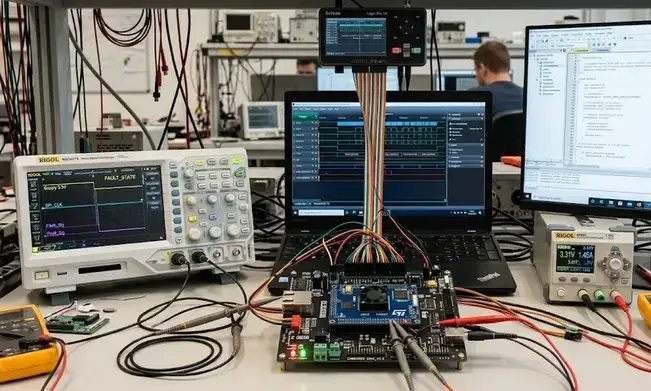
How to improve embedded software debugging depends on combining hardware and software investigation techniques.
Common techniques include:
Hardware Techniques
- Oscilloscope analysis
- Logic analyzer inspection
- Signal tracing
- Power integrity testing
- Hardware breakpoint usage
Software Techniques
- Source-level debugging
- Runtime logging
- Trace analysis
- Memory monitoring
- Unit testing
A structured workflow typically follows:
- Reproduce the fault.
- Isolate the affected subsystem.
- Collect diagnostic data.
- Identify root causes.
- Verify the correction.
- Perform regression testing.
JTAG Debugging Software for Embedded Systems
JTAG remains one of the most widely used interfaces for embedded debugging.
Benefits of JTAG debugging include:
- Real-time processor control
- Breakpoint management
- Register inspection
- Memory examination
- Flash programming support
Typical use cases:
| Application | Benefit |
| Firmware debugging | Step-by-step execution |
| Bootloader validation | Startup diagnostics |
| Hardware bring-up | Early-stage troubleshooting |
| Production testing | Fault verification |
How Can STM32 and Microprocessor Software Debugging Tools Improve Results?
How to improve embedded software debugging often depends on selecting appropriate debugging tools.
Popular STM32 and microprocessor debugging solutions provide:
- Real-time tracing
- Peripheral monitoring
- Memory visualization
- Performance profiling
Examples include:
- STM32CubeIDE debugger
- GDB-based debuggers
- SEGGER J-Link
- Lauterbach Trace32
- OpenOCD
When working with C++, developers should also:
- Enable compiler warnings
- Use static analysis tools
- Monitor stack usage
- Detect memory leaks
- Review exception handling behavior
For teams seeking documentation, many organizations maintain an internal how to improve embedded software debugging PDF guide that standardizes troubleshooting procedures and reporting formats.
What Are the Best Embedded Software Verification and Debugging Practices?
How to improve embedded software debugging becomes more effective when verification is integrated throughout development.
Recommended best practices include:
Code-Level Practices
- Conduct peer reviews
- Follow coding standards
- Implement unit testing
- Use static code analysis
System-Level Practices
- Hardware-in-the-loop testing
- Integration testing
- Continuous validation
- Regression testing
Monitoring Practices
- Event logging
- Performance measurement
- Fault injection testing
- Trace-based diagnostics
These practices help identify defects before deployment and improve long-term maintainability.
Conclusion
Improving embedded software debugging requires a structured combination of hardware analysis, software tools, verification methods, and disciplined engineering practices. Organizations that establish repeatable debugging workflows, leverage interfaces such as JTAG, and apply verification standards consistently are better positioned to deliver reliable embedded products.
These same principles are also valuable when evaluating software releases that often need debugging, where early fault detection and systematic validation can significantly reduce operational risks.
FAQ
How can I improve my debugging skills?
Practice systematic root-cause analysis, learn debugging tools thoroughly, and review real-world failure cases to improve troubleshooting efficiency.
How to improve embedded skills?
Debug an embedded system by reproducing the issue, collecting diagnostic information, isolating the fault, analyzing hardware and software interactions, and validating the fix.
How to improve embedded skills?
Develop expertise in microcontrollers, embedded C/C++, real-time operating systems, communication protocols, and hardware debugging tools through practical projects.
What are the debugging tools for embedded systems?
Common tools include JTAG debuggers, oscilloscopes, logic analyzers, trace analyzers, GDB, STM32CubeIDE, SEGGER J-Link, and Lauterbach Trace32.
What is the role of JTAG in embedded debugging?
JTAG provides low-level access to processors for breakpoints, memory inspection, register analysis, and firmware troubleshooting.
Sources
- https://www.meegle.com/en_us/topics/debugging/debugging-in-embedded-systems
- https://cranesvarsity.com/how-to-debug-embedded-systems-tools-and-techniques-for-firmware-developers/
- https://www.maven-silicon.com/blog/debugging-techniques-for-embedded-systems/
- https://www.reddit.com/r/embedded/comments/nztmn3/any_embedded_software_debugging_tips_and_tricks/
- https://www.isystem.com/media/news-insights/posts/what-debugging-methods-are-used-to-make-embedded-software-safer.html
- https://www.embedded.com/the-ten-secrets-of-embedded-debugging/
- https://www.beningo.com/5-tips-for-improving-embedded-development-in-2020/
- https://promwad.com/news/top-debugging-tools-embedded-systems-2025
- https://iies.in/blog/how-to-debug-embedded-systems-effectively/