
Medical imaging software development services help healthcare providers improve diagnostic accuracy, streamline workflows, and manage medical images efficiently. These solutions support radiologists, clinicians, and hospitals in interpreting complex medical images. They also help healthcare organisations manage growing imaging data while maintaining security and interoperability.
With advancements in artificial intelligence (AI), custom solutions can address specific clinical requirements and support data-driven healthcare decisions.
Table of Contents
What Are Medical Imaging Software Development Services?
Medical imaging software development services consist of developing applications that perform processes on medical images. Such software is used by healthcare professionals for capturing, storing, analyzing, and distributing diagnostic images.
Typical imaging procedures consist of magnetic resonance imaging (MRI), computed tomography (CT), ultrasound, mammography, and X-ray scanning. Based on the specific needs of healthcare providers, the software might provide advanced visualization features, image analysis, and even report generation.
Software development services may include custom-built imaging systems, artificial intelligence-enabled diagnostic solutions, and cloud-based image management systems.
Key Features of Medical Imaging Software Development Services
Medical imaging applications require specialised features to support clinical workflows and image management.
| Feature | Description |
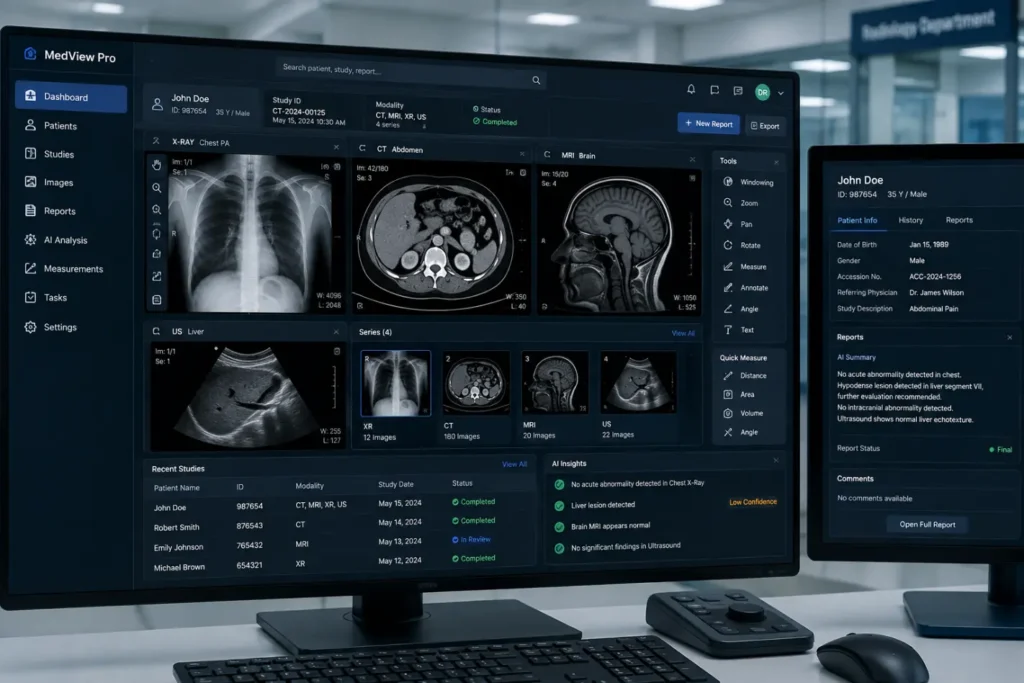
| Image visualisation | Displays medical images with zooming, panning, and measurement tools. |
| AI-powered analysis | Helps identify patterns and abnormalities in medical images. |
| DICOM compatibility | Supports standardised storage, transmission, and retrieval of medical images. |
| PACS integration | Enables centralised storage and access to diagnostic images. |
| 3D reconstruction | Converts image data into three-dimensional visualisations. |
| Image annotation | Allows clinicians to mark regions and add diagnostic notes. |
| Reporting tools | Helps create, manage, and share imaging reports. |
| Data security | Protects sensitive patient information through access controls and encryption. |
Types of Medical Imaging Software Development Services
Different imaging applications address specific diagnostic and operational requirements.
1. Picture Archiving and Communication Systems (PACS)
PACS solutions store, retrieve, and distribute medical images digitally. They allow authorised healthcare professionals to access imaging studies across departments and facilities.
2. Radiology Information Systems (RIS)
RIS applications manage radiology workflows, including patient scheduling, examination tracking, reporting, and billing. Integrating RIS with PACS can reduce administrative duplication.
3. AI-Powered Image Analysis Software
AI-based applications analyse medical images to identify patterns, highlight suspicious regions, and support clinical assessments. Their performance depends on validated models, image quality, and intended clinical use.
4. Medical Image Processing Software
Image processing applications enhance, reconstruct, segment, and measure medical images. They can help clinicians examine anatomical structures and prepare images for further analysis.
5. Cloud-Based Medical Imaging Platforms
Cloud-based platforms support remote image access, centralised storage, and collaboration between healthcare facilities.
Benefits of Medical Imaging Software Development Services
Imaging software customized for particular institutions can be used to solve clinical and operational problems in healthcare organizations.
1. Streamlining Diagnosis
Automation of image processing and visualizations will decrease repetitive tasks performed manually by radiologists when analyzing the results of imaging studies.
2. Increased Availability of Images
The centralization of the image platform will provide easy access to images by authorized personnel from all departments. Remote access will also be helpful in collaborative work between specialists from various places.
3. Efficient Handling of Information
Medical imaging software assists in organizing vast amounts of diagnostic information. PACS and cloud-based options will facilitate the process of storing and sharing the images.
4. Facilitating Collaboration
Integrated platforms will provide possibilities to share images and reports between radiologists and physicians.
5. Advanced Analysis of Images
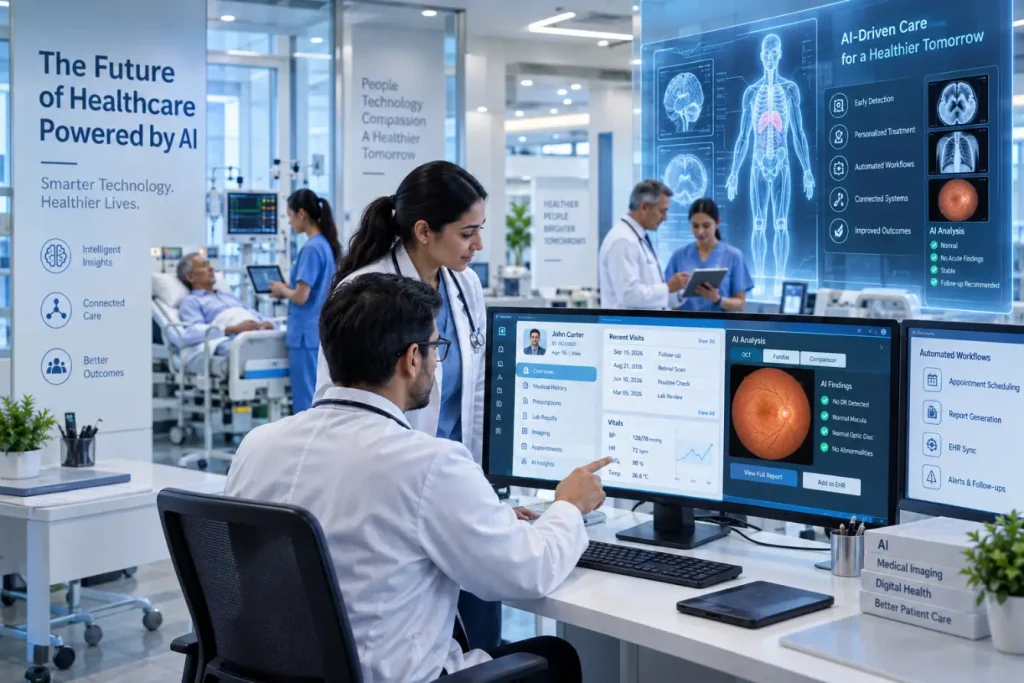
The use of artificial intelligence in image analysis can point out suspicious areas and quantify image findings. These options can assist in clinical diagnostics, but cannot substitute for medical judgment.
Technologies Used in Medical Imaging Software
Modern imaging applications use multiple technologies to achieve good performance, interoperability, and clinical capabilities.
- AI and machine learning: Used for image classification, segmentation, detection, and quantitative analysis.
- Cloud computing: Allows scalable storage and remote access and processing of images.
- 3D visualisation: Used for anatomical models, image reconstruction, and surgery planning.
- DICOM and DICOMweb: Allows standardised exchange of medical images and access via the web.
- HL7 and FHIR: Allows the exchange of clinical data between imaging applications and other healthcare IT systems.
Challenges
There are various challenges related to developing medical imaging applications.
- Large medical images: Large, high-resolution images need significant storage space and processing of images.
- Interoperability of system: It is difficult to make an imaging application work seamlessly with the existing PACS, RIS, and EHR systems.
- Medical information security: Private and sensitive information needs protection using data encryption and other methods.
- Image loading time and system reliability: Slow loading and system interruptions are unacceptable in this scenario.
How to Choose a Medical Imaging Software Development Company
Selecting a development partner requires evaluating its technical capabilities and understanding of healthcare workflows.
- Healthcare experience: Review its experience developing PACS, DICOM viewers, image analysis tools, and other clinical applications.
- Technical expertise: Check its knowledge of medical image processing, AI, cloud infrastructure, and healthcare interoperability standards.
- Security practices: Assess its approach to encryption, authentication, data protection, and security testing.
- Regulatory knowledge: Ensure the team understands applicable medical device regulations and software quality requirements.
Future Trends
Medical imaging software development services continue to evolve with advances in computing and healthcare automation.
- Generative AI: Emerging applications may assist with image reconstruction, reporting, and synthetic data generation, subject to clinical validation.
- Advanced 3D visualisation: Improved anatomical modelling can support surgical planning, education, and image-guided procedures.
- Automated workflows: Intelligent prioritisation and image processing may help reduce repetitive radiology tasks.
- Precision medicine: Quantitative imaging and radiomics may provide additional information for personalised treatment planning.
Conclusion
Medical imaging software development services support modern diagnostic workflows through advanced image processing, secure data management, and improved interoperability. Custom solutions can address the specific requirements of hospitals and diagnostic centres.
Choosing suitable technologies, prioritising security, and planning for regulatory requirements are essential for successful implementation. With appropriate clinical validation, these solutions can support informed healthcare decisions.
Frequently Asked Questions
1. What are medical imaging software development services used for?
Medical imaging software helps healthcare professionals view, process, analyse, store, and share diagnostic images.
2. How much does medical imaging software development cost?
Costs vary according to software complexity, integrations, AI features, security requirements, and regulatory needs.
3. How long does it take to develop medical imaging software?
Development timelines depend on project scope, technical complexity, integrations, and clinical validation requirements.
4. Can AI be integrated into existing medical imaging software?
Yes, AI can often be integrated into existing imaging platforms, subject to technical compatibility and regulatory requirements.
Also Read: Medical Imaging Displays and Post Processing Market
Pingback: Most Popular Medical Software: 7 Types