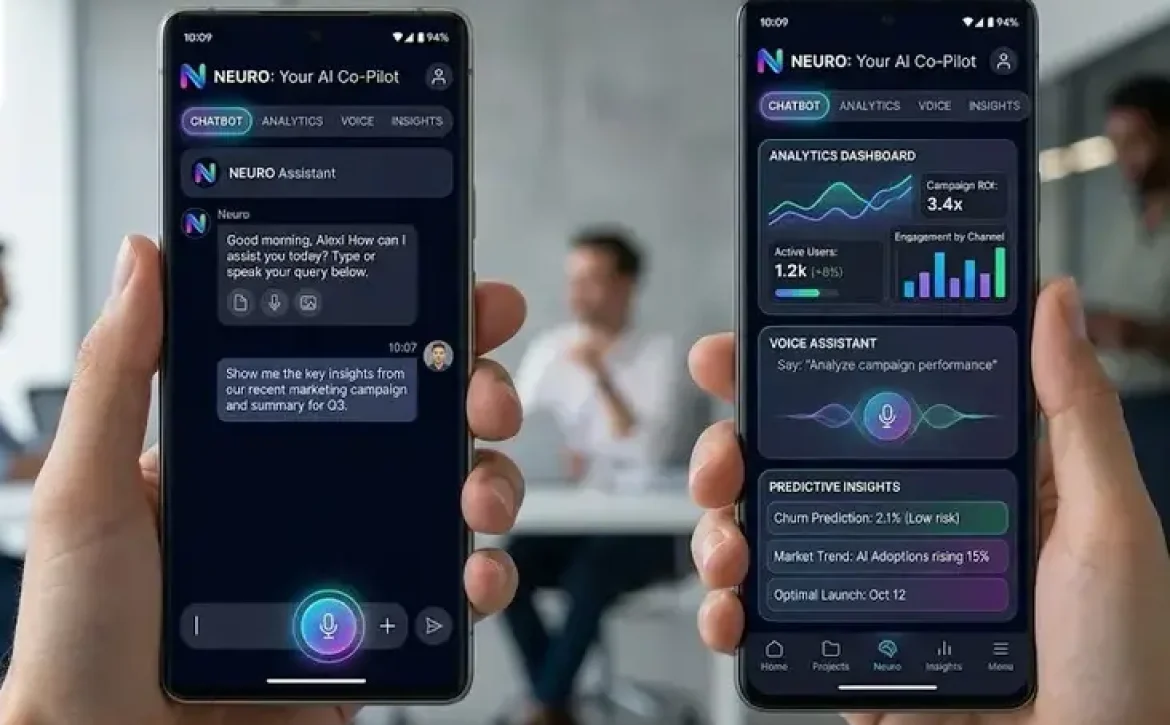
How to use AI in mobile app development refers to AI in mobile app development is the process of integrating predictive models, machine learning, and NLP into applications to enable smart behavior. It empowers apps to analyze information, automate tasks, and enhance user interaction in real time. What practical steps are needed for implementation?
Key Takeaways
- How to use AI in mobile app development follows a structured lifecycle
- Data quality and model selection are critical success factors
- Tools like TensorFlow Lite and Core ML enable mobile integration
- Use cases include personalization, automation, and prediction
- Performance optimization ensures scalability and efficiency
What steps and components are involved in practically using AI in mobile app development?
How to use AI in mobile app development begins with aligning business goals to intelligent features.
Core components include:
- Data pipelines: Collection, cleaning, and labeling
- Model selection: Supervised, unsupervised, or deep learning
- Integration layers: APIs, SDKs, or on-device models
- Continuous monitoring: Performance and bias checks
Example:
A banking app uses fraud detection models to flag abnormal transactions based on user behavior patterns.
How do you integrate AI into mobile app development step by step?
AI integration in mobile app development is carried out through a structured and sequential lifecycle.
- Define use case (e.g., recommendation engine)
- Collect and prepare data (user activity, logs)
- Choose tools and frameworks (TensorFlow Lite, Core ML)
- Train and validate models
- Integrate into app backend or device
- Test for accuracy and latency
- Deploy and monitor performance
Industry practice:
Retail apps use recommendation engines to increase conversions through personalized suggestions.
What technologies are used for AI in mobile app development?
How to use AI in mobile app development is determined by the selection of suitable tools.
| Category | Tools/Frameworks | Use Case |
| ML frameworks | TensorFlow Lite, PyTorch | Model deployment |
| NLP tools | Dialogflow, spaCy | Chatbots, voice assistants |
| Cloud platforms | AWS AI, Google AI | Scalable processing |
| On-device AI | Core ML, ML Kit | Offline intelligence |
Example:
Voice assistants in apps rely on NLP tools for speech recognition and intent detection.

How is AI commonly used in mobile app development?
Applying AI in mobile app development results in several practical and widely used applications.
- Personalization: Content recommendations (streaming apps)
- Image recognition: Face unlock, object detection
- Predictive analytics: Sales forecasting, health monitoring
- Automation: Chatbots for customer support
A mobile app often overlaps with interests such as AI-powered app features, machine learning tools for developers, and intelligent user experience design.
What obstacles come with using AI in mobile app development?
Applying AI in mobile app development involves challenges in both system design and legal requirements.
- Data privacy compliance: GDPR, HIPAA requirements
- Model accuracy: Bias and overfitting risks
- Performance constraints: Battery and latency issues
- Integration complexity: Compatibility with legacy systems
Best practice:
Use on-device processing for sensitive data to improve privacy and reduce latency
How to optimize performance when using AI in mobile apps?
Optimizing performance is crucial for successfully using AI in mobile app development.
- Model compression: Reduce size for mobile deployment
- Edge computing: Process data locally
- Efficient APIs: Minimize server calls
- Regular updates: Retrain models with new data
Example:
Fitness apps optimize models to track activity in real time without draining battery life.
Conclusion
How to use AI in mobile app development requires structured implementation, from data preparation to deployment and monitoring. Organizations that follow this framework can build scalable, adaptive applications. For foundational understanding, refer to what is ai in mobile app development, which explains the core concepts behind these implementations.
FAQs
Can I develop a mobile app using AI?
Yes, developers can integrate AI using frameworks, APIs, and pre-trained models to add intelligent features.
How is AI used in mobile apps?
AI is used for personalization, automation, prediction, and recognition tasks within apps.
What are 7 types of AI?
Reactive systems, limited memory frameworks, theory of mind intelligence, self-aware AI, narrow AI, general AI, and advanced super AI.
What is the 10 20 70 rule for AI?
It suggests 10% algorithms, 20% data infrastructure, and 70% business process integration for successful AI adoption.
Do mobile apps require cloud AI?
Not always; many apps use on-device AI for faster processing and improved privacy.
Sources
https://ripenapps.com/blog/ai-in-mobile-app-development-explanation-examples-benefits/
https://objects.ws/blog/ai-in-mobile-apps/
https://velvetech.com/blog/ai-in-mobile-app-development/
https://smtlabs.io/blog/ai-in-mobile-app-development
https://www.alignminds.com/ai-is-transforming-mobile-app-development/
https://www.spaceotechnologies.com/blog/artificial-intelligence-in-mobile-app-development/
https://dreamertechnoland.com/how-ai-is-transforming-android-app-development/
https://softwaremind.com/blog/how-to-use-ai-in-mobile-app-development/
https://webandcrafts.com/blog/ai-in-mobile-app-development