AI integration in enterprise app development alternatives is the process of incorporating intelligent functionalities into enterprise applications using varied frameworks, platforms, or architectures instead of a single standardized approach. These alternatives are essential because enterprises differ in infrastructure, data sensitivity, and operational scale. How can organizations select the most suitable integration path while maintaining compliance and performance?
Key Takeaways
- AI integration alternatives include cloud, on-premise, hybrid, edge, and API-based models
- Security and compliance drive architecture decisions in enterprises
- Low-code platforms simplify and accelerate implementation
- API-based integration enables modular and cost-effective deployment
- Hybrid models are increasingly preferred for balancing flexibility and control
What are the main AI integration in enterprise app development alternatives?
AI integration in enterprise app development alternatives can be categorized into several structured approaches based on deployment and architecture:
| Alternative Type | Description | Example Use Case |
| Cloud-based AI | Uses third-party cloud services | Chatbots, analytics dashboards |
| On-premise AI | Hosted within enterprise infrastructure | Banking fraud detection |
| Hybrid AI | Combines cloud and local processing | Healthcare data systems |
| Edge AI | Processes data on local devices | IoT-based monitoring |
| API-based AI | Integrates pre-built AI services via APIs | NLP-based customer support |
These classifications allow enterprises to align integration with security and scalability needs.
How do cloud and on-premise alternatives differ in enterprise applications?
AI integration in enterprise app development alternatives often involves choosing between cloud and on-premise models:
Cloud-based approach:
- Scalable and cost-efficient
- Faster deployment
- Dependent on internet connectivity
On-premise approach:
- Greater data control and privacy
- Higher upfront infrastructure cost
- Suitable for regulated industries
Industry practice shows finance and healthcare prefer on-premise or hybrid models due to strict compliance requirements such as GDPR and HIPAA-like frameworks.
What role do low-code and no-code platforms play in AI integration alternatives?
AI integration in enterprise app development alternatives increasingly includes low-code and no-code platforms to simplify development:
Key benefits:
- Reduced development time
- Minimal coding expertise required
- Built-in AI modules (prediction, automation)
Examples of usage:
- Workflow automation systems
- CRM customization
- Internal enterprise dashboards
These platforms enable faster experimentation without extensive engineering resources
How do API-based AI services function as an alternative?
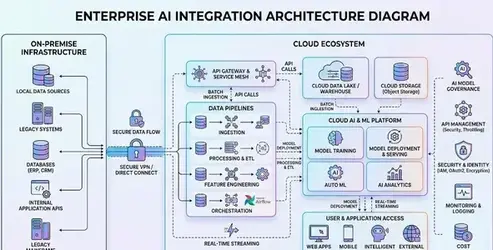
AI integration in enterprise app development alternatives frequently relies on API-based services for modular implementation.
How it works:
- Select AI service (e.g., NLP, vision, recommendation)
- Integrate via REST or SDK
- Process enterprise data through external models
Advantages:
- Rapid integration
- No need for model training
- Cost-effective for small to mid-scale applications
This method is widely used in customer support automation and document processing systems.
What are the compliance and security considerations for AI integration alternatives?
AI integration in enterprise app development alternatives is required to follow recognized governance and security protocols.
Key considerations:
- Data encryption (in transit and at rest)
- Access control and identity management
- Model transparency and auditability
Relevant standards:
- ISO/IEC 27001 for information security
- GDPR for data protection
- SOC 2 compliance for service providers
Enterprises handling sensitive data often prefer hybrid or on-premise models to meet these requirements.

How do enterprises choose the right AI integration alternative?
AI integration in enterprise app development alternatives is selected based on structured evaluation:
Decision factors:
- Data sensitivity level
- Budget constraints
- Infrastructure readiness
- Required scalability
- Real-time processing needs
Selection steps:
- Define business objective
- Assess data availability
- Evaluate deployment environment
- Test integration approach
- Monitor performance and compliance
A related concept often discussed alongside this topic includes enterprise automation platforms, intelligent workflows, and predictive analytics systems.
Conclusion
AI integration in enterprise app development alternatives provides flexible pathways for implementing intelligent capabilities across diverse business environments. Selecting the right model depends on infrastructure, compliance needs, and operational goals. As adoption expands into specialized domains such as ai in healthcare app development, enterprises will increasingly rely on hybrid and modular approaches for sustainable innovation.
FAQ
What are AI integration alternatives in enterprise development?
They are different methods such as cloud, on-premise, hybrid, and API-based approaches used to embed intelligent features into enterprise systems.
Which AI integration alternative is most secure?
On-premise and hybrid models are generally more secure due to greater control over sensitive data.
Why do enterprises use API-based AI integration?
It allows efficient deployment without building models anew, minimizing both time investment and development costs.
Are low-code platforms suitable for enterprise AI integration?
Yes, they are effective for rapid development and prototyping with built-in intelligent features.
What factors influence the choice of integration alternative?
Key factors include data sensitivity, cost, scalability requirements, and compliance obligations.
Sources
https://www.whitelotuscorporation.com/building-smarter-apps-integrating-ai-into-modern-development/
https://www.trootech.com/blog/ai-integration-enterprise-systems
https://www.g2.com/products/ai-integration-in-enterprise-applications/competitors/alternatives
https://www.kellton.com/kellton-tech-blog/enterprise-ai-integration-beyond-app-modernization
https://www.zoho.com/creator/decode/why-ai-assisted-app-development-is-future-of-enterprise-app-building
https://www.outsystems.com/ai/ai-software-development/
https://medium.com/@joshi.vignesh/integrating-ai-into-enterprise-apps-isnt-optional-it-s-a-necessity-5a35b2813152
https://reflex.dev/blog/top-7-enterprise-ai-app-builders/
https://triazinesoft.com/us/blog-details.php?post=how-ai-powered-enterprise-software-development-services-are-transforming-modern-businesses