Debugging in software engineering with example is the method of examining software systems to locate faults, determine their root causes, and eliminate them effectively. It helps developers ensure that applications function according to specifications and quality requirements. Effective debugging reduces system failures, improves user experience, and supports software compliance with development and testing standards used across industries.
Key Takeaways
- Debugging identifies and resolves software defects.
- A structured debugging process improves troubleshooting efficiency.
- Different debugging types address different defect scenarios.
- Specialized tools help analyze code, logs, and system behavior.
- Embedded, mobile, and system software require specialized debugging methods.
- Effective debugging improves software quality and operational reliability.
What Is Debugging in Software Development?
Debugging in software engineering with example entails investigating unexpected software behavior, diagnosing the source of the problem, and applying effective remedies.
Debugging Example
Consider a banking application that calculates account balances incorrectly.
| Issue | Cause | Solution |
| Incorrect balance displayed | Faulty arithmetic logic | Correct calculation formula |
| Negative balance shown unexpectedly | Missing validation check | Add input validation |
Common categories of software bugs include:
- Syntax errors
- Logic errors
- Runtime errors
- Memory-related defects
- Integration failures
A software engineer typically reproduces the issue, identifies the cause, applies a fix, and verifies the correction through testing.
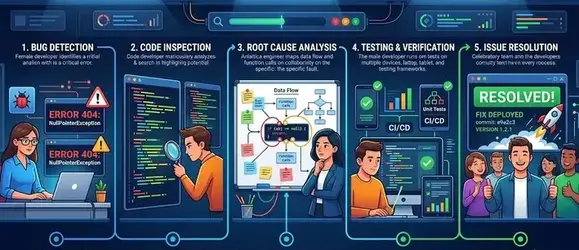
Steps in Software Debugging
Debugging in software engineering with example follows a structured workflow to ensure accurate defect resolution.
Standard Debugging Process
- Identify the defect.
- Reproduce the issue consistently.
- Collect logs and diagnostic information.
- Isolate the root cause.
- Implement corrective changes.
- Retest affected functionality.
- Document findings and preventive measures.
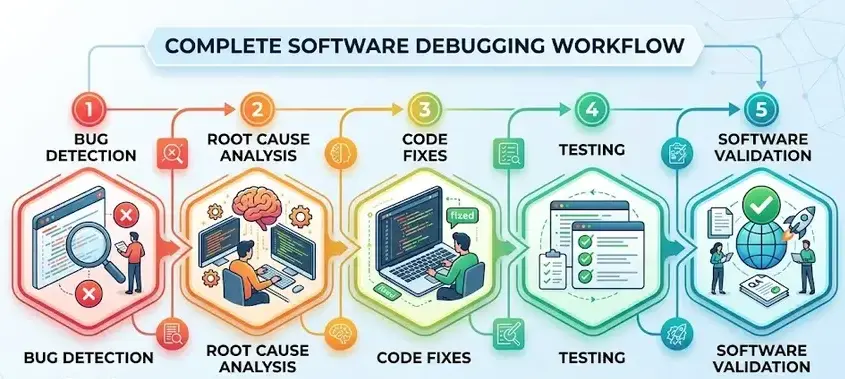
Debugging Process Diagram
Bug Report
↓
Reproduce Error
↓
Analyze Cause
↓
Apply Fix
↓
Retest
↓
Deploy Solution
This structured approach minimizes recurring defects and improves software quality.
Why Do We Need Debugging in Software?
Debugging in software engineering with example is essential because software defects can impact functionality, security, and system stability.
Key benefits include:
- Improved software reliability
- Reduced operational downtime
- Enhanced application security
- Better user experience
- Faster maintenance cycles
Many professionals also explore related topics such as software testing, error tracking, log analysis, and application performance monitoring to strengthen defect management practices.
What Are the Types of Debugging in Software Engineering with Example?
Debugging in software engineering with example includes several widely recognized approaches that help developers locate and eliminate software errors efficiently.
| Type | Purpose | Example |
| Brute Force Debugging | Uses logs and memory dumps | Reviewing crash logs |
| Backtracking | Traces execution backward | Finding incorrect variable assignment |
| Cause Elimination | Removes possible causes systematically | Testing alternative modules |
| Program Slicing | Focuses on relevant code sections | Isolating faulty functions |
| Automated Debugging | Uses specialized tools | Automated exception tracking |
Selecting the appropriate debugging type depends on system complexity and defect characteristics.
What Are Common Debugging Tools in Software Engineering?
Debugging in software engineering with example often relies on specialized tools for defect analysis.
Debugging Tools in Software Engineering
| Tool Type | Function |
| Source Code Debuggers | Step-through execution |
| Log Analyzers | Review application logs |
| Profilers | Measure performance bottlenecks |
| Static Analysis Tools | Detect code defects before execution |
| Error Tracking Platforms | Monitor production failures |
Examples include GDB, Visual Studio Debugger, WinDbg, and integrated development environment (IDE) debugging utilities.

How Is Debugging Applied in Embedded and Mobile Systems?
Debugging in software engineering with example extends beyond desktop applications into embedded and mobile environments.
Debugging Embedded Software
Embedded systems debugging focuses on hardware-software interactions.
Common techniques include:
- JTAG debugging
- Real-time tracing
- Memory inspection
- Firmware analysis
- Hardware breakpoint testing
These methods are frequently used in automotive, industrial control, and IoT systems.
Android Debugging Software and USB Debugging Tools
Android developers use debugging tools to diagnose application issues.
Common capabilities include:
- USB debugging connections
- Device log monitoring
- Performance profiling
- Crash analysis
- Application testing
USB debugging allows direct communication between a development computer and an Android device for troubleshooting purposes.
Debugging Methods in System Software
System software debugging focuses on operating systems, drivers, and low-level services.
Common methods include:
- Kernel debugging
- Memory dump analysis
- Trace logging
- Breakpoint debugging
- Driver diagnostics
These approaches help maintain system stability and performance.
Conclusion
Debugging remains a foundational software engineering activity that transforms defect detection into corrective action through structured analysis and verification. Understanding debugging types, tools, and processes helps teams maintain reliable software systems across diverse environments. For broader practical understanding, reviewing a debugging software example alongside formal debugging workflows can strengthen troubleshooting skills and support long-term software quality.
FAQ
What is debugging in software engineering?
Debugging is the method of identifying faults in software, analyzing their origins, and applying fixes to prevent failures or abnormal behavior.
What are the main types of debugging?
Software engineers frequently use debugging techniques such as brute force debugging, backtracking, cause elimination, program slicing, and automated debugging to resolve defects.
What is debugging in C?
Debugging in C involves locating and fixing issues such as memory errors, pointer problems, logic defects, and runtime failures using debugging tools.
Which tools are used for software debugging?
Developers commonly use GDB, Visual Studio Debugger, WinDbg, log analyzers, profilers, and static analysis tools.
Why is debugging important?
Debugging improves software reliability, security, maintainability, and overall application performance.
Sources
- https://www.geeksforgeeks.org/software-engineering/software-engineering-debugging/
- https://www.meegle.com/en_us/topics/debugging/debugging-in-software-engineering
- https://www.guvi.in/blog/debugging-in-software-development/
- https://www.frugaltesting.com/blog/what-is-debugging-in-software-engineering
- https://www.naukri.com/code360/library/debugging-in-software-engineering
- https://testfort.com/blog/what-is-debugging-in-software-testing
- https://www.meegle.com/en_us/topics/debugging/debugging-in-software-development
- https://www.tricentis.com/learn/debugging