The art of debugging process in software engineering is the structured practice of detecting, isolating, analyzing, and fixing software errors during development and testing. Debugging helps developers improve application reliability, maintainability, and performance while reducing system failures and operational risks. Effective debugging combines technical analysis, testing procedures, logging systems, and diagnostic tools to locate defects efficiently.
Key Takeaways
- Debugging is essential for software reliability and defect correction.
- Structured debugging processes improve development efficiency.
- Testing identifies defects, while debugging fixes them.
- Automated debugging tools accelerate enterprise software maintenance.
- Industries with safety-critical systems require rigorous debugging standards.
- Regression testing helps prevent recurring software failures.
Software Debugging Techniques
What are the most effective software debugging techniques?
The art of debugging process in software engineering relies on proven debugging techniques that help developers isolate faults and correct them systematically.
Common software debugging techniques include:
- Brute Force Debugging
- Uses logs, memory dumps, and print statements
- Common in small-scale applications
- Backtracking
- Traces program execution backward from the failure point
- Useful for logic and runtime errors
- Cause Elimination
- Removes suspected causes through testing
- Often combined with binary search methods
- Program Slicing
- Focuses only on code sections affecting a variable or output
- Reduces debugging complexity
- Automated Debugging
- Uses integrated debugging tools and monitoring software
- Common in enterprise DevOps pipelines
| Technique | Primary Use | Example |
| Backtracking | Logic errors | Incorrect calculations |
| Program Slicing | Variable tracking | Data corruption issues |
| Automated Debugging | Large systems | Cloud applications |
| Cause Elimination | Complex bugs | API integration failures |
A mobile application crash caused by null pointer exceptions can often be resolved through log analysis and breakpoint inspection inside integrated development environments.
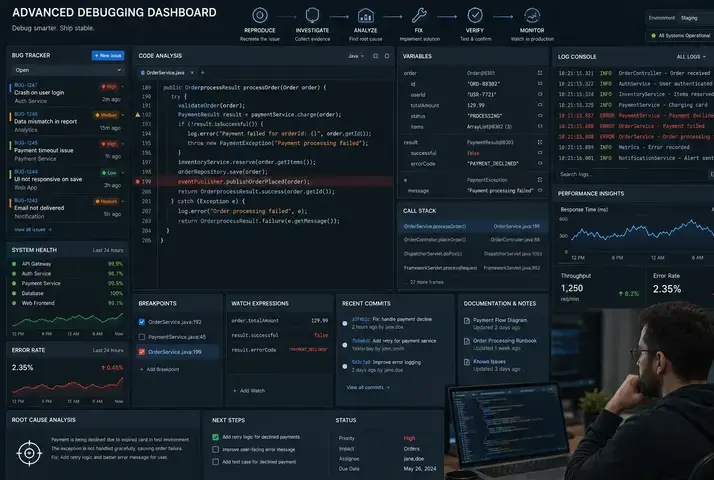
Process of Debugging in Software
What is the standard process of debugging in software?
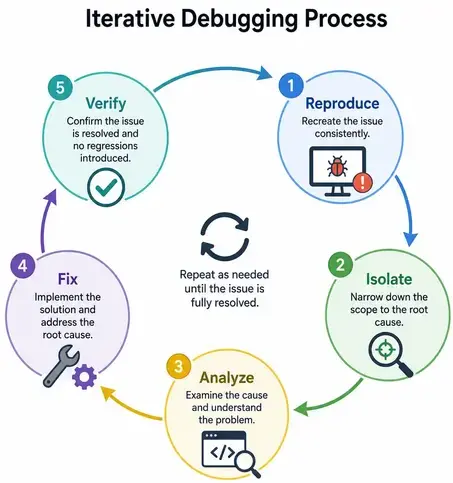
The art of debugging process in software engineering follows a structured workflow to reduce repeated failures and improve software quality.
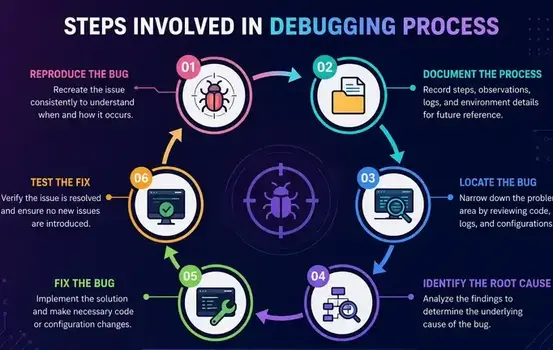
Standard debugging process
- Identify the Error
- Detect abnormal behavior or system failure
- Reproduce the Problem
- Repeat the issue consistently
- Analyze the Root Cause
- Inspect logs, variables, dependencies, and execution flow
- Develop a Fix
- Modify faulty logic or configuration
- Test the Solution
- Verify the defect no longer exists
- Perform Regression Testing
- Ensure other features remain unaffected
- Document the Issue
- Record the bug, fix, and preventive actions
For example, in embedded systems, debugging may involve hardware monitoring, firmware analysis, and serial communication testing.
People often explore related areas such as debugging tools in software engineering, software testing methods, and what is debugging in programming when studying defect management workflows.
Importance of Debugging in Software Development
Why is debugging important in software development?
The art of debugging process in software engineering directly impacts software stability, cybersecurity, compliance, and customer experience.
Key benefits of debugging
- Improves software reliability
- Reduces application downtime
- Prevents security vulnerabilities
- Enhances user experience
- Supports regulatory compliance
- Lowers maintenance costs
Industries such as healthcare, aviation, banking, and automotive systems rely heavily on debugging because software defects can create operational and safety risks.
Software Testing vs Debugging
The art of debugging process in software engineering differs from software testing because testing identifies defects while debugging fixes them.
| Software Testing | Debugging |
| Detects errors | Corrects errors |
| Performed by testers | Performed by developers |
| Focuses on validation | Focuses on root cause analysis |
| Uses test cases | Uses debugging tools |
Testing determines whether a defect exists, while debugging determines why the defect exists.
Testing and Debugging in Software Engineering
The art of debugging process in software engineering works closely with software testing throughout the development lifecycle.
Common testing stages linked with debugging
- Unit Testing
- Integration Testing
- System Testing
- Acceptance Testing
- Regression Testing
Modern development environments integrate testing and debugging through automated pipelines, continuous integration systems, and monitoring platforms.
What Is Debugging Process in Software Testing
The art of debugging process in software engineering supports software testing by helping teams isolate failed test conditions and repair defective logic.
During software testing, debugging usually includes:
- Reading execution logs
- Inspecting variables
- Setting breakpoints
- Monitoring memory allocation
- Verifying output consistency
Debugging tools such as GDB, Visual Studio Debugger, Eclipse Debugger, and Chrome DevTools are commonly used in professional software environments.
Conclusion
The art of debugging process in software engineering combines structured analysis, testing practices, and technical tools to improve software quality and operational reliability. Organizations that apply systematic debugging frameworks reduce defects, improve maintainability, and strengthen application security across development environments.
For embedded and hardware-level troubleshooting workflows, topics such as arduino software serial debug also provide practical insight into serial communication analysis and runtime diagnostics.
FAQ
What is the art of debugging in software engineering?
The art of debugging in software engineering is the systematic process of finding, analyzing, and fixing software defects to improve application performance and reliability.
What are the 7 steps of software testing?
The seven common steps include requirement analysis, test planning, test case design, environment setup, test execution, defect tracking, and test closure.
What is the software debugging process?
The software debugging process involves identifying errors, reproducing defects, analyzing causes, fixing code issues, testing solutions, and documenting results.
How many types of debugging are there?
Common debugging types include brute force debugging, backtracking, cause elimination, program slicing, and automated debugging.
What tools are used for debugging in software engineering?
Popular debugging tools include GDB, Visual Studio Debugger, Eclipse Debugger, WinDbg, Chrome DevTools, and integrated IDE debugging systems.
Sources
- https://www.geeksforgeeks.org/software-engineering/software-engineering-debugging/
- https://dev.to/arjun98k/the-art-of-debugging-in-software-engineering-33gg
- https://www.tricentis.com/learn/debugging
- https://www.meegle.com/en_us/topics/debugging/debugging-in-software-engineering
- https://www.slideshare.net/slideshow/the-art-of-debuggingpptx/253809890
- https://sestudies.hashnode.dev/the-art-and-science-of-debugging-in-software-engineering
- https://codegama.com/blog/the-art-of-debugging-tips-and-techniques-for-effective-troubleshooting/
- https://www.scribd.com/document/901432274/THE-ART-OF-DEBUGGING
- https://www.vinove.com/blog/guides-and-tutorials/mastering-the-art-of-debugging-a-guide/