Limitations of ai in app development refer to the inherent technical, data-driven, and operational constraints that restrict how effectively intelligent systems can design, build, and manage applications. These limitations impact scalability, reliability, compliance, and decision-making accuracy. Why do these constraints matter? Because ignoring them often leads to failed implementations, security risks, and unreliable application behavior.
Key Takeaways
- Limitations of ai in app development stem from data, technical, and regulatory constraints
- Data quality directly determines system performance and reliability
- Compliance frameworks significantly impact implementation
- Human oversight remains essential for accuracy and ethics
- Scalability is limited by infrastructure and computational demands
What are the key technical limitations of AI in app development?
The limitations of ai in app development often originate from technical constraints in model design and system architecture.
Key technical issues include:
- Lack of true understanding: Systems rely on pattern recognition, not reasoning
- Model rigidity: Difficulty adapting to unseen scenarios
- Dependency on training data quality
- High computational requirements
Example:
A recommendation engine may fail when user behavior shifts significantly due to external factors like market trends.
How do data dependencies create limitations of AI in app development?
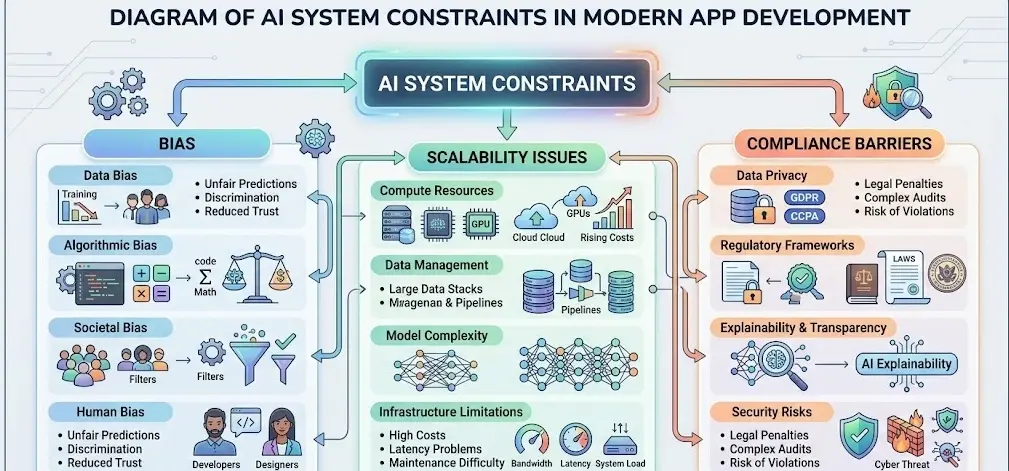
The limitations of ai in app development are heavily influenced by data availability, quality, and governance.
Common data-related constraints:
| Factor | Impact |
| Incomplete datasets | Inaccurate predictions |
| Biased data | Ethical and legal risks |
| Data silos | Limited system performance |
| Poor labeling | Reduced model accuracy |
Industry practice:
Healthcare applications must comply with HIPAA, requiring strict data handling, which limits data accessibility for training.
Why do limitations of AI in app development affect scalability?
The limitations of ai in app development restrict scalability due to infrastructure and performance challenges.
Scalability constraints include:
- High infrastructure costs for model training and inference
- Latency issues in real-time applications
- Complex integration with legacy systems
Example:
Real-time fraud detection systems in finance require low latency, which is difficult when models are computationally heavy.
What regulatory and compliance limitations impact AI app development?
The limitations of ai in app development extend to legal and compliance frameworks that govern data and system usage.
Key regulations:
- GDPR (data privacy in Europe)
- HIPAA (healthcare data protection)
- ISO/IEC 27001 (information security standards)
Implications:
- Restricted data usage
- Mandatory audit trails
- Increased development complexity
How do human dependency and skill gaps limit AI in app development?
The limitations of ai in app development include reliance on human expertise for design, monitoring, and ethical oversight.
Critical gaps:
- Shortage of skilled professionals
- Need for continuous model monitoring
- Human intervention in edge cases
Example workflow:
- Model outputs prediction
- Human validates decision
- Feedback improves system
What operational risks highlight the limitations of AI in app development?
The limitations of ai in app development become evident through operational risks during deployment and maintenance.
Major risks:
- Model drift over time
- Security vulnerabilities
- Lack of transparency (black-box behavior)
Example:
An AI-powered chatbot may degrade in performance if user language patterns evolve.
A system dealing with these challenges is often discussed alongside automation tools, predictive analytics platforms, and intelligent workflow systems used in enterprise environments.
Why do limitations of AI in app development impact reliability and trust?
The limitations of ai in app development directly affect user trust and system reliability.
Trust-related challenges:
- Inconsistent outputs
- Explainability issues
- Ethical concerns in decision-making
Industry example:
Loan approval systems must provide explainable decisions to comply with financial regulations.
Conclusion
The limitations of ai in app development highlight the need for structured implementation, strong data governance, and human oversight. Addressing these constraints ensures reliable, compliant, and scalable applications. For a deeper understanding of practical implementation strategies, refer to how to integrate ai in app development as a complementary framework.
FAQ
What is a limitation of AI applications?
A limitation is the inability to understand context beyond training data, leading to inaccurate or biased outputs.
What are the major limitations of AI?
Major limitations include data dependency, lack of reasoning, high costs, and regulatory constraints.
Why do 85% of AI projects fail?
Most fail due to poor data quality, unclear objectives, lack of expertise, and integration challenges.
What are the 5 disadvantages of AI?
High cost, data bias, lack of transparency, dependency on data, and limited adaptability.
Are there limits to AI capabilities?
Yes, AI cannot replicate human judgment, creativity, or contextual understanding fully.
Sources
https://www.appbuilder.dev/blog/limitations-of-ai-in-low-code-development
https://depextechnologies.com/blog/the-pros-and-cons-of-ai-in-mobile-app-development/
https://flinthillsgroup.com/risks-limitations-of-ai-app-builders/
https://appitventures.com/blog/how-to-develop-an-ai-app
https://www.adcocksolutions.com/post/6-limitations-of-ai-why-it-wont-quite-take-over-in-2023
https://www.tableau.com/data-insights/ai/advantages-disadvantages
https://medium.com/@avantikashergil/common-challenges-in-building-ai-first-apps-and-how-to-overcome-them-e23095c4c67d
https://www.reddit.com/r/nocode/comments/1jg8bca/limitations_of_ai_in_app_development/
https://www.accordhk.com/blog/limitations-of-ai-in-application-development-why-human-expertise-is-still-essential/