How to integrate AI in app development refers to the structured process of embedding machine learning models, data pipelines, and intelligent features into software applications. This integration enables automation, prediction, and adaptive user interactions. What are the exact steps and standards required to ensure reliable implementation?
Key Takeaways
- How to integrate AI in app development involves data, models, and system integration
- A structured workflow ensures reliable and scalable implementation
- Compliance and data security are essential for production systems
- Performance optimization continues after deployment
- Industry-specific use cases define integration complexity
What Does How to Integrate AI in App Development Involve?
How to integrate AI in app development begins with aligning business objectives with technical capabilities and data readiness.
Core components include:
• Data gathering and refinement
• Model identification and training
• Integration using APIs or SDK frameworks
• Deployment with continuous monitoring
Example:
A retail app may integrate recommendation engines using historical purchase data to personalize product suggestions.
How to Integrate AI in App Development Step by Step?
How to integrate AI in app development follows a structured workflow:
- Define Use Case
- Prediction, automation, or classification tasks
- Prepare Data
- Clean, label, and structure datasets
- Choose Model
- Pre-trained models or custom-built solutions
- Develop Integration Layer
- Use APIs, SDKs, or microservices
- Test and Validate
- Accuracy, latency, and reliability checks
- Deploy and Monitor
- Continuous performance tracking
| Stage | Key Output |
| Data Preparation | Structured datasets |
| Model Training | Predictive model |
| Integration | Functional AI feature |
| Deployment | Production-ready system |
What Technologies Are Used to Integrate AI into Apps?
How to integrate AI in app development requires specific tools and frameworks depending on the platform.
Common technologies:
- Cloud platforms (Azure AI, AWS AI services)
- Frameworks (TensorFlow, PyTorch)
- APIs (Natural language, vision, speech)
- SDKs (.NET AI SDK, Android AI libraries)
Example:
In .NET environments, developers use integrated AI libraries to add features like chatbots or document processing.
How to Ensure Data Security and Compliance?
How to integrate AI in app development must include regulatory compliance and data protection measures.
Key standards:
- GDPR (privacy and data protection rules)
- HIPAA (compliance for healthcare data)
- ISO/IEC 27001 (information security framework)
Best practices:
• Use encryption for stored and transmitted data
• Enforce role-based user access
• Enable logging and system monitoring
What Are Common Challenges in AI Integration?
How to integrate AI in app development often involves technical and operational challenges.
Typical issues:
- Poor data quality
- Model bias and inaccuracies
- Integration complexity with legacy systems
- High computational costs
Mitigation strategies:
- Use validated datasets
- Continuous model retraining
- Modular architecture for scalability
How to Optimize Performance After Integration?
How to integrate AI in app development does not end at deployment; optimization is ongoing.
Optimization methods:
- Model compression for faster inference
- Edge deployment for low latency
- Real-time monitoring and feedback loops
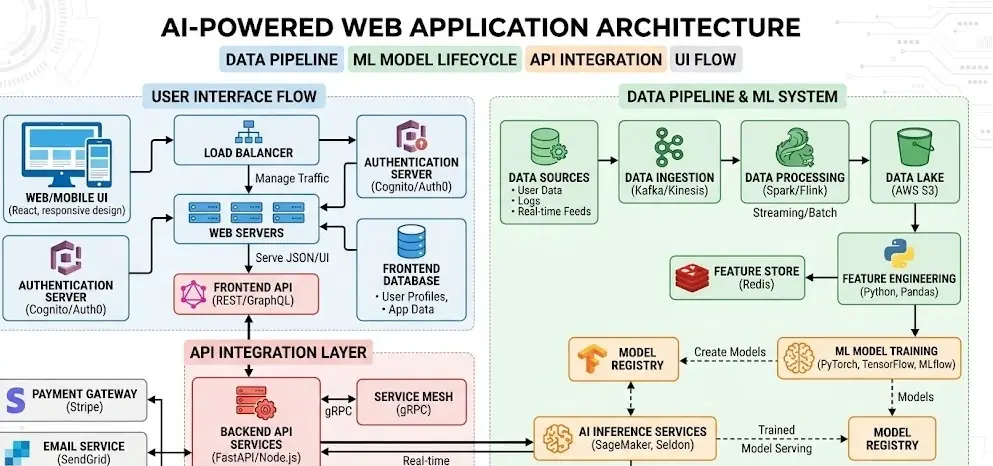
A web application context often includes related considerations such as model deployment pipelines, API latency optimization, and scalable backend infrastructure.
Conclusion
How to integrate AI in app development requires a structured approach combining data readiness, model selection, and secure deployment practices. A clear framework ensures scalability, compliance, and performance across industries. For implementation continuity, understanding how to use ai in app development helps refine integration strategies and long-term system evolution.
FAQ
What is the first step in integrating AI into an app?
Define a clear use case aligned with business objectives and available data.
Can AI be added to existing applications?
Yes, through APIs or microservices without rebuilding the entire system.
How long does AI integration take?
Typically 3 to 9 months depending on complexity, data, and infrastructure.
What industries use AI in app development?
Healthcare, finance, retail, logistics, and entertainment are major adopters.
Is coding required to integrate AI?
Yes, but low-code and pre-built AI services can reduce development effort.
Sources
https://labs.lamatic.ai/p/how-to-integrate-ai-into-an-app
https://dotnet.microsoft.com/en-us/apps/ai
https://www.databricks.com/blog/ai-app-development
https://www.eleken.co/blog-posts/how-to-integrate-ai
https://www.directimpactsolutions.com/en/integrating-ai/
https://www.couchbase.com/blog/ai-app-development/
https://www.antino.com/blog/integrating-ai-into-existing-apps
https://developer.android.com/ai
https://appinventor.mit.edu/explore/ai-with-mit-app-inventor