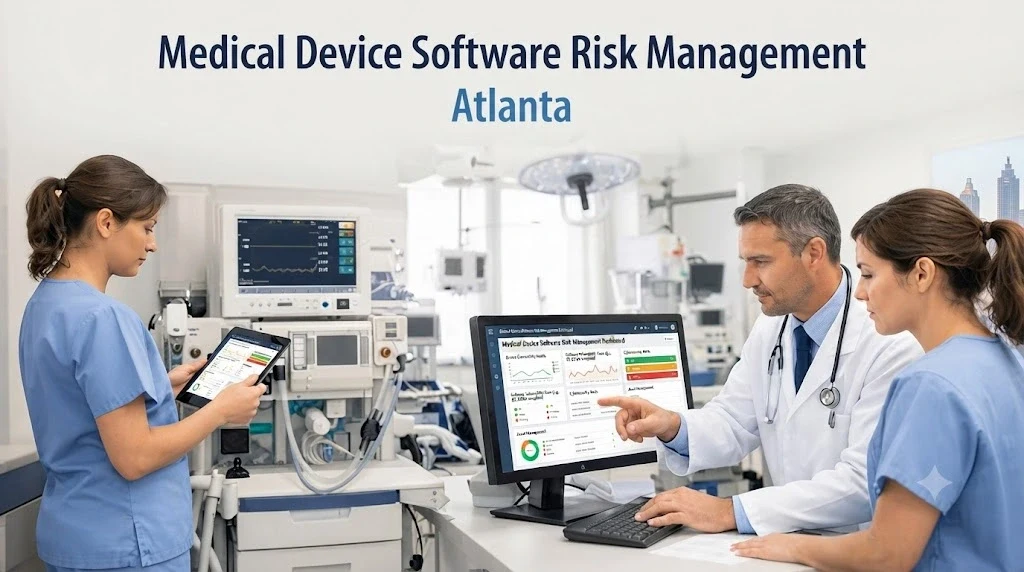
Medical device software risk management Atlanta teams rely on starts with one idea: find what can go wrong before a patient does.
Whether you are developing a clinical application, an algorithm for diagnostics, or software code for a medical device, a defined process for risk management helps protect patients and makes your job easier in regulatory affairs. Here is everything you need to know about risks in medical device software development.
Key Takeaways
- Risk management should run from concept through post-market, not just at design.
- ISO 14971 and IEC 62304 guide the process, and FDA’s QMSR now aligns with ISO 13485.
- Keep hazards linked to controls and tests, and update your risk file with every software change.
Table of Contents
Medical Device Software Risk Management Atlanta: Why It Matters Now
Software can fail in ways hardware rarely does. The wrong code, a vulnerability or the unpatched piece of hardware can quietly change how the device works. This is what we call risk management: identifying such possibilities, ranking them, and then reducing them to a tolerable level.
The expectations were changed by 2026. On February 2, 2026, FDA published the Quality Management System Regulation (QMSR), making 21 CFR Part 820 consistent with the ISO 13485:2016. This regulation calls for a risk-based approach throughout the entire life cycle of the product, and industry guidance indicates that inspectors can start with the risk management document.
The Standards Behind Software Risk Management
Three frameworks do most of the heavy lifting:
- ISO 14971:2019: The core standard for applying risk management to medical devices, covering hazard analysis, risk evaluation, controls, and residual risk.
- IEC 62304: The software lifecycle standard, which ties development activities to risk and assigns safety classes (A, B, C) based on potential harm.
- ISO 13485:2016: The quality system standard that FDA’s QMSR now incorporates.
For connected products, FDA also expects cybersecurity risks to be addressed in premarket submissions, including how you will monitor and patch vulnerabilities.
Medical Device Software Risk Management Atlanta: A 6-Step Process
- Define intended use. List who will use the software, where, and for what clinical purposes. Risk is a consequence of use.
- Identify hazards. Think about incorrect outputs, delays, data losses, cyber attacks, and misuse.
- Assess and quantify risks. Assess their severity and likelihood and compare them against your criteria for acceptance.
- Control risks. Design for inherent safety first, followed by protection and warning.
- Verify and track. Relate each hazard to its controls, requirements, and tests using a traceability matrix.
- Monitor and re-assess. Use feedback on complaints, adverse events, and changes to the software in your risk assessment file.
Software-Specific Risks to Watch
Third party and open-source software: According to the IEC 62304 standard, these are examples of software of unknown provenance, and updates might bring new risks.
- Cybersecurity: Insufficient authentication or outdated software libraries may cause patient harm.
- AI and algorithms: The performance may degrade due to the difference between actual and training datasets.
- Interoperability: The data transferred between the devices may be wrongly interpreted.
- Usability: A non-intuitive interface design may cause users to make mistakes.
The Atlanta Advantage
Medical device software risk management performed by Atlanta start-ups and long-established businesses becomes much easier thanks to the depth of the ecosystem. According to the Georgia Department of Economic Development, there are more than 550 medical device manufacturers in the state.
One of the top biomedical engineering programs in the country can be found at the joint Georgia Tech and Emory Biomedical Engineering program, and the Global Center for Medical Innovation is an organization that helps in getting devices to the market.
What Belongs in Your Risk Management File
- A risk management plan with acceptance criteria
- Hazard analysis, including software hazards and cybersecurity hazards
- Risk control measures associated with requirements
- Evidence of verification and validation
- Residual risk and risk/benefit assessment
- Post-market monitoring plan and change log
Medical device software risk management Atlanta – Common Mistakes to Avoid
Many organizations make the same mistakes. Here’s what medical device software risk management Atlanta organizations must avoid:
- Thinking about risk as paperwork: A report compiled at the end won’t capture the reality of design decisions.
- Neglecting software updates: Any update poses risk.
- Weak traceability: Hazards without linked controls and tests invite audit findings.
- Overlooking cybersecurity: Security gaps are safety gaps.
- Skipping post-market feedback: Real-world data is your best source of new hazards.
Final Thoughts
Good medical device software risk management Atlanta teams require a continuous process which is proactive, associated with design and testing, and evolves continuously even post-release. Begin with the intended purpose, add traceability through the development process, and conduct risk assessment when there is a change in software.
Need a software partner for medical device software risk management Atlanta teams can build on? Talk to RCEENetworks about your project.
Frequently Asked Questions
1. What is medical device software risk management Atlanta teams should follow?
Most companies base their processes on ISO 14971 for the overall process, and IEC 62304 for the software lifecycle, covering hazard identification, risk assessment, mitigation, verification, and post-market monitoring.
2. What is the difference between ISO 14971 and IEC 62304?
ISO 14971 defines how to manage risk across the whole device, while IEC 62304 defines the software development lifecycle and requires that risk management be integrated into it.
3. Is risk management required for medical device software?
Yes, regulators expect documented risk management for software that qualifies as a medical device, and FDA’s QMSR now aligns with ISO 13485, which requires risk-based controls throughout the lifecycle.
4. How often should software risk files be updated?
Update your file whenever the software changes, a new hazard or incident emerges, or post-market data reveals new information, and review it regularly as part of medical device risk management.
Also Read: What is medical software?