Develop generative ai apps in azure refers to the process of building, deploying, and managing AI-powered applications using Azure’s cloud ecosystem and AI services. These applications leverage large-scale models, APIs, and orchestration tools to generate content, automate workflows, and enhance decision-making. Why is this important? Organizations require secure, scalable, and compliant environments to operationalize generative AI effectively.
Key Takeaways
- Azure provides a complete ecosystem for generative AI development
- AI Foundry and its portal streamline deployment workflows
- Certifications like AI-3016 support professional validation
- Security and compliance are integral to implementation
- Tools like Semantic Kernel enhance orchestration capabilities
What Does It Mean to Develop Generative AI Apps in Azure?
To develop generative ai apps in azure means integrating prebuilt or custom AI models into applications using Azure infrastructure and services.
Key components include:
- Azure OpenAI Service for model access
- Azure AI Studio for development workflows
- Azure Machine Learning for customization
- Azure Cognitive Services for APIs
Example:
A customer support chatbot using GPT-based models hosted securely in Azure with enterprise data controls.
How Does Azure AI Foundry Support Generative AI Development?
Develop generative ai apps in azure AI Foundry involves using a unified platform to design and manage AI solutions.
Core capabilities:
- Model catalog for prebuilt AI models
- Prompt engineering tools
- Deployment pipelines
- Monitoring and evaluation systems
Industry practice:
Organizations use AI Foundry to standardize development and reduce time-to-deployment across teams.
What Is the Role of Azure AI Foundry Portal in Deployment?
Develop generative ai apps in azure AI Foundry portal enables developers to configure, test, and deploy AI applications through a centralized interface.
Typical workflow:
- Select model (e.g., GPT variants)
- Configure prompts and parameters
- Integrate data sources
- Deploy via API endpoints
Benefits:
- Simplified interface for rapid prototyping
- Built-in governance controls
- Real-time performance monitoring
What Tools and Frameworks Are Used in Azure Generative AI Development?
To develop generative ai apps in azure, developers rely on a combination of tools and SDKs.
Common tools:
| Tool/Framework | Purpose |
| Azure OpenAI Service | Model access and inference |
| Semantic Kernel | Orchestration and memory management |
| Azure AI Studio | End-to-end development |
| GitHub repositories | Code versioning and collaboration |
Example use case:
Using Semantic Kernel to connect AI models with enterprise APIs for task automation.
What Certifications and Learning Paths Support Azure AI Development?
Develop generative ai apps in azure certification paths validate skills in building and deploying AI solutions.
Relevant certifications:
- AI-3016: Develop Generative AI Apps in Azure
- AI-103T00: Develop AI apps and agents on Azure
Training focus areas:
- Prompt engineering
- Model deployment
- Responsible AI practices
- Security and compliance
What Are the Key Security and Compliance Considerations?
Develop generative ai apps in azure requires adherence to strict enterprise and regulatory standards.
Key considerations:
- Data privacy (GDPR, HIPAA where applicable)
- Role-based access control (RBAC)
- Model output validation
- Content filtering and moderation
Best practices:
- Use private endpoints
- Implement audit logging
- Monitor model behavior continuously
What Are Practical Examples of Azure Generative AI Applications?
Develop generative ai apps in azure example use cases demonstrate real-world implementation.
Examples:
- Automated document summarization systems
- AI copilots for enterprise productivity
- Code generation assistants
- Intelligent search and recommendation engines
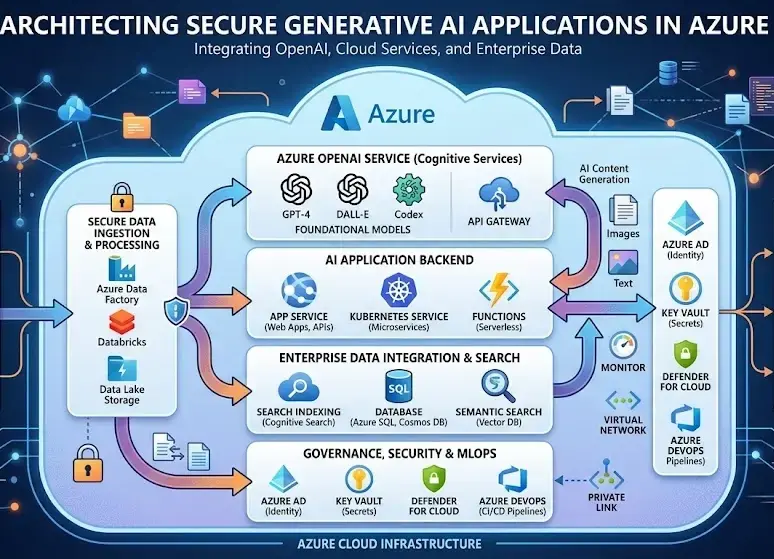
A generative AI solution is often discussed alongside Azure OpenAI Service, Semantic Kernel integration, and AI model deployment pipelines
Conclusion
Developing generative AI applications in Azure provides a structured, scalable framework for enterprise adoption. By combining standardized tools, certifications, and governance practices, organizations can ensure reliable deployment and long-term value. This foundation also aligns with broader advancements such as generative ai in mobile app development, enabling consistent innovation across platforms.
FAQ
What is Azure OpenAI Service?
It provides access to advanced generative models for building applications with natural language and content generation capabilities.
What is AI-3016 certification?
It validates skills in developing and deploying generative AI applications using Azure tools and services.
Can generative AI apps in Azure be customized?
Yes, models can be fine-tuned or combined with enterprise data for domain-specific applications.
Is Azure suitable for enterprise AI deployment?
Yes, it offers scalability, security, and compliance features required for enterprise-grade solutions.
What is Semantic Kernel used for?
It orchestrates AI workflows by integrating models with memory, APIs, and business logic.
Sources
https://learn.microsoft.com/en-us/training/paths/develop-generative-ai-apps
https://learn.microsoft.com/en-us/azure/developer/ai/introduction-build-generative-ai-solutions
https://www.koenig-solutions.com/ai-3016-develop-custom-copilots-azure-openai-studio-course
https://learn.microsoft.com/en-us/credentials/applied-skills/resources/study-guides/apl-3016
https://www.udemy.com/course/develop-generative-ai-apps-in-azure-ai-foundry-portal/?srsltid=AfmBOooi4LZDYRB6Ck8BK5zU3YKQKbpZIA1l9zYO09ppW97AZY6nBhkw
https://www.fastlaneus.com/course/microsoft-ai-3016?srsltid=AfmBOooVHbVKxH5RdJEKDcKoYKu7kcwye7AZW1PQLVNbGgMlS613P20t
https://www.qa.com/course-catalogue/courses/develop-generative-ai-apps-in-azure-applied-skills-workshop-mai3016/
https://www.netcomlearning.com/course/AI-3016-Develop-copilots-with-Azure-AI-Studio