Hospitals, clinics and home-care programs across the USA are connecting more devices than ever before, and the software that ties them together matters just as much as the hardware. Choosing the best medical IoT software has less to do with a long feature list. What matters is a platform that moves patient data safely, fits the way your clinicians work and stays online even when the network is under strain.
This guide explains what the software does, the main categories, the features that set strong products apart from weak ones, and a step-by-step way to choose. It also touches on security and privacy basics, what drives cost and the questions buyers ask most.
Key Takeaways
- Medical IoT software connects devices, patient data and care teams.
- No one product fits every hospital or clinic.
- HIPAA safeguards and FDA cybersecurity expectations should come first.
- Connecting to the EHR through HL7 or FHIR saves clinicians time.
- Untracked devices are the largest hidden security risk.
- Starting with a small pilot works better than a large launch.
- The best medical IoT software fits your workflow, not just your list of devices.
What Is Medical IoT Software?
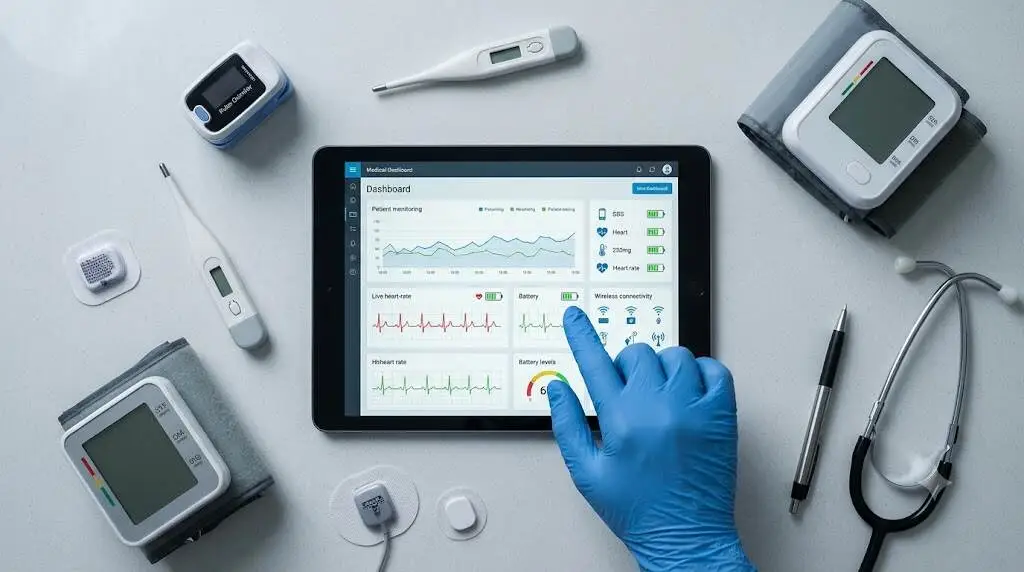
Medical IoT software collects, moves, stores and analyzes data from connected health devices. Examples include wearable heart monitors, connected glucose meters, smart inhalers, infusion pumps, hospital beds and tags attached to equipment. Together, these devices form the Internet of Medical Things, commonly abbreviated as IoMT.
Once a device captures a reading, the software takes over. It verifies the device is authentic, receives the data, checks it against set rules, alerts the appropriate person and adds the result to the patient’s chart.
Vendors use several names for the same idea, such as healthcare IoT software, IoMT software and medical IoT platform. Each refers to tools that turn raw device signals into information clinicians can act on.
Why Providers Are Investing in Connected Care
Care now reaches beyond the exam room. Patients with chronic conditions can be monitored at home, and staff can spot trouble before it becomes an emergency. That shift keeps pushing demand for healthcare IoT software upward. Teams comparing the best medical IoT software typically cite these benefits first:
- Earlier warnings: continuous readings can show changes between visits.
- Fewer unnecessary visits: remote patient monitoring software allows stable patients to be followed from home.
- Less manual charting: devices send readings straight into the record.
- Better equipment use: location tags cut the time spent searching for pumps, wheelchairs and monitors.
- Medication support: connected dispensers and inhalers remind patients and notify caregivers.
Medication adherence shows why this matters. A widely cited estimate holds that more than half of patients do not follow their prescribed treatment, and that gap is linked to a meaningful share of hospital admissions. Reminders and alerts built into the software can help close it.
Main Types of Medical IoT Software
Most products on a best medical IoT software shortlist fall into a handful of families. Many vendors blend several, so treat this list as a loose map instead of fixed categories.
- Remote patient monitoring: collects home readings such as heart rate, blood pressure, glucose and oxygen, then alerts the care team.
- Device management and connectivity: enrolls, updates and keeps track of thousands of devices across Bluetooth, Wi-Fi and cellular connections.
- Asset tracking: uses tags and sensors to locate equipment in real time and show which items sit unused.
- Environmental monitoring: watches the temperature and storage conditions of medication and vaccine refrigerators.
- Medication adherence: links smart dispensers or inhalers to apps that log doses and alert caregivers.
- Telemedicine-linked tools: combine video visits with live device data so clinicians can view the numbers during a consult.
- Analytics and AI: spots trends, forecasts decline and supports individualized care plans.
- Security and asset visibility: finds every connected device on a hospital network and restricts what each can access.
The table below shows where each family fits best and what to ask a vendor before moving forward.
| Software category | Best for | Key question to ask |
| Remote patient monitoring | Chronic-care and home programs | How do alerts get routed and escalated? |
| Device management | Large, mixed fleets | Which protocols and device types does it support? |
| Asset tracking | Hospitals that lose time searching for equipment | How accurate is the location tracking, and how long does the battery last? |
| Environmental monitoring | Pharmacies, labs and vaccine storage | Does it log data for audits? |
| Medication adherence | Older and chronic-care patients | Who gets notified when a dose is missed? |
| Security and asset visibility | Hospital IT and security teams | Does it work without agents installed on devices? |
| Analytics and AI | Large systems with data teams | How are the models validated? |
Best Fit by Organization Type
Your organization’s size and setting shape what matters most. Here is a rough guide:
- Large hospital systems: need enterprise device management, deep EHR integration, asset tracking and security visibility across many locations.
- Small and mid-size clinics: generally fit better with ready-made remote patient monitoring software that launches fast and requires little IT support.
- Home health and senior care: should prioritize simple patient setup, reliable cellular connectivity and fall or emergency alerts.
- Device manufacturers: require a regulated cloud platform, device management and records that back up FDA submissions.
What Makes the Best Medical IoT Software
Feature lists look nearly identical across vendor websites, so judge platforms by how they hold up under real clinical pressure. These areas deserve the closest look.
Security and HIPAA readiness
Device readings often count as protected health information, so the software must protect them from end to end. Look for encryption in transit and at rest, role-based access, audit logs and multi-factor login. A vendor that handles patient data for you should be willing to sign a Business Associate Agreement.
FDA awareness
When a product forms part of a medical device, or is regulated as software that acts like one, FDA cybersecurity expectations apply. Ask how the vendor monitors vulnerabilities, delivers patches and supplies a software bill of materials. Also ask plainly whether the product is cleared, approved or exempt.
EHR integration and interoperability
Data trapped in a standalone dashboard creates extra work for busy staff. Strong platforms exchange information with your electronic health record through standards like HL7 and FHIR. Ask which EHR systems the vendor already connects to, and request a live demo rather than a slide presentation.
Device-level standards such as IEEE 11073 also let equipment from different manufacturers communicate in a shared language.
Device and protocol compatibility
Your fleet probably includes devices from several manufacturers. Confirm support for Bluetooth Low Energy, Wi-Fi and cellular, and find out how new device types are added. Being locked into a single vendor becomes expensive as soon as you need to swap hardware.
Reliable alerts that fit clinical workflow
An alert nobody reads is worse than no alert. Good software lets you set thresholds for each patient, route messages to the correct role and escalate if no one responds. Cutting false alarms also protects staff from alert fatigue.
Scalability, uptime and connectivity
A pilot might include a few devices, while production can include thousands. Ask about cloud capacity, edge processing for time-critical readings and what happens when a connection drops. Backup connectivity is especially useful for ambulances, rural clinics and home programs.
Usability for staff and patients
Patients using home kits are often older and less comfortable with technology. Simple pairing, large text and clear instructions boost adoption. Clinicians need dashboards that surface what is urgent within seconds.
Analytics, reporting and vendor support
Useful reports cover trends, adherence and device health. Support counts just as much, including response times, onboarding assistance, training and a dependable update schedule.
The Technology Behind the Software
A typical medical IoT platform is built from a few core parts. Sensors capture the readings. Bluetooth, Wi-Fi, NFC or cellular connections carry them onward. Cloud systems store and process the data, while edge computing handles urgent calculations close to the device to cut delay. Artificial intelligence then looks for patterns that people could miss.
You do not have to be an engineer to evaluate these parts. You just need straight answers about where data lives, how quickly alerts arrive and how the system responds when a component fails.
Security Risks You Cannot Ignore
Connected devices widen the attack surface of every hospital. Many were built with function as the priority, and older models may run outdated firmware that is hard to patch. Even the best medical IoT software cannot protect devices that no one is monitoring.
A widely cited industry report found that most healthcare organizations had experienced cyberattacks targeting their IoT devices. Figures vary from survey to survey, but the direction is clear.
Start with the basics. The HIPAA Security Rule requires administrative, physical and technical safeguards for electronic patient information, and the software you choose should make meeting those safeguards easier rather than harder. Reliable IoMT software vendors will demonstrate exactly how their product supports each one.
Everyday habits matter as much as compliance. Keep a current inventory of every connected device, separate vulnerable equipment from critical systems, retire old devices properly and watch for unusual behavior. Strong medical device cybersecurity is an ongoing routine, not a one-time purchase.
Privacy Beyond HIPAA
HIPAA is not the only set of rules. Some state privacy laws add their own consent and data-handling requirements, and health apps that fall outside HIPAA can be subject to other federal rules, including those the FTC enforces.
Look for consent management, clear data-retention settings and the ability to export or delete a patient’s data. Since requirements differ by state and use case, have legal counsel confirm what applies to you.
Standards and Frameworks to Know
Standards give buyers a shared yardstick when vendor claims start to sound alike. Three are worth asking about by name:
- IEEE 11073: device-interoperability standards that help equipment from different makers exchange data in a common format.
- NIST Cybersecurity Framework: a structured way to identify, protect, detect, respond to and recover from security problems.
- Zero-trust network segmentation: treats every device as untrusted by default and limits what each one can reach.
Ask each vendor which of these its product supports and how it can prove it.
Build Custom or Buy Ready-Made?
Ready-made platforms launch faster and cost less upfront. They suit standard needs such as remote monitoring for common conditions. Custom development takes more time and money, but it can fit unusual workflows or a new device you plan to release.
Combining the two is common. Many teams license a core medical IoT platform and then build custom integrations or dashboards on top. Whichever route you take, decide who owns the data and the code before you sign.
Medical IoT Software for Device Makers
Companies that make connected devices need more than a monitoring dashboard. They need a secure, regulated cloud back end, a cybersecurity plan that satisfies FDA premarket expectations and solid quality processes.
Standards such as ISO 13485 for quality management and IEC 62304 for the medical software life cycle are frequently cited. Ask whether a platform maintains documentation that supports your submission, and whether it can scale from a pilot to thousands of devices.
How to Choose the Best Medical IoT Software
- Define the clinical goal. Decide which problem you want to solve, such as fewer readmissions or faster equipment location.
- List your devices and systems. List your current devices, your EHR and any telehealth tools.
- Set security and compliance rules. Record HIPAA, FDA and internal policy requirements before any demo.
- Shortlist and book live demos. Ask each vendor to walk through your use case rather than give a generic tour.
- Check references. Talk with similar organizations about uptime, support and surprise costs.
- Run a pilot. Test on a single unit or a small group of patients for several weeks.
- Plan rollout and training. Staff and patient adoption determines whether the investment pays off.
Ask every vendor these questions:
- Where is our data stored, and who has access to it?
- Are you willing to sign a Business Associate Agreement?
- Which devices and EHR systems do you support right now?
- How does the system perform during an outage?
- What happens to our data if we switch vendors?
- Does your IoMT software come with audit logs and role-based access built in?
Watch for these red flags while evaluating:
- Refusal to sign a Business Associate Agreement.
- Unclear answers about encryption, access control or patching.
- No reference customers with a comparable setup.
- A closed ecosystem that supports only one device brand.
- No published patch policy or process for vulnerability disclosure and updates.
- Pricing that stays hidden until late in the sales process.
A simple scorecard keeps comparisons fair. Rate each shortlisted product from one to five on every row, and weight the rows to reflect your priorities. The weights below are just an example you can copy.
| Criterion | Example weight | What a strong score looks like |
| Security and compliance | 25% | Encryption, audit logs, signed BAA |
| EHR and device interoperability | 20% | HL7 or FHIR, proven EHR connections |
| Alert quality and workflow fit | 15% | Per-patient thresholds and escalation |
| Device compatibility | 15% | Many brands and protocols supported |
| Scalability and uptime | 10% | Tested at your expected device count |
| Usability | 10% | Easy for patients and clinicians |
| Support and total cost | 5% | Clear onboarding and open pricing |
Costs and Return on Investment in the USA
Prices for the best medical IoT software vary widely, so be wary of any page that quotes a single figure. Cost typically depends on the number of devices or patients, the depth of EHR integration, hosting, support level and compliance work.
Look beyond the license fee. Add up device hardware, cellular data plans, staff training, integration work and ongoing security reviews. To measure return, track avoided admissions, staff hours saved on charting and equipment searches, and how patients feel about healthcare IoT software.
Reimbursement can also shape the business case. Some remote monitoring services may be billable for eligible patients, but rules differ by payer and shift over time, so verify current requirements with your billing and compliance teams.
Common Implementation Challenges
Rolling out the best medical IoT software still brings some hurdles:
- Network readiness: poor Wi-Fi or dead zones can disrupt monitoring.
- Data overload: too many readings without clear rules can overwhelm staff.
- Patient adoption: a hard setup makes people give up.
- Legacy devices: older equipment may lack current security features.
- Change management: clinicians need training and input on the design.
Start small, gather feedback and adjust before you expand.
Where the Best Medical IoT Software Is Heading
Expect sharper analytics that catch problems sooner, more processing at the edge for faster alerts and closer ties between home devices and hospital systems. Smart pills, connected contact lenses and robotic surgery tools show how far the field is reaching.
Market forecasts published in recent years project the sector growing well past $100 billion. Greater competition means more options, which makes careful evaluation even more important.
Frequently Asked Questions
What is medical IoT software?
It is software that connects medical devices to networks and clinical systems so data can be collected, analyzed and acted on. Examples include remote patient monitoring software, equipment tracking tools and medication adherence apps.
What is the best medical IoT software for hospitals?
No single product is the winner everywhere, since the best medical IoT software depends on your devices, EHR and goals. Compare options on security, interoperability, alert quality, scalability and support, then test the top choices in a pilot.
Does medical IoT software have to be HIPAA compliant?
If it creates, receives or stores protected health information for a covered entity, the vendor generally qualifies as a business associate and must follow HIPAA safeguards. Ask for a signed Business Associate Agreement and a clear description of the security controls.
How much does medical IoT software cost?
Cost depends on device count, integrations, hosting and support, so quotes differ widely. Ask vendors for a full cost breakdown that covers hardware, data plans and training.
What are examples of IoT in healthcare?
Common examples include smart hospital beds, wearable heart monitors, continuous glucose monitors, smart inhalers, connected pill dispensers, equipment trackers and ingestible sensors.
Bottom Line
The best medical IoT software protects patient data, integrates smoothly with your EHR and gives clinicians alerts they can rely on. Start with your clinical goal, hold vendors to clear security and compliance standards, and confirm the fit in a pilot before you scale. Done well, connected care software helps your team catch problems sooner and spend more time with patients.