Famous medical software from the 70s played an important role in transforming healthcare from paper-based recordkeeping to computer-assisted clinical information management. During this period, hospitals began adopting computerized systems to manage patient records, laboratory results, billing, and clinical workflows. These early innovations established the foundation for modern electronic health records (EHRs), medical applications, and healthcare information systems.
Key Takeaways
- The 1970s introduced important developments in computerized hospital information systems. Famous medical software from the 70s includes MIS-I.
- Early medical software improved patient data management and clinical workflows.
- Modern medical software requires appropriate regulatory assessment, testing, and risk management.
Table of Contents
Famous Medical Software from the 70s: Systems That Changed Healthcare
The 1970s marked an important period in medical informatics. Hospitals and research institutions started exploring computers to improve healthcare administration and clinical decision-making.
Several pioneering systems demonstrated how technology could support doctors, nurses, laboratory professionals, and hospital administrators.
1. Technicon Medical Information System (MIS-I)
MIS-I was one of the earliest hospital-wide medical information systems. It originated through collaboration between Lockheed and El Camino Hospital in California. It is a famous medical software from the 70s.
The system enabled healthcare professionals across hospital departments to access patient information and enter work orders electronically.
Its features included:
- Electronic patient information management.
- Laboratory and imaging orders.
- Hospital workflow coordination.
- Computerized clinical information access.
MIS-I used innovative technologies for its time, including light-pen-controlled terminals and matrix programming. Its development demonstrated how an integrated computer system could support multiple hospital departments.
The system was introduced at El Camino Hospital in 1974 and became an important milestone in medical informatics.
2. Computer-Stored Ambulatory Record (COSTAR)
The COSTAR system was invented at Massachusetts General Hospital for improved outpatient medical records management. It is a famous medical software from the 70s.
The system was invented in the late 1960s, implemented in 1969, and it continued to impact healthcare information management in the 1970s.
It facilitated patient registration, appointment scheduling, clinical information management, and billing.
COSTAR was very crucial in that it showcased how computers can be used to manage outpatient medical records and provide access to patient data.
3. Health Evaluation through Logical Processing (HELP)
HELP was one of the early hospital information systems invented at LDS Hospital in Salt Lake City.
It was invented in the late 1960s, and its clinical applications grew over the next decade.
The system facilitated management of patient information and computer-assisted decision-making.
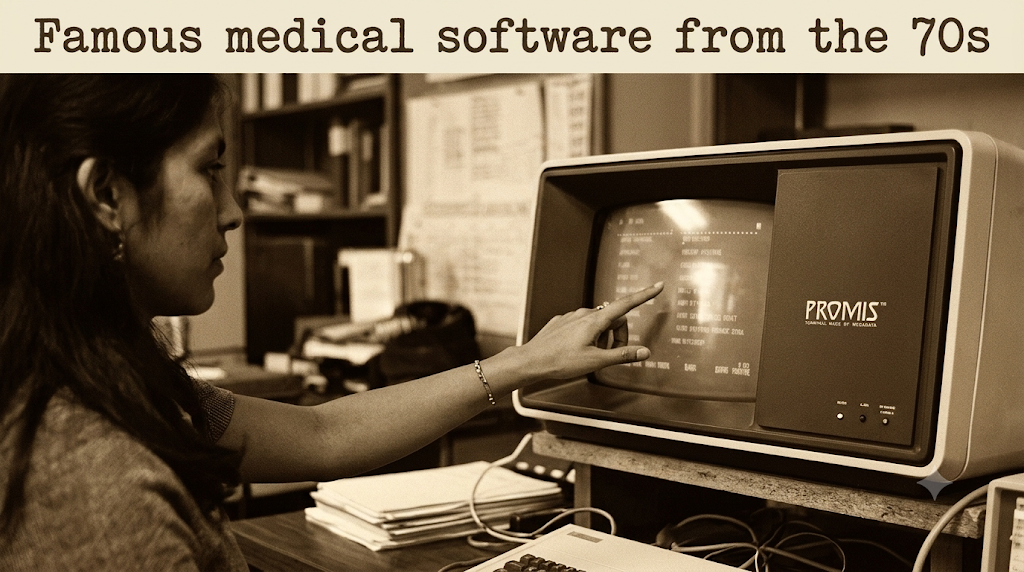
4. Problem-Oriented Medical Information System (PROMIS)
PROMIS was developed at the University of Vermont during the 1970s. It is a famous medical software from the 70s.
Its primary objective was to organize medical information around patients’ health problems rather than simply maintaining traditional chronological records.
The system explored interactive computing and improved communication between healthcare professionals and patient information systems.
PROMIS also demonstrated the importance of designing technology around clinical workflows.
5. MYCIN: An Early Medical Expert System
MYCIN was an artificial intelligence research system developed at Stanford University during the 1970s. It is a famous medical software from the 70s.
Unlike hospital management platforms, it focused on medical decision support.
It used rule-based reasoning to help identify bacterial infections and suggest appropriate antimicrobial treatments.
Although MYCIN was not widely deployed as a commercial clinical application, it became an influential example of artificial intelligence in medicine.
How Did Medical Software from the 70s Influence Modern Healthcare?
Early medical software introduced concepts that remain important in healthcare technology.
| Early Development | Modern Application |
| Computerized patient records | Electronic Health Records |
| Laboratory information management | Laboratory Information Systems |
| Clinical decision support | AI-assisted clinical applications |
| Electronic hospital orders | Computerized Physician Order Entry |
| Patient scheduling | Digital appointment platforms |
| Integrated hospital systems | Healthcare interoperability |
These developments showed that computers could do more than store information. They could also support clinical workflows, organize healthcare data, and improve communication between departments.
FDA Approval for Medical Software: What Has Changed?
The development of medical software has introduced new regulatory responsibilities. However, not every healthcare application requires FDA authorization.
The FDA evaluates software according to its intended medical purpose and whether it meets the legal definition of a medical device.
Software that independently performs medical functions may qualify as Software as a Medical Device (SaMD). Other software may operate as part of a physical medical device.
Understanding the distinction is important before pursuing FDA approval for medical software.
Understanding the FDA Approval Process for Medical Software
The FDA approval process for medical software depends on the product’s intended use, classification, and associated risks.
The general process involves several important steps.
- Determine Regulatory Classification: Identify whether the software qualifies as a medical device and determine its applicable classification.
- Select the Regulatory Pathway: Depending on classification and eligibility, the product may require a 510(k) submission, De Novo request, or Premarket Approval (PMA).
- Prepare Technical Documentation: Provide relevant information about software design, development, testing, performance, and risk management.
- Submit for FDA Review: Submit the appropriate documentation and respond to questions raised during the review process.
- Meet Applicable Requirements: Complete relevant registration, listing, quality system, and postmarket responsibilities.
The FDA approval of medical device software is not a single universal process. Some software functions may not require premarket authorization, while others must undergo regulatory review before marketing.
These activities help improve software reliability and support applicable regulatory requirements.
Conclusion
Famous medical software from the 70s represents an important chapter in healthcare technology. Systems such as MIS-I, COSTAR, HELP, and PROMIS introduced new approaches to patient information management and hospital operations. MYCIN demonstrated the early potential of computer-assisted medical decision-making.
Today, healthcare software is considerably more advanced, but the fundamental priorities remain similar: accurate information, reliable functionality, and better patient care.
Looking for Medical Device Software Risk Management Support?
RceeNetworks provides information and support related to medical device software risk management. Explore its Medical Device Software Risk Management in Atlanta page to understand the importance of managing software-related risks.
Frequently Asked Questions
1. What was the first medical software system?
MIS-I, which is one of the first medical information systems in hospitals that was created through the collaboration of Lockheed and El Camino Hospital, provided access to patient information and hospital work orders electronically. It is a famous medical software from the 70s.
2. What were computers used for in hospitals during the 1970s?
Hospitals used computers for patient record management, laboratory information, billing, appointment scheduling, clinical data processing, and decision support.
3. Does all medical software require FDA approval?
No. FDA oversight depends on the software’s intended purpose and whether its functions meet the legal definition of a medical device. Some applications are outside medical device regulation, while others may require premarket review or other regulatory controls.
4. How can manufacturers understand FDA requirements for medical software?
Manufacturers should evaluate intended use, software functionality, device classification, applicable regulatory pathways, and risk management requirements. The FDA Digital Health Center of Excellence provides official guidance and resources for understanding medical software regulations.