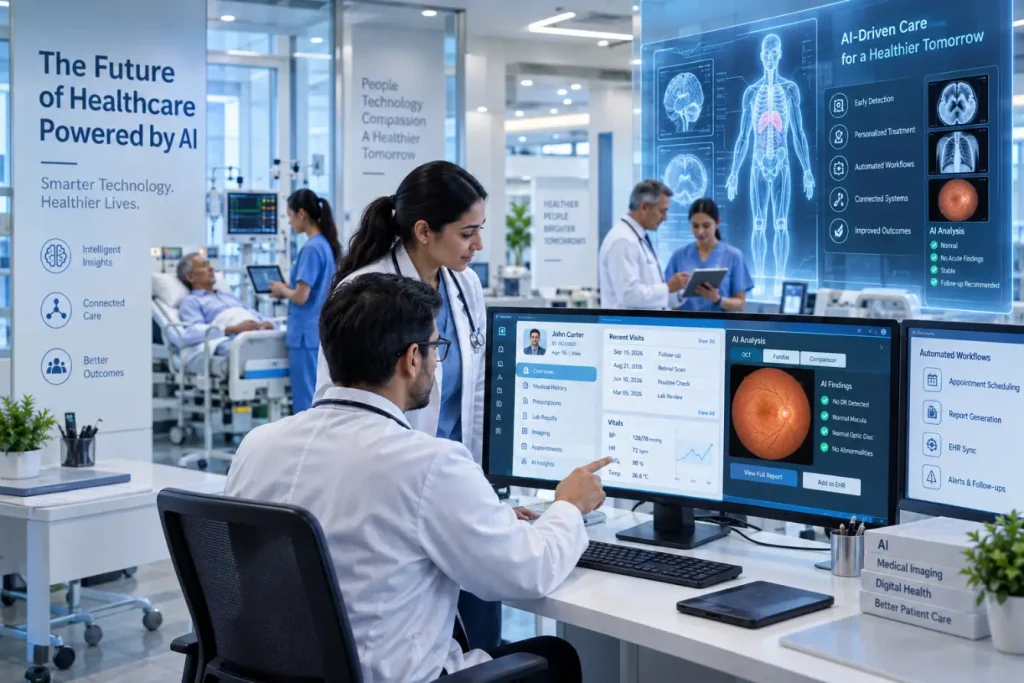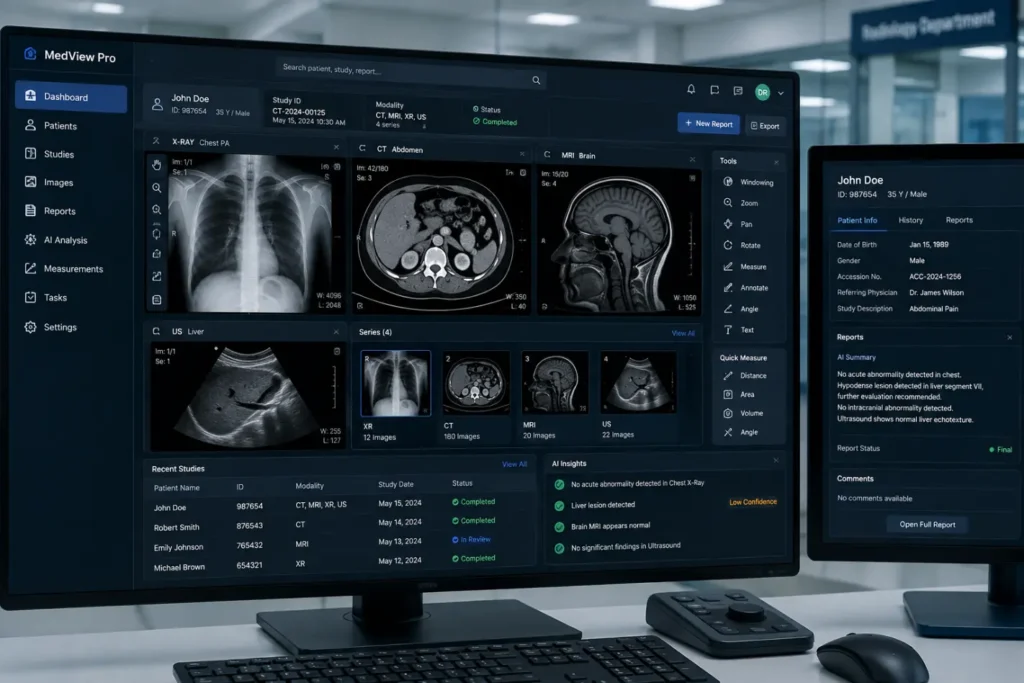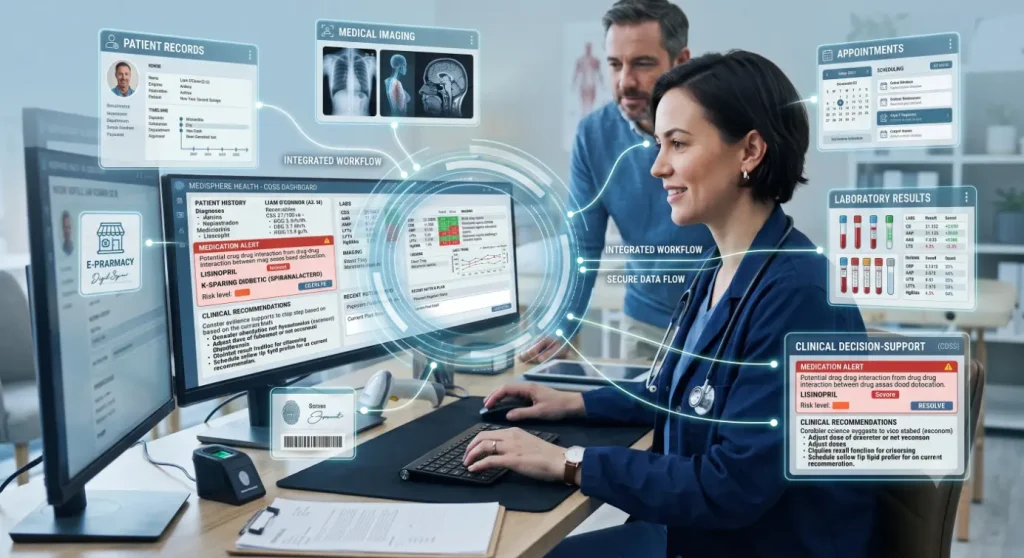
What is the most commonly used medical software in healthcare today? The short answer is the electronic health record (EHR), the digital system that stores patient histories, medications, test results, and clinical notes. Almost every hospital and most clinics rely on one, and many other tools connect to it. This guide explains how common EHRs are, which supporting tools come next, and what to consider for safety and compliance when choosing software.
Key Takeaways
- EHR systems are the most widely used medical software, with adoption now reaching nearly all U.S. hospitals.
- Practice management, billing, scheduling, e-prescribing, and patient portals usually sit around the EHR.
- Common does not mean risk-free, so security, safety, and compliance still need active management.
Table of Contents
What Is the Most Commonly Used Medical Software?
The EHR is the foundation of modern care. Federal data cited by Definitive Healthcare shows hospital EHR adoption climbing to about 96%, a sharp increase from roughly 72% a decade earlier. Because an EHR holds the patient record, it becomes the hub that billing, imaging, labs, and telehealth tools plug into.
Among U.S. hospitals, Definitive Healthcare’s April 2026 analysis found these vendors installed most often:
| EHR Vendor | Share of U.S. Hospital Installations |
| Epic Systems | 43.90% |
| Oracle Cerner (Oracle Health) | 18.90% |
| MEDITECH | 10.70% |
Epic and Oracle Cerner together exceed 62% of inpatient installations. In outpatient settings, vendors such as athenahealth and eClinicalWorks are also widely used. Exact figures vary between research firms, so treat them as a snapshot rather than a permanent ranking.
The Other Software Most Providers Use
What is the most commonly used medical software? Beyond the EHR, a typical clinic or hospital runs several connected tools:
| Software Type | What It Does |
| Practice management | Handles registration, scheduling, and front-office workflows |
| Medical billing and revenue cycle | Prepares claims, tracks payments, and reduces denials |
| Appointment scheduling | Manages bookings, reminders, and cancellations |
| E-prescribing | Sends prescriptions securely to pharmacies |
| Patient portals | Gives patients access to records, results, and messages |
| Telehealth | Supports video visits and remote follow-up |
| Imaging and PACS | Stores and displays X-rays, CT scans, and MRIs |
| Laboratory systems | Tracks samples and reports test results |
Smaller practices often choose an all-in-one product that combines the EHR, scheduling, and billing, while large hospitals usually build a larger ecosystem of specialist systems.
EHR vs. Practice Management Software
These two are often confused. EHR concentrates on the clinical aspect, including documentation, ordering, results, and history. Practice management tools concentrate on the financial aspect, such as scheduling, verification, billing, and reporting. Today, many systems provide these features bundled together, thus causing the confusion. It is important to evaluate whether your system of choice provides all this functionality or requires some kind of integration to do so.
What is the Most Commonly Used Medical Software? Understanding Factors
Several forces push certain systems to the top:
- Regulation and incentives: There have been programs that encouraged digitization of health records, thus driving their adoption.
- Integration: Hospitals need systems that integrate easily with labs, pharmacy, imaging, etc.
- Familiarity: There is a great number of people familiar with a popular system.
- Scalability: A popular system should be able to operate across several clinics and specialties within a single framework.
- Mobile and cloud accessibility.
Popularity can also be self-reinforcing, since a widely used platform tends to attract more integrations and more trained users.
Common Does Not Mean Risk-Free
The most commonly used software still needs careful oversight. A system that is widely deployed is also a larger target for cyberattacks, and configuration mistakes can cause real harm, such as missing alerts or wrong information on a screen. Organizations should pay attention to:
- Patient safety: Identify what could go wrong, such as incorrect dosage display, and put controls in place before it reaches patients.
- Data security: Use access controls, encryption, audit trails, and regular security reviews.
- Privacy compliance: Follow HIPAA requirements for protecting health information.
- Vendor accountability: Confirm how updates, outages, and incidents are handled.
- Software quality: Software that functions as a medical device may be subject to FDA oversight and recognized standards such as ISO 14971 for risk management and IEC 62304 for software development.

How to Choose the Right Medical Software
What is the most commonly used medical software? Instead of simply picking the most popular option, ask:
- Does it fit our size, specialty, and workflows?
- Does it integrate with our current labs, billing, and imaging systems?
- What are the total costs, including training and support?
- How strong are its security and audit features?
- What do similar organizations say about it?
- Can we pilot it with real users first?
Involving clinicians and administrators early helps surface problems that a sales demo may hide.
Concluding Thoughts
The most commonly used medical software is the EHR, supported by scheduling, billing, e-prescribing, imaging, and patient communication tools. Popularity brings advantages such as integrations and trained staff, but it never replaces careful selection. Choose software that fits your workflows, protects patient data, and has clear processes for managing safety and compliance. When risk management is built in from the start, even the most widely used systems can serve patients more safely and reliably.
Need support managing risk in your medical software? Contact Rceenetworks today for safer, compliant solutions.
Frequently Asked Questions
1. What is the most commonly used medical software?
Electronic health record (EHR) software is the most common. It stores patient information digitally and connects with many other healthcare tools.
2. Which EHR is used the most?
Epic Systems has the largest share of U.S. hospital installations, followed by Oracle Cerner and MEDITECH.
3. What is the difference between an EHR and practice management software?
An EHR manages clinical information such as medical histories and treatment notes. Practice management software handles scheduling, billing, and other administrative tasks. Many platforms combine both.
4. Does medical software need to be HIPAA compliant?
If it creates, stores, or transmits protected health information on behalf of a covered entity, yes. The HHS overview of the HIPAA Security Rule explains the safeguards required to protect electronic health data.
Also Read: Most Popular Medical Software